Ilnur Garifullin presented “Sak-Sok” at the Menzelinsky theater as an ancient Turkic epic
Yoldyz Minnullina went beyond the traditional baith and created a new story based on its motifs
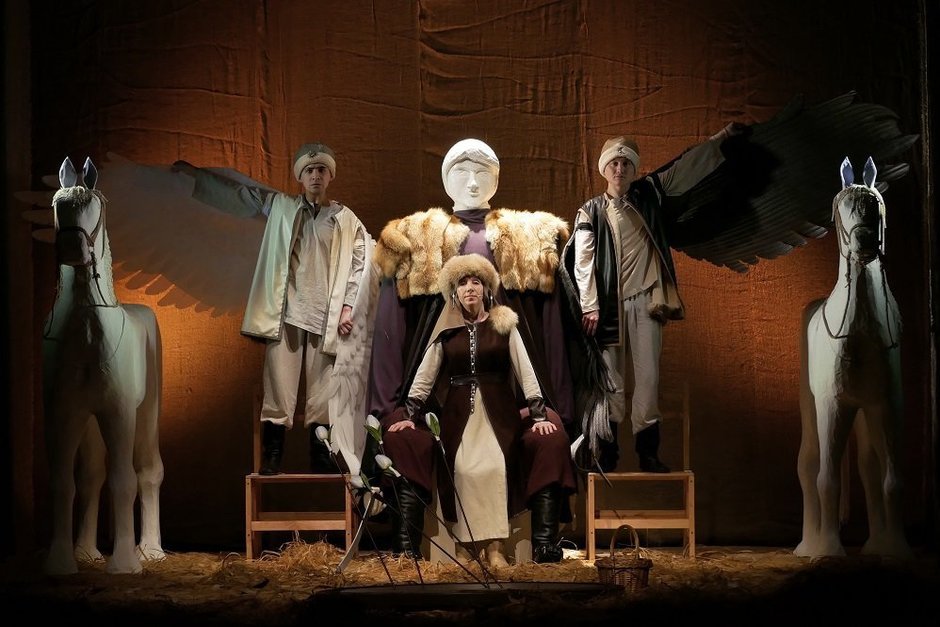
Director Ilnur Garifullin presented “Sak-Sok” (12+) at the Menzelinsky Theater. Although the performance is billed as a staging of the classical baith, the show is actually a full-fledged new story based on its motifs, written by poet Yoldyz Minnullina. It transcends the narrative about the relationship between mothers and children, rising to the scale of an ancient Turkic epic. Details in this report by Realnoe Vremya.
Once upon a time, two brothers
The Menzelinsky Theater presented the performance “Sak-Sok” (12+). This is an ancient Turkic baith (a cross between an epic and a lyrical song) that tells the story of two brothers and has been a subject of scholarly research thanks to the poet Utyz-Imäni (1754—1834). Its known versions range from 12 to 100 stanzas.
The canonical story is as follows: two brothers quarreled over an arrowhead, for which their mother rashly cursed them, turning them into birds that can never meet each other but constantly hear the calls “Sak” and “Sok.”
It seems that any Tatar child never understood why this sad work was published as children's literature (despite the wonderful illustrations by Tavil Khaziakhmetov). Usually, this story is interpreted as a tale about the relationship between parents and children or as a cautionary text.
Based on it, Rabit Batulla wrote a drama, and Shamil Sharifullin composed numerous melodies. Choreographers Nurbek Batulla and Marat Kazikhanov turned it into an electronic-plastic performance transitioning into improvisation.
Original work, based on motifs
In Menzelinsk, the poster promises a dramatization based on the Turkic baith, but in reality, Yoldyz Minnullina wrote an extensive original work.
The brothers (Rustem Zinnurov and Ilimir Kashapov) came into this world simultaneously (to the sound design by Kamil Gataullin). One is calm, the other is furious. Their father set out on a journey to break a huge mountain and bring back the sun. Later, he sent a message home.
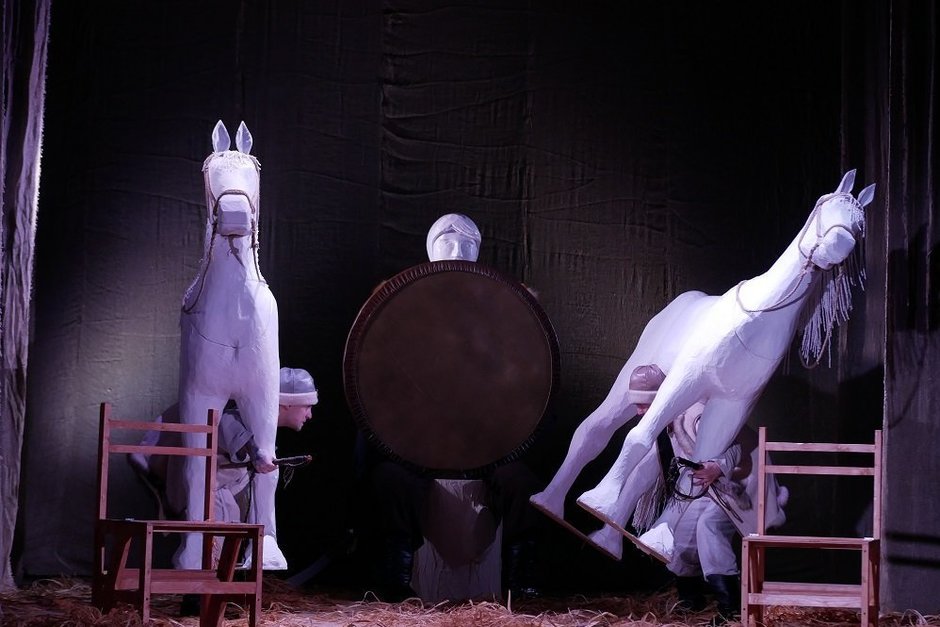
The brothers have identical cradles. Also identical paired swords and shields with which they fight. The same huge toy horses (artist — Natalya Vildanova), but real, loud whips.
When the time comes to divide the state, the brothers, instead of competing in archery, point their weapons at each other, receive their mother's curse (Raushaniya Galiullina), and turn into birds with huge wings. All this is observed by a stone idol, representing both the throne and the father himself. At one point, the brothers lift their father like a puppet, and flowers appear on the tips of the arrows.
No place for tears
Director Ilnur Garifullin, who now works in Menzelinsk (and on whom great hopes are placed here), is not encountering Turkic folk art for the first time. At the Tinchurin Theater in 2023, he played the title role in the epic “Idegei," embodying on stage a warrior who was both a supporter of the Golden Horde Khan Tokhtamysh and his enemy Tamerlane, a ruler of the Golden Horde and the founder of the Nogai Horde. It was Garifullin's first role in the Tatar language.
Yoldyz Minnullina (as a puppet) appeared in the “Sak-Sok” performance at the Naberezhnye Chelny puppet theater directed by Ilgiz Zainiev (alongside Gabdulla Tukay and the fallen angel from Gabriel García Márquez). In 2019, together with Nurbek Batulla, she presented the performance ÖTÜKÄN — about how in the 6th century the Turkic Khaganate first arose, then split into Eastern and Western, with the Eastern falling under the rule of China.
Although the original baith sings: “Don't cry, mother, why are you crying? You cursed them yourself, what were you thinking?”, Garifullin aims to turn Minnullina's new text into a tragedy where, essentially, the punishment is not the mother's fleeting whim. It seems she is fulfilling the will of higher powers. So there is no point in showing her anguish, turning the performance into a melodrama.
The figure of the father, although it comes to life (however, the director is already considering a different course of action), initially resembles stone idols, for example, balbals. And when the brothers shoot arrows at the shield on his chest (and the children in the audience finally fall silent), one wishes this action were not ordinary — in trying to compete, the brothers cross a line from which there is no return.
Therefore, their mother must stop the confrontation, which escalates from competition to battle, not hastily but with full understanding.
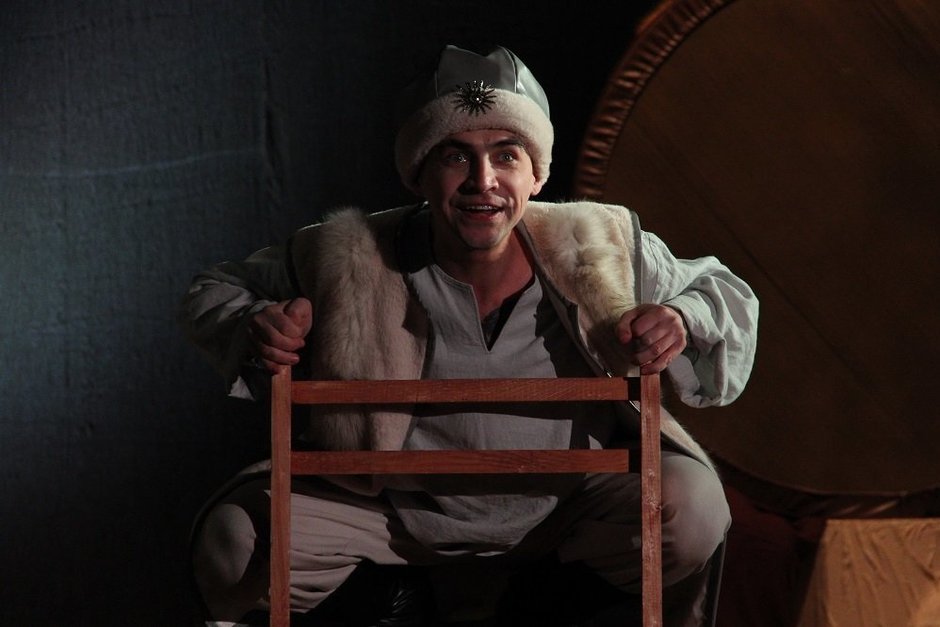
Signs of the moon and sun on the brothers' costumes indicate that what is happening is not merely a whim. Just as these celestial bodies can never meet, the relatives are now fated never to see each other again. Everything is already predetermined.
Incidentally, according to one version, the basis of “Sak-Sok” is an ancient Chinese story (“xin-yan” — “left-right”) about a dispute between sun worshipers and moon worshipers who were dividing fertile lands, after which the Great Wall of China was built...
And in reality, the baith, with its age rating of 6+ and a duration of just over 40 minutes, holds far more than what is heard at the premiere. The actors have yet to become the giants of tragedy embedded in this text. It is all the will of the gods.