Dzhambul in the land of the soviets
Film “Dzhambul. New era” about the great Kazakh akyn shown in Kazan, demonstrating how to portray national heroes
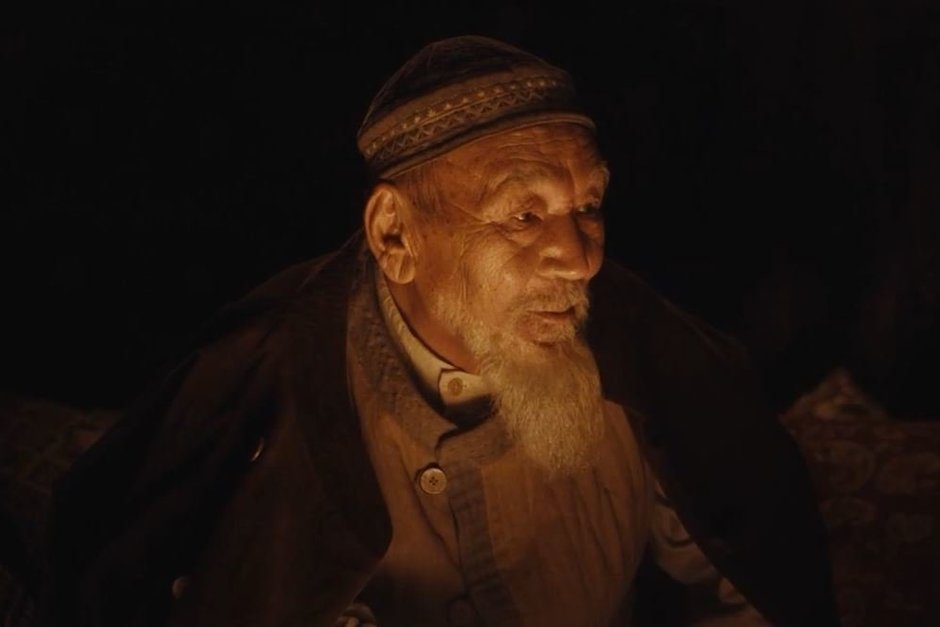
One of the most prominent premieres of Kazakh cinema in recent years, “Jambyl. Jaña däuir” (“Dzhambul. New Era”) — about the akyn, the national folk poet Zhambyl Zhabayev (often spelled Dzhambul in Russia) — was presented at the “Mir” cinema. It demonstrates how national heroes can be interestingly portrayed in the genre of dynamic cinema.
A 99-year-old hero
This is the debut film by director Zhandos Kussainov. The film about one of Kazakhstan's most famous poets began shooting in October 2021 and was first shown three years later. It depicts the last nine years of the akyn's life.
Zhambyl was born in 1846. In his youth, he roamed with a dombra, composed poems, improvised, memorized ancient epics, and studied under the famous akyn Suyunbay.
Many of his texts glorify the communist system. Several theories also exist suggesting that during this period, other poets wrote for Zhambyl, while he himself merely played the role of an elder who had fully accepted the new regime. These rumors were later publicly refuted.
Incidentally, the first Kazakh color feature film, released in 1953, was titled “Dzhambul.”
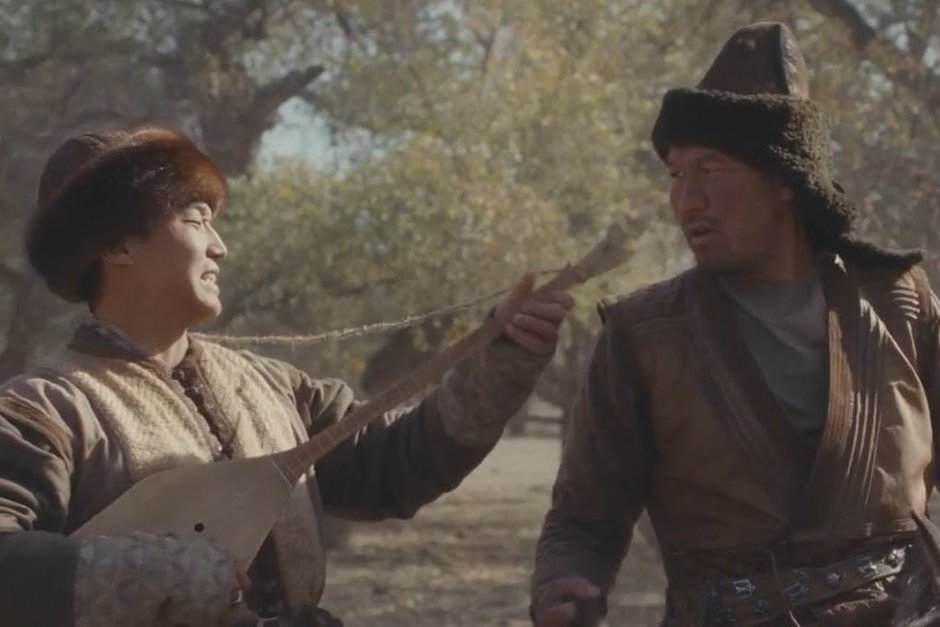
The film's narrative moves through the juxtaposition of 19th-century Kazakh steppe morals and 20th-century Soviet realities. The poet is played by two actors: the young Zhambyl by Asylbek Aitish, and the elderly one by Doszhan Zhanbotayev. The film is, of course, not an exact recreation of events but conveys the central theme: the confrontation between a master of the oral tradition, raised in the steppes, and the totalitarian system operating by carrot and stick.
According to the director, he prepared the script for eight months and rewrote it 16 times. The action begins in the 1930s with all the elements of that era, but the feeling is that the viewer arrives not at a gathering of akyns, but at a bardic evening. Zhambyl starts reciting the epic “Suranshi Batyr” — and it immediately unfolds before the audience. Thus, the listeners at the concert are also engrossed in watching a “film.” Battle scenes were filmed near the village of Mynbayevo in the Zhambyl district of the Almaty region.
Under the wing of power
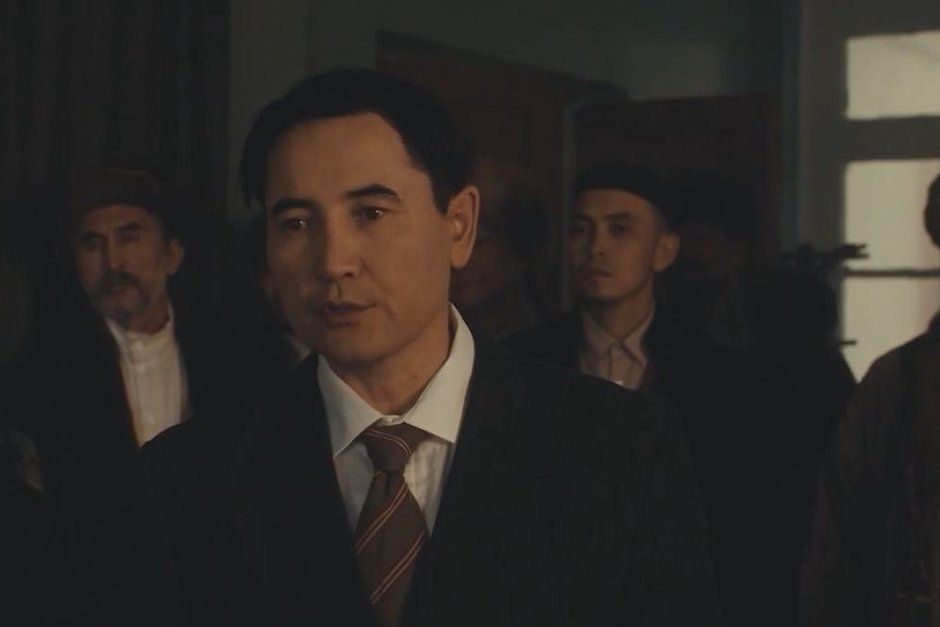
Stalin learns about the poet and calls Levon Mirzoyan (Farkhad Makhmudov). During Mirzoyan's time as secretary of the Kazakhstani Regional Committee of the All-Union Communist Party (Bolsheviks) and first secretary of the Central Committee of the Communist Party of Kazakhstan, the first congress of Kazakh writers was held, a musical theater and philharmonic society appeared, and the legacy of Abai was restored.
The decision is made to take Zhambyl under the Soviet wing. He is assigned a secretary-driver, Kabdilman Kadyrov (Almas Shayakhmetov). He is also shadowed by the writer Iosif Gilman (Philip Voloshin), who, incidentally, speaks excellent Kazakh. The revolutionary Oraz Zhandosov (Asan Mazhit) is also responsible for Zhambyl.
Zhambyl sings, Kabdilman writes, the poems are translated — and then lines are edited, replacing “Almighty” with “Stalin.” When the poet protests, his close ones begin to be arrested. Zhandosov, specifically, is compromised by having a photograph of Zhambyl from the celebration of the Romanovs' anniversary.
The 19th-century storyline shows the young Zhambyl. He is friends with Zhagipar, who once returns their stolen horses (during this time, his comrade listens to the akyn performing the epic “Edige Batyr”). Zhambyl has nothing but his songs and talent. He defeats other akyns in aityses (improvised competitions), gives his horse to a poor man, abducts his beloved, incurring the wrath of her kin, and does not hesitate to criticize the tsarist government...
“Do I, in general, exist?”
Even in old age, Zhambyl remains sharp-tongued. He tells officials that if the party relies on an old man, then that party is shaky. “Do I, in general, exist?” he asks his minders. In protest, he sets fire to the tent where his poems are stored. But then he is convinced: everything here is the property of the Soviets. So he eventually thanks Stalin in a fairytale-like Moscow and lives in a specially built house.
Meanwhile, his “minders” assert that anything can be written in Zhambyl's name — he's an improviser!
Winter arrives, war begins, Zhambyl's contradictory entourage falls under the repressive steamroller, and his children go to the front. In essence, he outlives all the other characters. Zhambyl passed away on June 22, 1945.
Opinions within Kazakhstan itself about this film are undoubtedly varied (online reviews range from calling it the beginning of a new era to shaming the director for the script). But such cinema is certainly interesting to watch from the outside.
The film delights with soft colors, large-scale scenes, and an authentic (from a foreign perspective) portrayal of Kazakh life. A young viewer might perceive the akyns as a kind of rock star of that era and compare the improvisational competitions to today's rap battles. There is a love story, good people and villains, and characters who cannot be judged unequivocally. The director shows the figures of the totalitarian system, but his plot focuses on Zhambyl, a man existing in two eras, a bearer of wisdom and truth that propaganda cannot hide. It is especially pleasant to watch this film after the biopic about Musa Jalil. The main difference between Kazakh cinema and Tatarstan cinema is that after watching the film about Zhambyl, you learn enough about him to appreciate the hero properly and want to read more about him.