Michel Houellebecq — France’s most scandalous contemporary writer
This week's book: Michel Houellebecq’s novel “Submission”
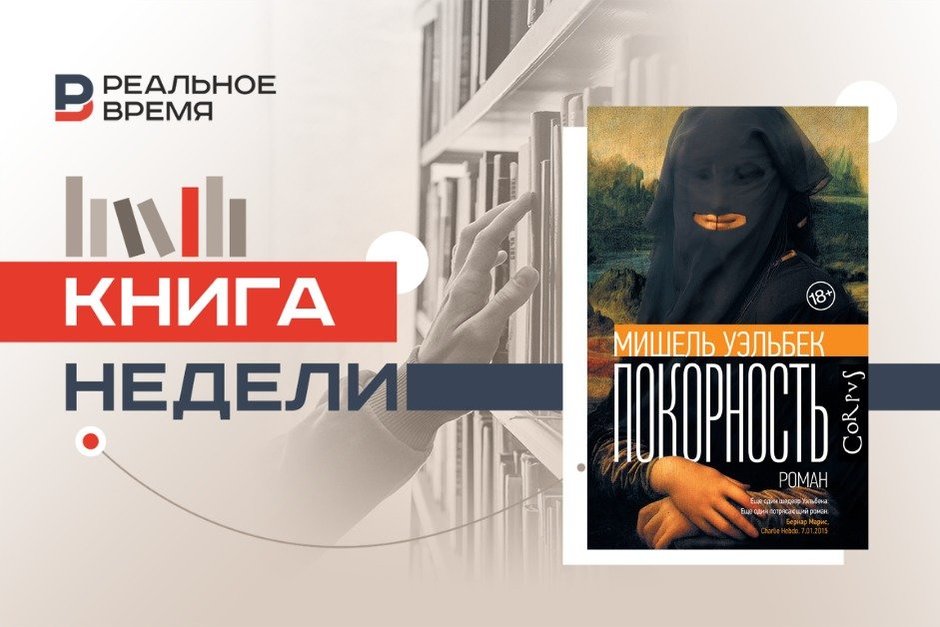
This week, on February 26, marked the 70th anniversary of the birth of Michel Houellebecq — one of the key authors of modern French prose, laureate of the Prix Goncourt, and a constant participant in literary and political polemics. A novelist, poet, essayist, author of “Atomised” and “The Map and the Territory," he consistently explores liberal society, sexual freedom, and solitude. Literary columnist for Realnoe Vremya, Yekaterina Petrova, explains how “Submission” became Houellebecq's most scandalous novel, how this dystopia about France in 2022 turned into an international bestseller and a subject of fierce debate, and what the “submission” of elites and intellectuals can teach us.
One of the key authors of modern French prose
Michel Houellebecq (real name Michel Thomas) was born on February 26, 1956, on the island of Réunion. He himself claimed that his mother “falsified his birth certificate," indicating 1956 instead of 1958, “because she considered him a child prodigy.” His father was a mountain guide, his mother an anesthesiologist; both were involved in the communist movement. His early childhood was spent without parental involvement: first he was raised by his maternal grandparents in Algeria, then by his paternal grandmother, Henriette Thomas, née Houellebecq, whose surname he later adopted as a literary pseudonym “as a sign of gratitude.”
Houellebecq studied at a lycée in Meaux, then at preparatory courses at the Lycée Chaptal in Paris. He entered the National Agronomic Institute Paris-Grignon, obtaining a degree as an agricultural engineer specializing in “Ecology and Environmental Protection.” In the 1980s, he worked in IT, including at the Ministry of Agriculture and the National Assembly. Periods of unemployment and divorce were accompanied by depression.
Houellebecq began his literary career with poetry and essays. In 1991, his first books were published: the collection “Live to Live” and a study of H.P. Lovecraft, “H. P. Lovecraft: Against the World, Against Life.” In 1994, his debut novel “Whatever” (original French title: Extension du domaine de la lutte) was published, initially rejected by several publishers. The novel made him a notable figure, but true fame came with “Atomised” (1998), which caused widespread public resonance. The book received the Prix Novembre, after which the prize's founder resigned, and the award was renamed Prix Décembre. Later, Houellebecq became a laureate of the Prix Goncourt for the novel “The Map and the Territory” (2010).
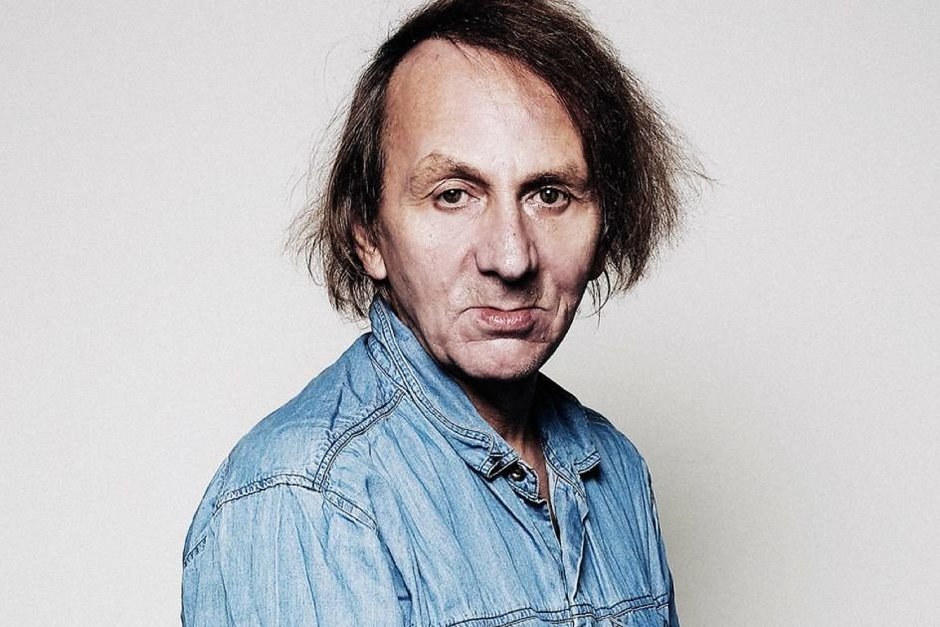
The characteristics of Houellebecq's writing have repeatedly become a subject of discussion. The writer himself formulated his approach in an interview with La Nouvelle Revue française: “The first — and practically the only — condition for a good style is to have something to say.” In the preface to the collection “Interventions," he wrote: “Theoretical reflections seem to me as good novelistic material as any other... Everything should turn into a single book, which one would write until death.”
Novelist Jean-Philippe Domecq describes his manner as a “flat style” or “white writing” — short sentences, minimal metaphor, inclusion of scientific and journalistic vocabulary. Houellebecq noted in an interview with La Nouvelle Revue française: “Certain mental states seem quite specific to me; in particular, the one expressed in the presentation of banal sentences whose juxtaposition produces an absurd effect.” In “Platform” (2001), he formulated one of his characteristic tones:
The absence of a desire to live is, alas, not enough to want to die.
The themes of Houellebecq's prose are linked to the analysis of liberal society, sexual freedom, and solitude. In his essay on Lovecraft, he wrote: “Liberal capitalism has extended its influence to consciousness... Worse, liberalism has spread from the economic sphere to the sexual.” In the novel “Whatever," this idea is formulated:
With absolute economic freedom, some amass immense fortunes; others languish in poverty. With absolute sexual freedom, some live a rich, vibrant sex life; others are doomed to masturbation and solitude.
In “Atomised," a generalization about human nature sounds: “This unfortunate, brutish species, not far removed from the ape, was nevertheless characterized by limitless noble aspirations.” Religious issues are also present in Houellebecq's books. In one interview, he asserted the right to criticize monotheistic religions and stated: “The foundational monotheistic texts preach neither peace, nor love, nor tolerance. From the start, they are texts of hatred.”
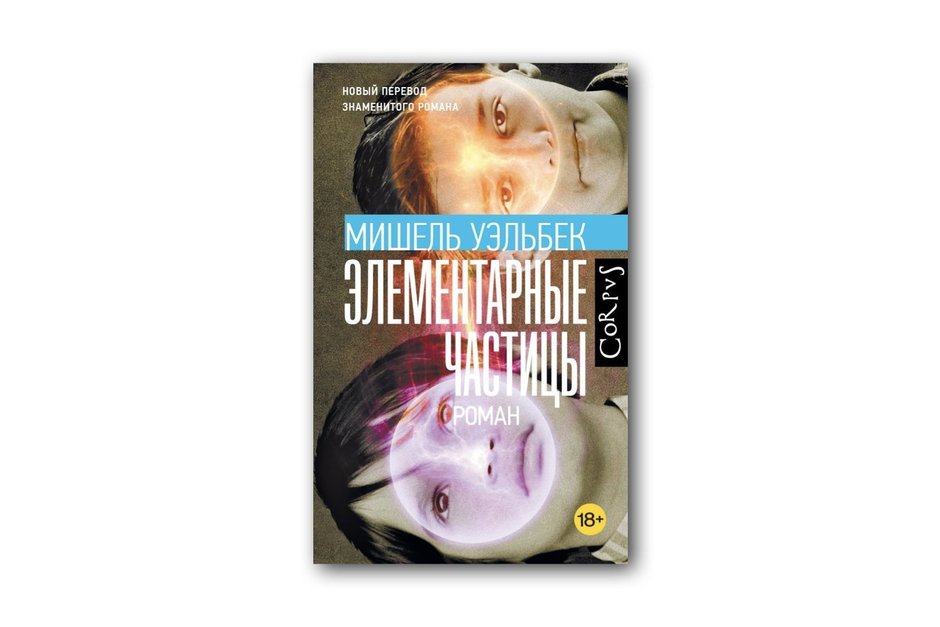
By the beginning of the 21st century, Houellebecq had become one of the most famous contemporary French writers. His works have been translated into more than forty languages. He also worked as a director and actor, adapting his novel “The Possibility of an Island” into a film, which was negatively received by critics in 2008. In 2010, upon receiving the Prix Goncourt, Michel Houellebecq stated: “Now they won't ask if I'll get the Goncourt next time; there will be less pressure, more freedom.” In 2019, the writer was awarded the Legion of Honour. His figure regularly finds itself at the center of polemics — literary, political, and legal — yet in academic and media assessments, he is consistently regarded as one of the key authors of modern French prose.
The attack, Charlie Hebdo, and “Submission”
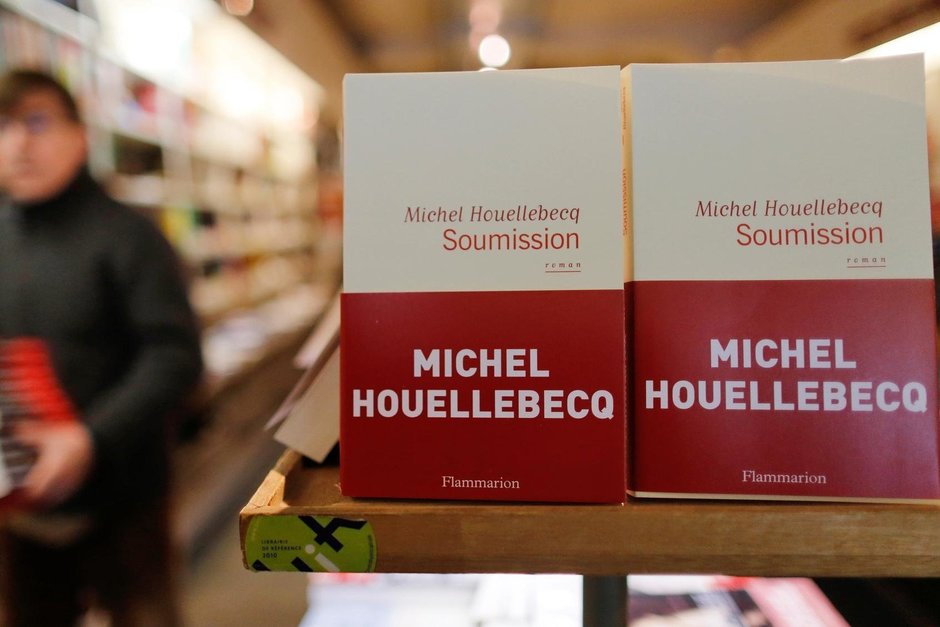
“Submission” is the most scandalous novel by the French writer. On December 15, 2014, representatives of the publishing house announced that Michel Houellebecq's sixth novel would be released on January 7, 2015. On December 29, the specialized blog Aldus reported the book's pirated distribution on torrent networks and suggested it was “the first case of piracy of a French book before its appearance in bookstores.”
The novel sparked controversy before publication: on January 5, French President François Hollande stated on France Inter that he “would read the book because it is controversial.” On January 6, Houellebecq gave a ten-minute interview on the evening news on France 2, and on the morning of January 7, the day of the novel's release, he said on France Inter: “In this country, there is real contempt for all forms of power... You feel that this cannot continue. Something has to change. I don't know what, but something.”
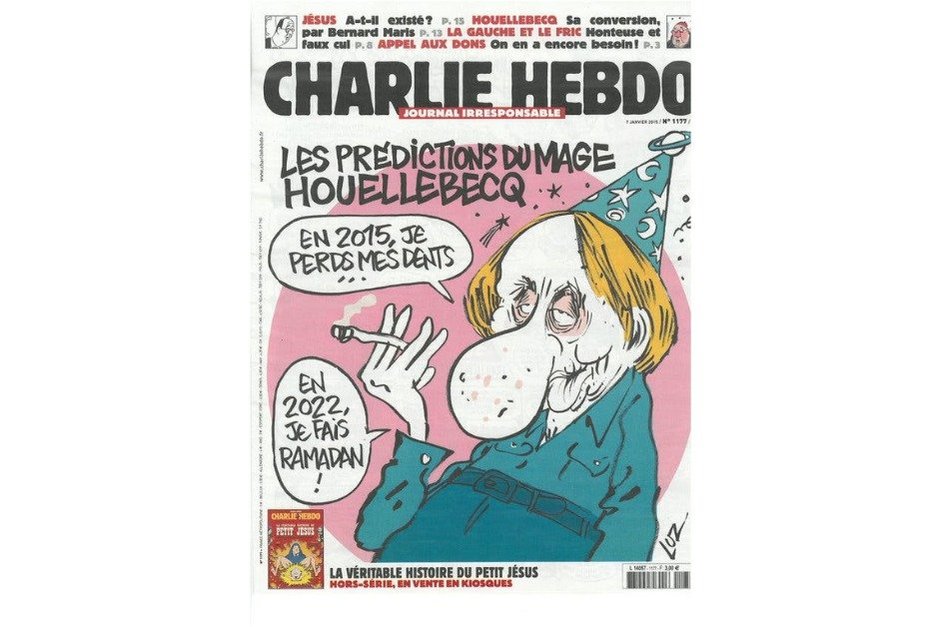
On the same day, January 7, a caricature of the writer appeared on the cover of the satirical magazine Charlie Hebdo with the caption: “Predictions of the wizard Houellebecq: in 2015, I lose my teeth, in 2022, I observe Ramadan.” Inside the issue, a drawing was published with the headline “Still no terrorist attacks in France.” On this same day, the magazine's editorial office was attacked. Twelve people were killed, among them economist Bernard Maris, a friend of Houellebecq.
French Prime Minister Manuel Valls told journalists after the attack: “France is not Houellebecq.” The writer stopped promoting the book. His agent reported that he was “deeply shocked” by Maris's death and had left Paris. Later, Houellebecq said in Cologne: “After what happened, it could have been even worse.” On January 27, he stated: “The Paris attacks are a great victory for the jihadists," and also reported that he was under police protection.
Despite the events surrounding its publication, the book quickly became a bestseller. By the end of February, over 500,000 copies had been printed in France, and the Italian and German editions each sold more than 200,000. The Italian translation, Sottomissione, was released on January 15, 2015, by Bompiani; the German, Unterwerfung, on January 16 by DuMont Buchverlag. The initial German print run of 100,000 copies was fully reserved before the book's release, after which the publisher decided on three additional reprints totaling 175,000 copies.
Before publication, the novel had already risen to the top of Amazon's bestseller list in France. In the UK, the book was released on September 10, 2015, and in Russia in November. At the end of the year, The New York Times included it in the list of “100 Notable Books of 2015.”
Muslim France
The action of the novel “Submission” begins in the spring of 2022. Its narrator is François, a forty-five-year-old professor of literature at the Sorbonne, a specialist in the French writer Joris-Karl Huysmans. François senses the approaching end of his sexual and sentimental life and sees only emptiness and solitude ahead.
At the beginning of the book, Paris is depicted against a backdrop of regular clashes between young identitarians and young Salafists, while the media, fearing a general conflagration, do not report all the information, and the country seems on the verge of civil war. François himself is apolitical: he says of himself that he is “no more politicized than a towel in the bathroom” and contemptuously describes democratic change of power as “nothing more than a way of dividing power between two warring gangs.”
Amidst a three-way struggle — between the Socialists, Marine Le Pen's National Front, and a new party, the “Muslim Brotherhood” — the Socialists form an alliance with the Muslim party to prevent a far-right victory. The charismatic and moderate leader of the “Brotherhood," Mohammed Ben Abbes, advances to the second round and wins. Around the same time, the parents of François's Jewish girlfriend emigrate to Israel and take her with them. He fears he is close to suicide.
After Ben Abbes's election, France in the novel “calms down," unemployment falls. The new government implements sweeping legislative changes: universities, including the Sorbonne (Paris-IV), are privatized and Islamized; only Muslims can teach. Gender equality is abolished, polygamy is legalized, women are forbidden to work and are required to dress “unattractively.” Compulsory schooling ends at age 12, and higher education is largely funded by Saudi petrodollars. Jews are encouraged to emigrate to Israel.
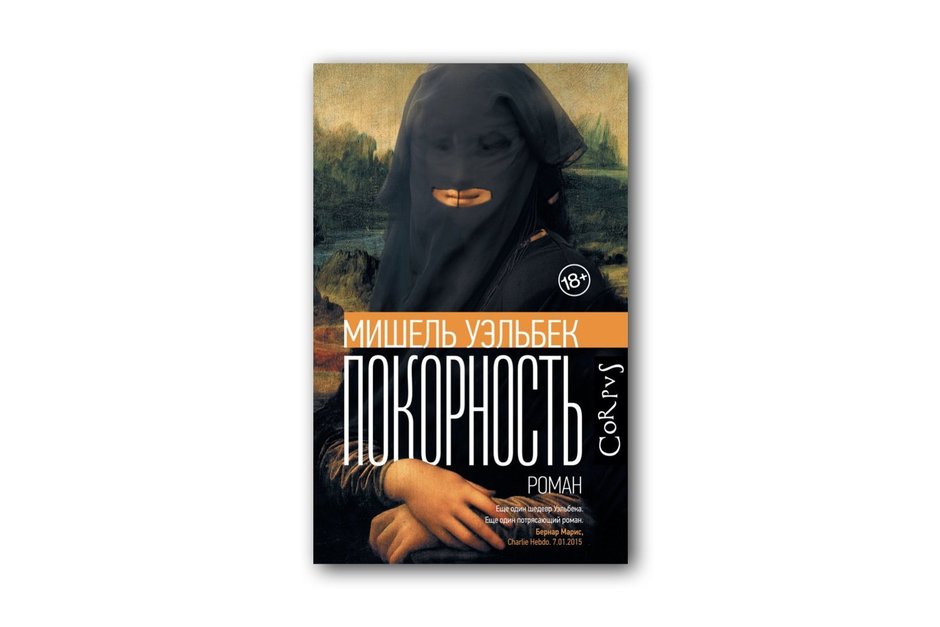
Simultaneously, Ben Abbes promotes a project to expand the European Union to include North African countries and Turkey, aiming to create a “new Roman Empire” led by an Islamized France. In this system, François, deprived of his chair, gets the chance to return to the university and “rediscover the path to honors” at the cost of converting to Islam. His colleagues who convert to Islam receive positions and enter arranged marriages with young wives.
The submission of elites and intellectuals
The Islamization of France and Europe in the novel is presented as the result of successive political decisions, not violence. Ben Abbes is a quite secular politician, moderate in his speeches and actions, unlike Khomeini or even Erdoğan. The new regime represents a soft version of Sharia, based on family values, traditional morality, and patriarchy, while Islam itself is presented as a new humanism capable of attracting Catholics. Unemployment decreases due to the displacement of women from the labor market. Islamic parties join coalitions in Britain, the Netherlands, and Germany, and Belgium becomes a country where Muslims are the leading force. The expansion of Islam is treated by Houellebecq as an immanent quality of the religion, but responsibility for its success is placed on Western elites and their “submission.”
The satire in the novel is directed at French society and, above all, at intellectuals. The author's targets are the weary, pampered, myopic European chattering classes — intellectuals, politicians, and journalists. The media are accomplices to the new order because they pander to a public electrified by the worship of successive icons. Houellebecq formulates this harshly:
Many 20th-century intellectuals supported Stalin, Mao, and Pol Pot, and they were never particularly reproached for it; French intellectuals did not undertake to take responsibility; they are above that.
“Submission” is not a novel about the “Muslim threat," but about the readiness of modern man to submissively accept any order if it serves his interests.
The character of François is constructed as a figure of an alienated observer. He is a misanthropic, misogynistic Sorbonne professor, dividing women into “cooks” and “sluts.” François lives alone, eats ready meals, is incapable of intimacy, and admits: “For various psychological reasons, which I have neither sufficient competence nor desire to analyze, I did not fit into the framework of the general scheme.” His potential conversion to Islam is motivated not by faith but by conditions: reinstatement in his position and the right to polygamy. The novel ends with François's imagined future conversion, and the final line reads: “And I will regret nothing," marking a personal choice as a form of adaptation.
“Submission” is a novel of ideas. That is, prose where plot and characters serve as carriers of philosophical, social, and political concepts. Characters act as “mouthpieces” for positions, and the action unfolds through discussions. This book is a concentration of various ideas: from the distributism of Hilaire Belloc and G. K. Chesterton to debates on demographics, education, and the “new Roman Empire.” The long theoretical monologues by Lempereur, Alain Tanner, and Robert Rediger structure the text as intellectual disputations.
“No one has ever changed their mind by reading a book”
Michel Houellebecq's first public appearance after the Paris attacks and the release of “Submission” was in Cologne at the Lit.Cologne festival in late January 2015, in the Muslim district of Mülheim. In France, the writer canceled meetings with readers, but in Germany, he appeared under heightened security measures. In Cologne, Houellebecq said: “Firstly, I did not write an Islamophobic book, and secondly, I have the right to write an Islamophobic book.” Recalling his murdered friend from Charlie Hebdo, he added: “You don't have to be a hero to do something heroic. Sometimes it's enough to be stubborn.” Responding to accusations that the novel played into the hands of the National Front, the writer said: “I'm rather indifferent to that. I don't think that's the case. No one has ever changed their mind by reading a book.”
Nevertheless, the novel sparked public debate on the left, where it was called Islamophobic. At the same time, some reviewers, including Steven Poole in The Guardian, noted that “the book is perhaps not primarily about politics at all," and that the target of its satire was “the predictable venality and lubricity of the modern metropolitan male.”
French writer Emmanuel Carrère saw in “Submission” “a novel of extraordinary novelistic density” and compared Houellebecq's predictions to George Orwell's “Nineteen Eighty-Four” and Aldous Huxley's “Brave New World.” Bruno de Cessole in Valeurs actuelles wrote that the writer “does not provide answers, but formulates the questions of the era.” Bernard Maris in Charlie Hebdo gave a positive review and concluded: “Another magnificent novel. Another masterstroke.”
Conversely, Jérôme Dupuis in L'Express called the book “a sequence of false provocations," Marc Weitzmann considered it the author's “clearest and weakest” novel, and Christine Angot stated: "'Submission' is a novel that soils the person who reads it... It's not a pamphlet, it's graffiti: 'Shit to the one who reads it.'" Reviewer Mark Lilla in The New York Review of Books wrote that “the Europe of 2022 must find another way to escape the present, and 'Islam' is simply the name of the next clone.” Thus, the novel proved to be both a commercial success and a subject of polarized assessments — ranging from comparisons with classic dystopias to accusations of provocation and weak writing.
Publisher: Corpus
Translation from French: Maria Zonina
Number of pages: 288
Year: 2019
*Age rating: 18+*
Yekaterina Petrova is a literary columnist for the online newspaper Realnoe Vremya and hosts the Telegram channel «Булочки с маком».