Exhibition on the history of puppet animation opens in Kazan
It turns out that 100 years later, animators take longer to make new puppet films
An interactive traveling exhibition, “The History of Puppet Animation," has opened in Kazan. It arrived in Tatarstan from Moscow, where it was first shown at the Russian State Children's Library and then at the Mikhail Bulgakov Museum. Here, the exhibition has been placed in the most relevant venue — the “Ekiyat” Puppet Theater — where children and adults attending performances can visit it.
From stag beetles to digital
After Kazan, the exhibition will travel to Ufa, Saransk, and St. Petersburg. The project is implemented with the support of the Presidential Fund for Cultural Initiatives. In Kazan, it is located on the second floor of the “Ekiyat” Puppet Theater. Here, one can learn a brief history of animation, from early 20th-century experiments to recently released films.
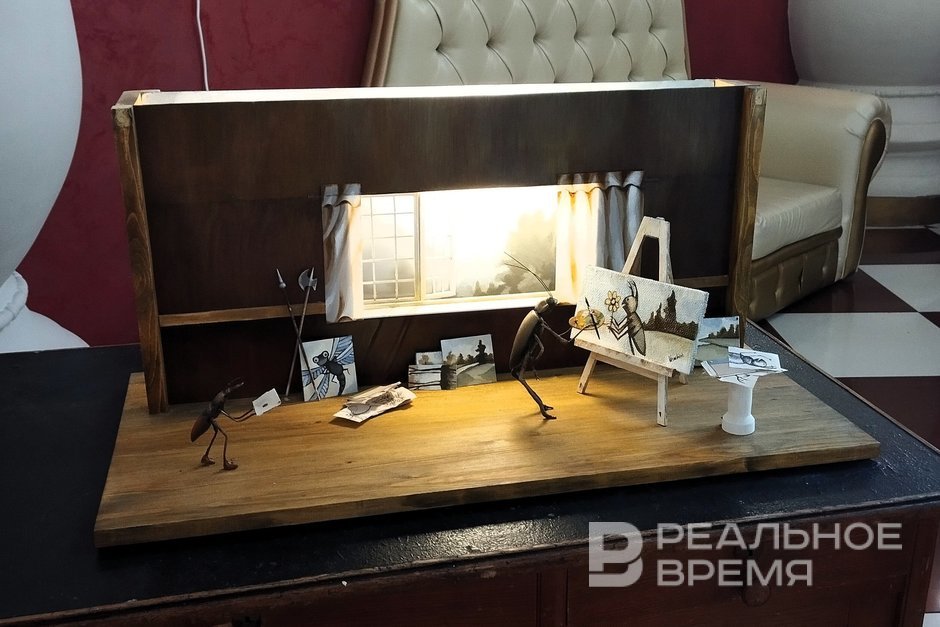
The exposition therefore begins with a reconstruction of the studio of Władysław Starewicz — a director, artist, and cameraman.
The exhibition tells about his film “The Beautiful Lukanida, or the War of the Stag Beetles with the Longhorn Beetles.” Starewicz was inspired to make this film by his passion for entomology, which he had pursued since childhood. He also loved photography. One day, Starewicz decided to make a documentary about two stag beetles but, failing to succeed (the heroes kept running away), he took two dead beetles and began shooting scenes from their life frame by frame, creating a parody of the pseudo-historical plots popular in silent cinema.
The director was, so to speak, on trend because debates about genetics and heredity were very popular at the time. He gave an interview to the English magazine Bioscope in makeup, claiming that he had been observing and experimenting on the 453rd generation of beetles since 1881: “For my insects, my word is law.”
The film was restored in 2012, adding voice-over and Pyotr Tchaikovsky's “Sentimental Waltz.”
Here, the visitor can also see what a modern animator's workspace looks like. The film “Lorenzo and Me” by director Elena Britova and animator Vladimir Vishnyakov is used as an example.
There is also a model set and puppets, but also a digital camera and a computer with special programs. However, the working principles are the same — position the puppet, take a photo, change the pose. In total, the organizers point out, it takes 36 to 120 frames.
Three to ten frames per second was the norm before, but with the advent of sound cinema, the frame rate doubled to 24 frames per second.
With a computer, it's certainly easier; you don't need to develop film and suddenly realize everything needs to be redone. “An animator still shoots three to five seconds of screen time per day, but the quality requirements for the footage have increased significantly over the last decade," the organizers reported. So the process has become longer.
From “Cheburashka” to Bulgakov
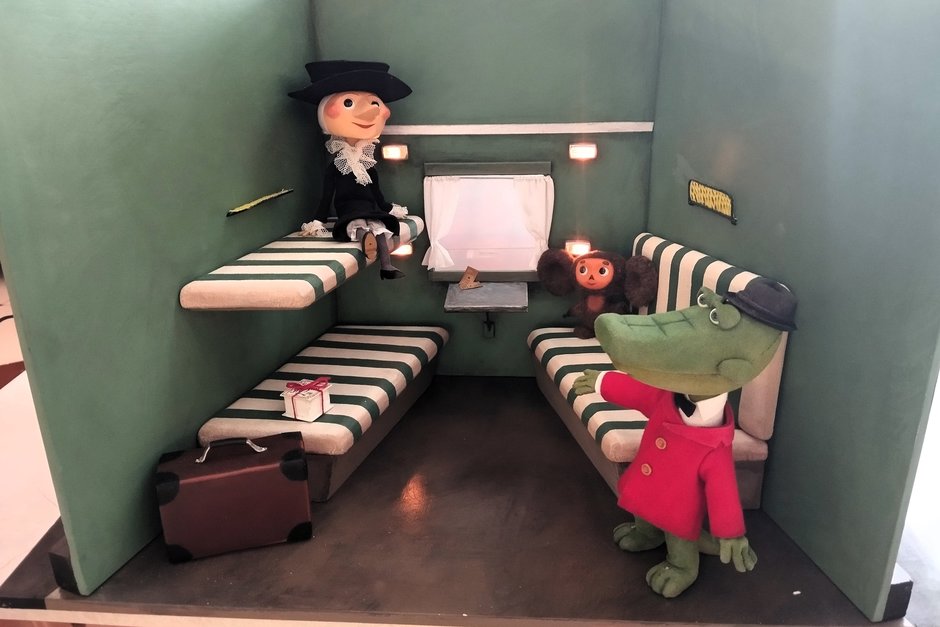
Any older visitor to the exhibition will be overcome with nostalgia, as they encounter characters from the animated films “Cheburashka” and “The Mitten," directed by Roman Kachanov. The 1967 story about a little girl who desperately wanted a dog reflects the aspiration of authors of that period not just to make toy-like animation but to address serious themes. And what is the series about Crocodile Gena if not a reflection on loneliness? That is probably why we still rewatch this cartoon today. Incidentally, in both examples, the unforgettable character designs were created by Leonid Shvartsman.
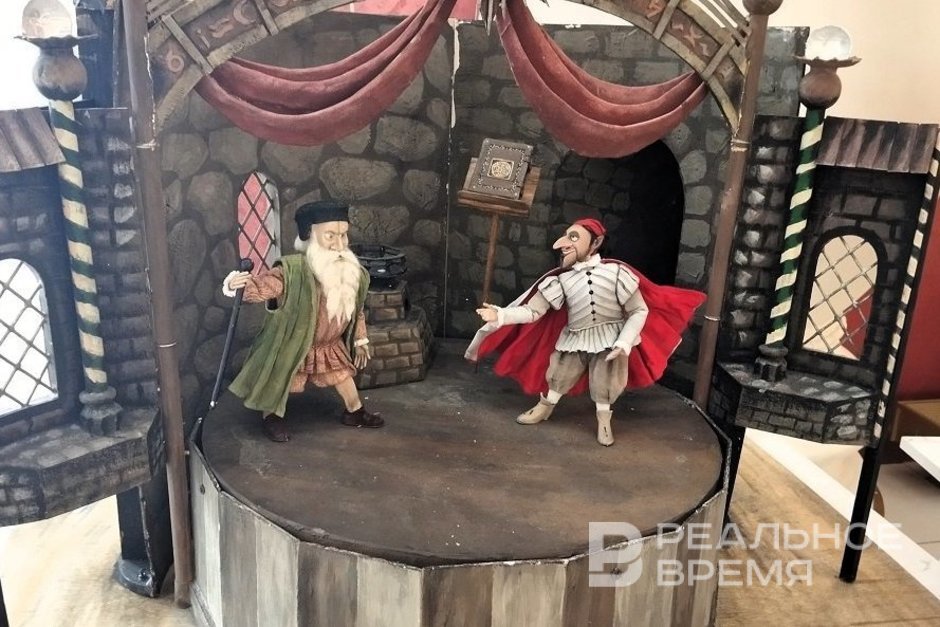
In 2018, Soyuzmultfilm released “Hoffmaniada” by Stanislav Sokolov, based on novellas by the German writer. This is an example of an animated film for a mixed-age audience, involving Mikhail Shemyakin, who had previously worked on Hoffmann-inspired set designs at the Mariinsky Theatre and depicted his works in graphic art. Moreover, “Hoffmaniada” is as much a puppet film as Kachanov's works.
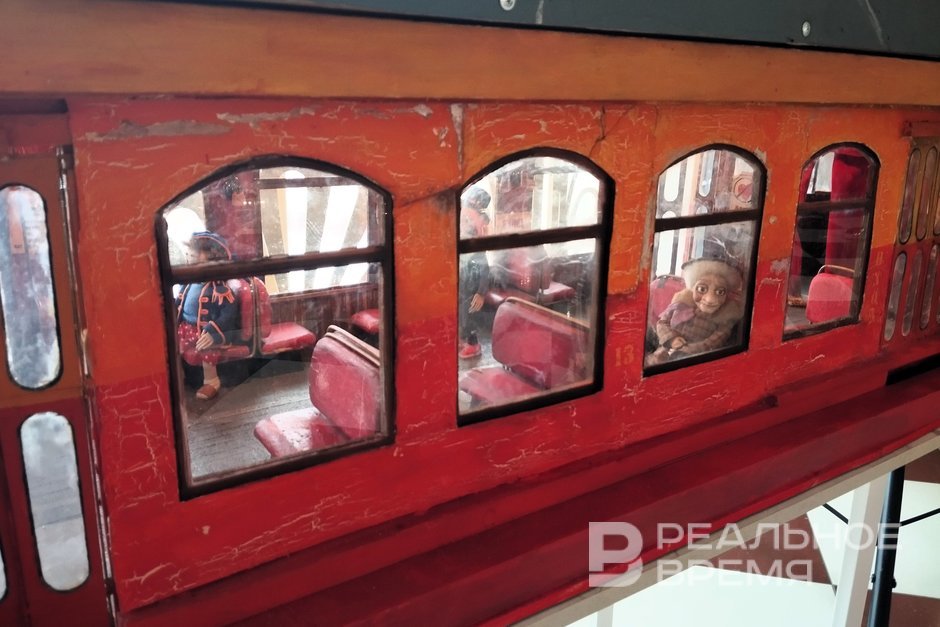
Finally, the exhibition features several brand new animated films. One is “Tram No. 13," the debut of Irina Kovtun-Menturovich, in the genre of black humor. An impressive model of the tram is also part of the exhibition.
The company “CinemaScope," which brought the exhibition to Kazan, also talks about its large-scale project. This is the 20-minute “Bulgakov” by the same Sokolov, who also served as the artist. All the roles in the animated film are voiced by Viktor Sukhorukov, and it is based on the diaries, letters, feuilletons, and short stories of Mikhail Bulgakov. Here, puppet animation is combined with hand-drawn and 3D animation — all to convey the writer's imagination and to show Moscow, “where theaters and palaces blazing with lights coexist with shabby fences and lopsided woodsheds.”
Currently, the same creative team is working on a full-length film, “Bulgakov. Mystery”: it will depict the Civil War, the hungry life in the capital in the early 1920s, and the work on plays and the novel “The Master and Margarita.” Incidentally, one of the project's animators, Ksenia Lipskaya, came to the exhibition opening, showing visitors how many secrets are hidden within the tiny “Bulgakov” puppets. For example, she explained that each one has several interchangeable heads — to portray different emotions in greater detail.
In addition to models and video screens, the exhibition has many QR codes with additional information. The exhibition at the “Ekiyat” Puppet Theater will run until March 9th.