A time crystal, a new potentially habitable planet, fattened polar bears
Interesting science news of the week
Melting Arctic ice has not worsened the quality of life for polar bears: they have even gained weight. For the first time in history, physicists assembled a two-dimensional time crystal and proved it can be stable. “Night owls” have a higher risk of heart attack or stroke than “larks.” The oldest wooden tools were found in Greece: they are 430,000 years old and were presumably made by Homo heidelbergensis. And astronomers have found a planet that is equally likely to be either a cosmic “snowball” or a home for living organisms.
The disappearance of sea ice has made polar bears gain weight
Global warming is causing polar ice to melt. Because of this, scientists have been worried about the fate of the polar bear in various areas of its habitat. It gets a significant portion of its calories by hunting ringed seals and their pups, which have not yet learned to swim — meaning they sit on the ice like on a dish with a blue border, representing a ready-made meal for the bear. Therefore, there was a theory: the less sea ice, the fewer feeding grounds for polar bears. And consequently, over time they should, at best, go extinct, at worst — lose weight.
Norwegian scientists studied the condition of the polar bear on Svalbard. They chose this habitat specifically because it has become a full 10 degrees warmer over the past 45 years. Accordingly, sea ice is melting especially intensively — the number of ice-free days in the Barents Sea has increased by about a hundred per year during this time. In 2004, there were approximately 2,650 polar bears in this location, and the population has not decreased at all to this day. This is the first thesis described in the article.
But the most interesting part isn't that. Between 1992 and 2019, scientists measured and weighed 770 adult bears. And it turned out that since 2000, when the Barents Sea began losing ice especially intensively, the bears… have been intensively gaining fat! So has the loss of ice affected the animals' condition favorably?
What is making the bears grow fatter as it gets warmer? Scientists have several versions. The first is that reindeer and walruses began increasing in numbers because people hunted them less, and consequently, more was left for the bears. And the second — ringed seals, with the loss of ice, began to gather in smaller areas, making it even easier for polar bears to hunt.

“Night owls” are at higher risk of stroke or heart attack than “larks”
British scientists have found that people who prefer to stay awake at night and sleep long in the morning are at higher risk of a cardiovascular catastrophe than those adhering to a traditional sleep schedule.
Doctors from Harvard Medical School and Brigham and Women's Hospital analyzed data from more than 300,000 people from the UK Biobank database. It turned out that the risk of heart attack or stroke for those who identified themselves as “night owls” was 16% higher than for the rest (“larks” and “pigeons”). And overall, those who liked to stay up past midnight encountered cardiovascular diseases a whole 79% more often than people who strictly adhered to a sleep schedule. At the same time, the risk of cardiovascular disease for pure “larks” was 5% lower than for representatives of other groups.
Doctors found several explanations for this phenomenon. First, the disruption of circadian rhythms, with which “owls” constantly live. Second, metabolic problems: an “owl” finds it harder to digest a high-calorie breakfast in the morning, but eats a lot late in the evening when the body is no longer tuned to absorb food. Third, statistically, there are many smokers among night owls.

Therefore, British doctors warn: if you are a “night bird," you need to pay close attention to your own health, try to eat right, and subject your cardiovascular system to as little stress as possible.
For the first time, physicists have built a two-dimensional time crystal
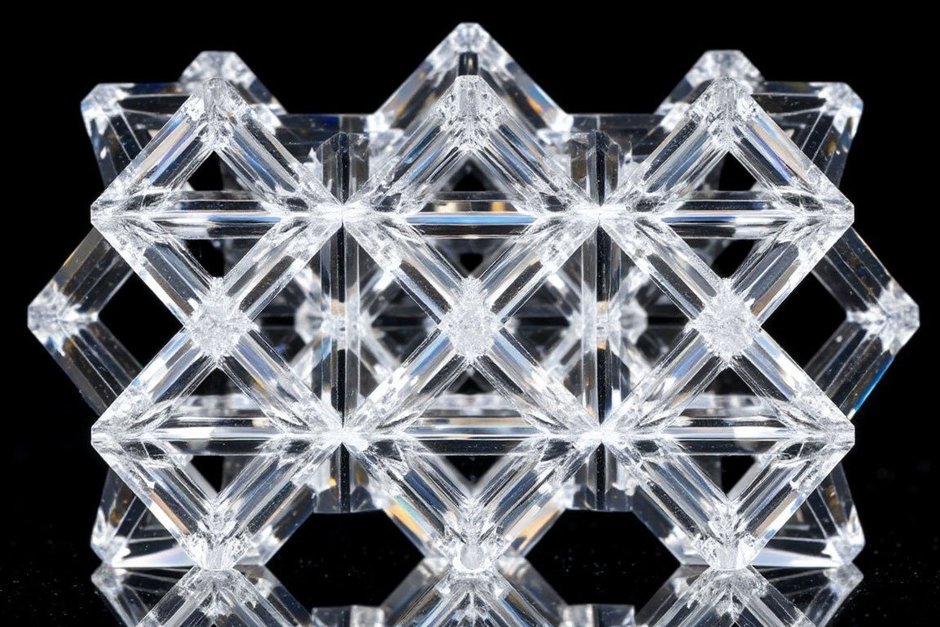
Time crystals are not the invention of science fiction writers. In modern physics, this is the name for a special state of matter in which the crystalline structure repeats not in space, but in time. For example, atoms in the crystal lattice of ordinary table salt are arranged in a clear lattice — their structure repeats in space. But a time crystal behaves differently: its particles constantly oscillate between different states and return to the starting point at equal time intervals. The most amazing thing is that these oscillations occur without consuming energy — a kind of “perpetual motion machine” violating all conceivable laws.
Scientists predicted such crystals long ago and have even learned to create them for some time now. But only one-dimensional ones: simple chains of particles. But a two-dimensional crystal — a flat layer of particles — seemed impossible to assemble. After all, the more dimensions a system has, the less stable it is. Therefore, physicists doubted that ordered pulsation could be maintained in a flat form. However, this week, news appeared that a two-dimensional time crystal had indeed been created.
To do this, they used a powerful quantum computer processor: they arranged 144 qubits into a hexagonal lattice. And they created a special type of interaction between them — the anisotropic Heisenberg model. And they achieved the desired result! The system began to resist increasing entropy, the qubits began to oscillate with a certain period. The lattice began to behave like a time crystal.
This work became a real breakthrough in understanding quantum interactions. Time crystals can be used for quantum computing (they protect qubits from destruction of the quantum state), for creating highly precise sensors, for improving atomic clocks and gyroscopes, for processing electromagnetic wave signals, and in many other important areas of science and technology.
The oldest wooden tools are over 400,000 years old
Archaeologists working at the excavation of a Middle Pleistocene site in Greece have found two wooden objects estimated to be more than 400,000 years old. Apparently, these are the oldest wooden tools found to date. And they were used by ancestors of Neanderthals or representatives of another, as yet unknown, species of ancient humans.
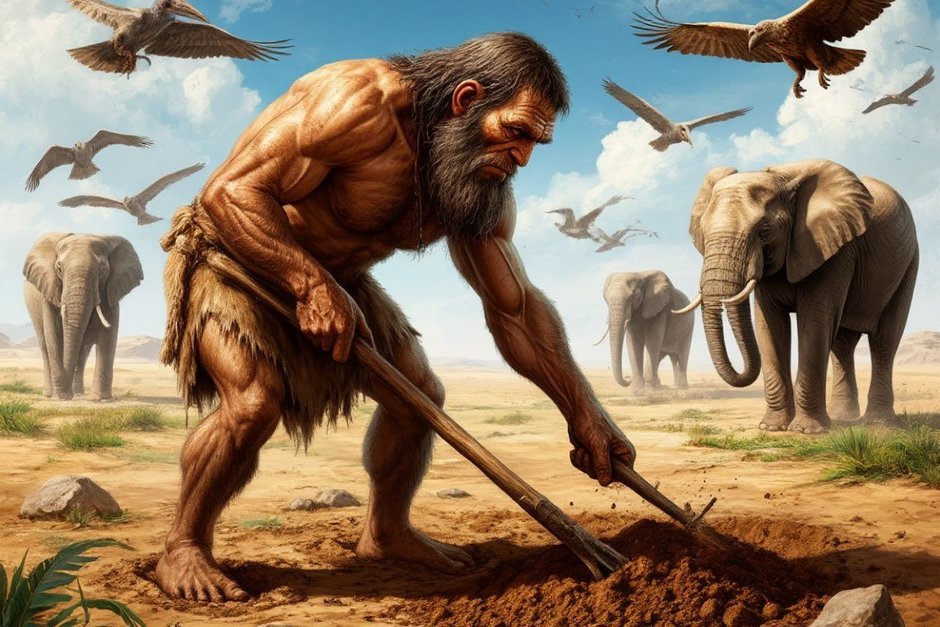
Scientists have long thought that ancestors of humans used wooden tools — the proverbial digging stick and its “colleagues” — for millions of years. But without a time machine, it's impossible to verify this, because wood does not last long. It's a rare stroke of luck if a wooden object falls into a swamp, peat, any other oxygen-free environment and is reliably preserved there. There is already an example of such a find: a fragment of a wooden spear discovered in England. It is believed to be about 400,000 years old.
And now in Greece, at one of the Pleistocene sites, German archaeologists found two objects they considered the oldest wooden tools ever found. The site's age is 430,000 years. At that time, glaciation reigned in Europe, but the lake on whose shore the site is located had a milder microclimate.
A lot of wood was found here: 144 fragments. But two caught the archaeologists' attention: an 81-centimeter stick made of alder and a 5.7-centimeter object made of poplar. Both objects were examined under a microscope, confirming that they were processed by humans: cut, bark removed, given the desired shape. The stick most likely served for digging up roots and tubers. But what the second find was for, there are no clear hypotheses.
Just as there are no remains of ancient humans at that site. These were definitely not sapiens: 430,000 years ago, people of modern anatomy did not yet exist. Neanderthals had also not fully formed by that time. Therefore, scientists decided that, most likely, it was Homo heidelbergensis — the main candidate for the role of the ancestor of Neanderthals and the ancestor of the lineage from which Homo sapiens later evolved. However, it is possible that these were some other ancient humans about whom we still know nothing.
There is a potentially habitable planet 146 light-years away
An international group of scientists from Australia, the UK, the USA, and Denmark has studied a planet with the poetic name HD 137010 b, which is 146 light-years away from us and could very well be habitable.
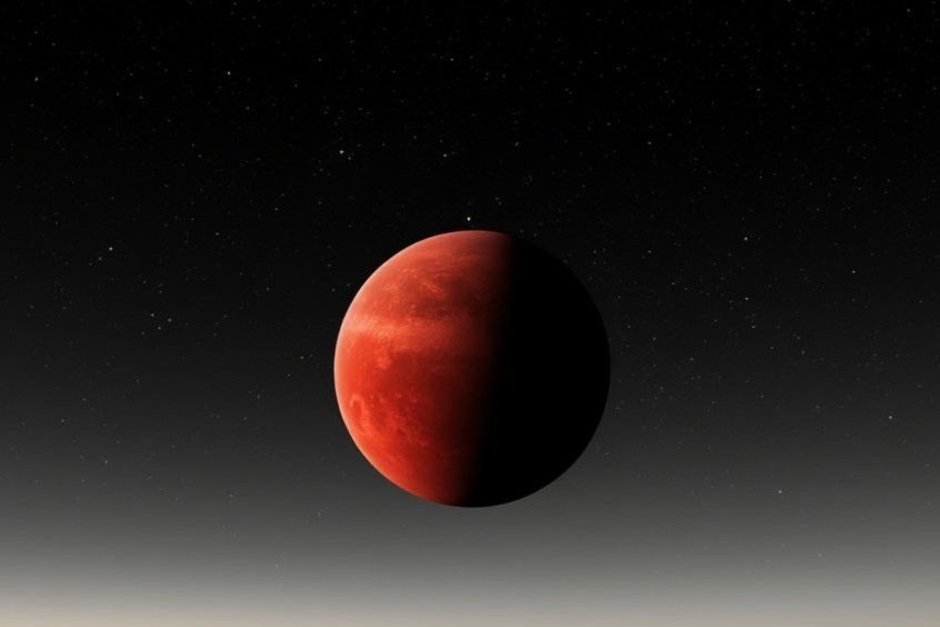
Data collected in 2017 during the extended mission of the Kepler space telescope showed the following. The planet orbits a star similar to the Sun; in size, it is about 6% larger than Earth; conditions on it are close to those that have developed on Mars. That is, theoretically, it is an Earth-like planet. It even has an orbit similar to ours, with a period of 355 days. And most importantly — there is about a 50% chance that it is in the habitable zone of its star (astronomers also call such a zone — where the emergence and existence of life is possible — the Goldilocks zone).
But the star around which the planet orbits is colder and dimmer than the Sun. And therefore, the temperature on the planet's surface could be below -70 degrees Celsius. That is, HD 137010 b could simply be a huge cosmic “snowball.”
However, for now, this is the nearest planet to us that could be habitable. 146 light-years, by cosmic standards, is very little. The next planet meeting the habitability criteria in the “Goldilocks zone” of its star is planet Kepler-186f. It is four times farther away, and its star is 20 times dimmer than the Sun.
HD 137010 b will continue to be observed with the help of next-generation telescopes.