Teachers oppose plans to class homework-answer websites alongside extremist content
Who makes billions from publishing ready-made homework and how pupils may circumvent the ban

In Tatarstan’s teaching community, experts have assessed an initiative by the Ministry of Education to equate GDZ — ready-made homework answers — with prohibited information, alongside drug propaganda, extremist materials and pornography. At present, a draft law banning the online publication of textbook solutions, answers to Olympiad questions, the Unified State Exam (EGE) and the Basic State Exam (OGE) is undergoing pedagogical review. How developed and profitable the business of giving pupils shortcuts is, and how teachers and lawmakers view attempts to shut it down, was examined by Realnoe Vremya.
A “ban” under review
Russian experts have described as a dead-end and ineffective way of tackling cheating in schools one of the Education Ministry’s recent initiatives.
The ministry has published on its website draft amendments to legislation banning the distribution of ready-made homework answers, solutions to assessment materials for state certification, and answers to Olympiad questions. The proposal is currently undergoing pedagogical review. The document has not yet been submitted to parliament.
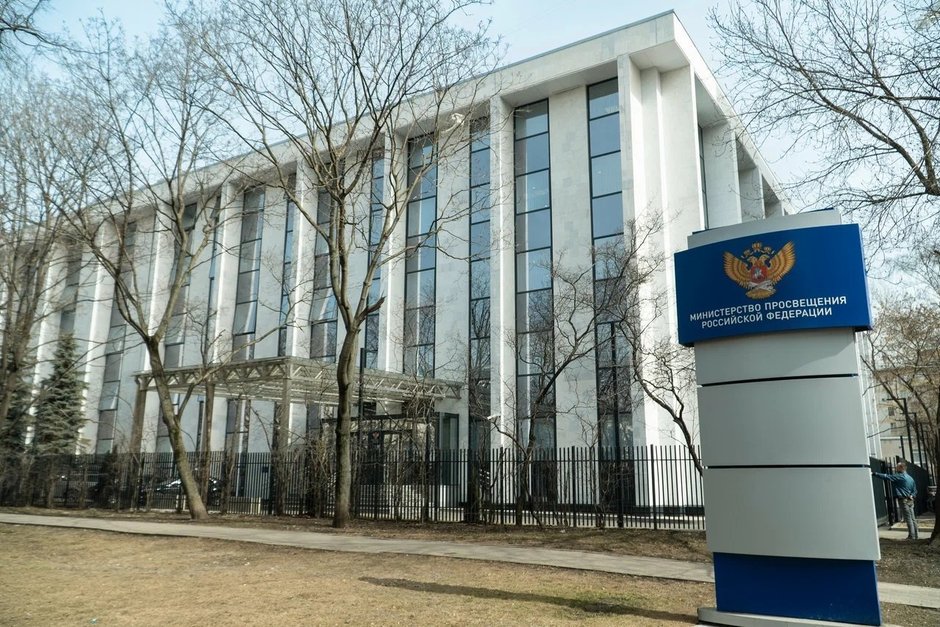
The Ministry of Education has published on its website draft amendments to legislation banning the distribution of ready-made homework answers, solutions to assessment materials for state certification, and answers to Olympiad questions.
It is proposed to ban the dissemination of information about assessment materials and methods for solving educational tasks. An exception would be made only for information contained directly in textbooks and their electronic versions. There are also plans to restrict the circulation of ready-made solutions to tasks from the All-Russian School Olympiad on social networks. The ministry proposes placing such information on a par with content banned from publication, such as information on the manufacture and use of narcotic substances, suicide, as well as material aimed at inducing minors to commit unlawful acts that threaten their lives, contain calls for extremist activity, and the like.
“The use of ready-made solutions violates the principles of independence and objectivity in assessing students’ knowledge, creates unequal conditions for students who complete tasks conscientiously and those who use ready-made solutions, <…> and poses risks of reducing students’ motivation for independent work,” the explanatory note to the draft law states.
“Until the system changes, blocks will not work”
Anton Gorelkin, first deputy chairman of the State Duma Committee on Information Policy, does not consider the idea of banning the publication of ready-made solutions to be sound. However, the alternative he proposes to counter cheating differs fundamentally from what teachers consider reasonable.
“School curricula need to be lightened, so that exam preparation does not provoke children to cram or cheat,” he wrote on his Telegram channel. “Rewriting the federal law ‘On Information’ to solve education problems (or rather, to create the appearance of solving them) is wrong. In my view, placing school cheat sheets on a par with destructive information goes too far. Moreover, the practice of working through past exam papers emerged as a natural response to the system the ministry has been building for years. And until it changes, no blocks will work — most likely they will push pupils into the darknet and towards fraudsters.”
“Negative content, including homework solutions sold by commercial operators, certainly needs to be restricted, but we must understand that artificial intelligence will develop, and it will in any case be used by our talented pupils,” says State Duma deputy from Tatarstan Airat Farrakhov. “Our children are very talented, intelligent and promising, and if they want to, they will be able to find solutions online even after a ban on GDZ is introduced. So the solution is not bans, but changing the situation.”

He stressed that pupils often resort to cheating because of overloads and because they do not manage to absorb material at school during lessons. As a result, the large volume of homework and teachers’ reliance on independent mastery of material push pupils to look for the simplest and easiest way out of time pressure.
“Academic overload is a road to nowhere, just like a ban on the distribution of ready-made solutions online. However, this content, which people earn money from, is extremely harmful, just as populism in general is harmful, so it needs to be tackled,” the deputy believes. “We need to review school workloads and return once again to the issue of the unified state exam, because it is precisely this format that forces children to turn to ready-made solutions. We need to understand why we so often encounter situations where a person with excellent grades and even medals turns out to be completely unfit for anything. Let us return to the idea that average students often achieve far greater results in life than straight-A students — this is a question for us, for how we assess diligence and knowledge today.”
In Farrakhov’s view, it is very important to support teachers who focus not on homework but on classroom work with pupils — to stop over-controlling and overburdening them, and to free up their time and energy for work in class. And alongside motivating pupils to acquire knowledge, to motivate them to respect their teachers.
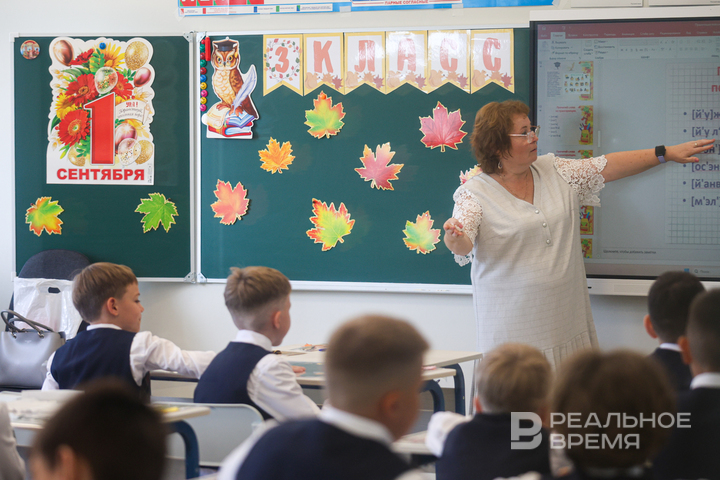
In Farrakhov’s view, it is very important to support teachers who focus not on homework but on classroom work with pupils.
“Recently, the head of the Presidential Council for Human Rights, Valery Fadeyev, expressed the idea that pupils should be expelled from school for bad behaviour. I agree: rudeness and insulting teachers until recently were unacceptable in our country; teachers were always and everywhere the most respected people, and this should remain the case — the issue is ripe in society. We have abolished the notion of ‘services’ in relation to education: the transfer of knowledge is not a service but a great gift that must be valued. And we very much hope that we will continue moving in this direction.”
“A ban does not motivate learning”
Arman Kostanyan, director of the Innopolis Lyceum and Tatarstan’s Teacher of the Year 2023, believes that no positive effect should be expected from the initiative.

Kostanyan noted that, of course, there are pupils who mindlessly copy solutions from GDZ, and it is clear that the ministry is trying to combat this. However, in his view, this should not be done through bans. It is important for teachers and parents to motivate children not towards such “box-ticking” for a grade, but towards conscious learning, awakening a desire to solve problems independently.
“One can draw an analogy with private tutoring. A tutor can effectively do a child’s homework for them, or can work with a pupil who understands they have gaps and wants to close them or prepare to score highly in exams. Children need to be guided towards the second option. Simply banning GDZ is ineffective.”
In addition, the Innopolis Lyceum director believes that a ban on publishing GDZ does nothing to motivate pupils to study, because workarounds can always be found. He recalled that today is the era of generative artificial intelligence, with a huge number of services capable of solving problems and finding answers. For this reason, he argues, there is only one constructive path: to foster a conscious approach to learning among pupils.
“Why are leak investigations not being carried out right now?”
The Education Ministry’s legislative initiative has also failed to gain full support from Gulnara Islamova, head of the Republican Olympiad Centre. She does, however, believe that the publication of GDZ should have been banned long ago to avoid meaningless copying of answers from textbooks.
However, Islamova considers a ban on publishing solutions to already completed Olympiads not only pointless but harmful. She argues that solutions to Olympiads that have not yet taken place do not appear online; instead, tasks from previous years are published so that pupils and teachers can understand roughly what to expect in future competitions.
“There is nothing bad in this. On the contrary, there are only benefits in Olympiad centres publishing tasks from previous years. A teacher preparing children for Olympiads must also prepare themselves and see what needs to be covered beyond the curriculum.”
Prominent Kazan education innovator Pavel Shmakov believes the problem of cheating can be solved without rewriting legislation.

Shmakov recalled a recent scandal involving the annulment of biology Olympiad results, when several participants gave identical incorrect answers. He expressed bewilderment that, given today’s level of technology for tracking violations, no investigations are carried out in such cases to identify the source of leaked correct solutions.
“Links to correct answers appear online and are then removed — I have screenshots of such posts. A year ago, I tried to get an investigation launched, filed a police report, which was accepted, but it was made clear that there was little desire to pursue it. I received no results. Why are law enforcement agencies not investigating such leaks right now, when they have the authority and obligation to combat violations of the law? And what will this draft law change? I do not understand.”
A profitable business
Meanwhile, the business of selling ready-made answers from school textbooks continues to thrive. According to SPARK-Interfax data, the revenue of Chelyabinsk-based LLC GDZ.RU increased almost 4.7 times between 2020 and 2024, from 16.75 million roubles to 78 million. The company’s net profit, registered in 2016, fell just short of 2 million roubles in 2023, and amounted to almost 1.6 million in 2024. Turnover dynamics across all cash registers over the past six months have remained unchanged — more than 3 million roubles.
The general director and sole beneficiary of GDZ.RU, Maksim Salnikov, also owns another profitable business — LLC Fourth Generation. The company specialises in data collection, processing and analysis, IT solution development and neural network training, and in 2024 generated revenue of 42.2 million roubles and net profit of 2.8 million.
Moscow-registered LLC Skyeng, according to SPARK-Interfax, is 61% owned by Russian national Rustam Aynetdinov and 39% by the Cyprus-based company VIMBOX LIMITED, owned by Alexander Laryanovsky. Its revenue reached 2.16 billion roubles in 2023 with net profit of 1.24 billion; in 2024 it stood at almost 1.66 billion with a loss of 110 million. “Don’t worry if you can’t complete the task — look at the solution and remember the algorithm for the future,” GDZ providers tell young clients on their website.
While the websites of GDZ.RU and Skyeng openly disclose their owning companies, Realnoe Vremya was unable to find publicly available information on the owners of solution sites such as Megaresheba, Reshak, Pomogalka and others.
The publication received no responses from the owners of GDZ.RU and Skyeng to questions about the positive and negative aspects of pupils using ready-made solutions and about the Education Ministry’s plans to ban their publication. Any comments received will be published.