The Central Bank featured the Palace of Farmers in Kazan on the new 1,000-ruble banknote
The Nizhny Novgorod Kremlin is depicted on the front of the banknote
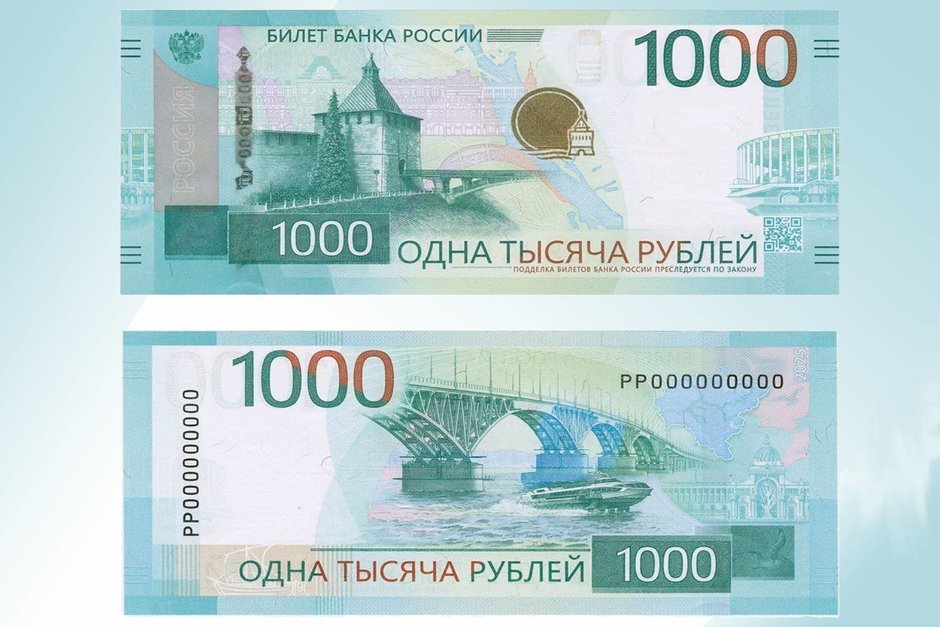
Today, at a briefing, the Deputy Chairman of the Central Bank of the Russian Federation, Sergey Belov, presented an updated 1,000-ruble banknote dedicated to the symbols of the Volga Federal District. It is noteworthy that the Palace of Farmers in Kazan is depicted on the reverse side of the banknote. Read about what else is depicted on the new 1,000-ruble note, when it will be put into circulation, and why the banknote was updated in the Realnoe Vremya article.
Nizhny Novgorod Kremlin on the front of the banknote and the Palace of Farmers on the back
The Nizhny Novgorod Kremlin, a stylized map of the city, a stadium, and a fair are depicted on the front of the banknote. Sergey Belov, Deputy Chairman of the Central Bank of the Russian Federation, spoke about this at the briefing, presenting the banknote to journalists. At the same time, the color palette of the updated 1,000-ruble note is still in turquoise, like the previous banknote.
«On the front side, we see the Nizhny Novgorod Kremlin, the pearl of the city. Also, against the background of a stylized map of the city and the meeting point of two rivers, the Volga and Oka, is the famous Nizhny Novgorod Fair. On the right side of the banknote is a modern stadium that was opened for the World Cup. When developing the reverse side of the banknote, we took into account the wishes of our citizens, who voted for monuments and landmarks of the Volga Federal District. Here we see the Volga, the main symbol that unites many regions of the Volga Federal District. The Saratov automobile bridge with openwork spans, one of the longest bridges in Europe, stretches across the Volga. And, of course, the Meteor sailing on the waves. On the right is the Palace of Farmers, a famous monument of modern architecture in Kazan,» he said.
Belov recalled that the 1,000-ruble banknote is already the third banknote that the Central Bank has updated. Now the updated 100-ruble note with landmarks of Moscow and the Central Federal District is actively in circulation. New 5,000-ruble notes dedicated to Yekaterinburg and the Ural Federal District are also becoming more common.
The new 1,000-ruble banknotes featuring the Meteor ship and the Palace of Farmers will not enter circulation immediately. According to the speaker, this process takes up to a year and a half — this period is associated with the adjustment of equipment. However, Belov admitted that the process could go faster, since the country has already issued updated banknotes of other denominations in the past.
«Maybe at the end of 2026, the banknote will appear in circulation,» Belov suggested, adding that first the updated banknote will go to banks, then to retail enterprises, and after that — into public circulation.
Earlier, the dome of an Orthodox church without a cross was depicted on the new 1,000-ruble banknote
Let us recall that the Central Bank has already presented an updated 1,000-ruble banknote. At that time, the Nikolskaya Tower of the Nizhny Novgorod Kremlin was depicted on the front side, and the Museum of the History of Statehood of the Tatar People and Tatarstan, the Syuyumbike Tower in Kazan, and the Museum of Archeology and Ethnography in Ufa were depicted on the reverse side. However, the image of the museum caused indignation. In particular, priest and blogger Pavel Ostrovsky was outraged that the banknote allegedly depicted a church without a cross and a minaret with a crescent.
«Have you completely lost your fear there, comrades? On the new 1,000-ruble banknote, you depict a minaret with a crescent and the dome of an Orthodox church without a cross,» Priest Ostrovsky pointed out.
Later, the Russian Orthodox Church also paid attention to the problem. The head of the department for interaction with the media, Vladimir Legoyda, called for more careful selection of images for banknotes in order to «not create tension where there should be none». At the same time, the Russian Orthodox Church emphasized that the church is depicted on the banknote without a cross because it is a museum, and in real life, there is no cross on its dome.
However, in the end, the Central Bank decided to stop the issuance of the banknote without putting it into wide circulation. To avoid misunderstandings in the future, the regulator launched a vote on its website for the objects to be depicted on the banknote. 25 symbols of the Volga Federal District participated in the vote. As a result, the high-speed hydrofoil ship Meteor, produced in Zelenodolsk, received the most votes. The Kazan Palace of Farmers came in second place, and the Saratov automobile bridge over the Volga came in third. About 700 thousand Russians participated in the voting.
The main goal of updating the banknote is to make it more difficult to counterfeit
In turn, Igor Kokh, a professor at KFU and Doctor of Economic Sciences, noted that the main goal of updating any banknotes remains security and minimizing the risks of counterfeiting.
«The image on the banknote itself will not affect either the country's economy or the finances of citizens. The main goal of updating the banknote is to make counterfeiting more difficult. Each time a new generation of banknotes is released, it contains some new security features that, accordingly, make it difficult to counterfeit them. And those fraudsters who have already set themselves up to counterfeit old banknotes will not be able to counterfeit the new ones. Such updates are carried out every few years, but all such measures are exclusively a matter of combating counterfeiting,» Kokh told Realnoe Vremya.
As Sergey Belov, Deputy Chairman of the Central Bank of the Russian Federation, emphasized, in general, the number of cases of counterfeiting banknotes in Russia is decreasing every year, but the positive trend does not negate the fact that the Central Bank must be «one step ahead of counterfeiters».

«We have significantly strengthened the security complex in the new banknotes. We have made the elements that each of us can check ourselves — by tilting the banknote or by touch — more complex. We have paid special attention to machine-readable security features that are read by payment terminals and other devices. At the same time, it is impossible to change the security complex and keep the previous appearance of the banknote. New security complexes require new design solutions,» he summarized.