Kazan of the early 21st century: Admiralteyskaya sloboda
Let's walk through Bishbalta.
Let's take a journey to the historical places of Kazan in the early 21st century, to Admiralteyskaya Sloboda. Historically, it began with the Tatar village of Bishbalta. It seems changes in this area started relatively recently, and now Admiralteyka is turning into another symbol of Kazan's renewal. Let's examine photographs by local history popularizer Ilya Yevlampiev and try to recognize familiar places.
Railway Crossing
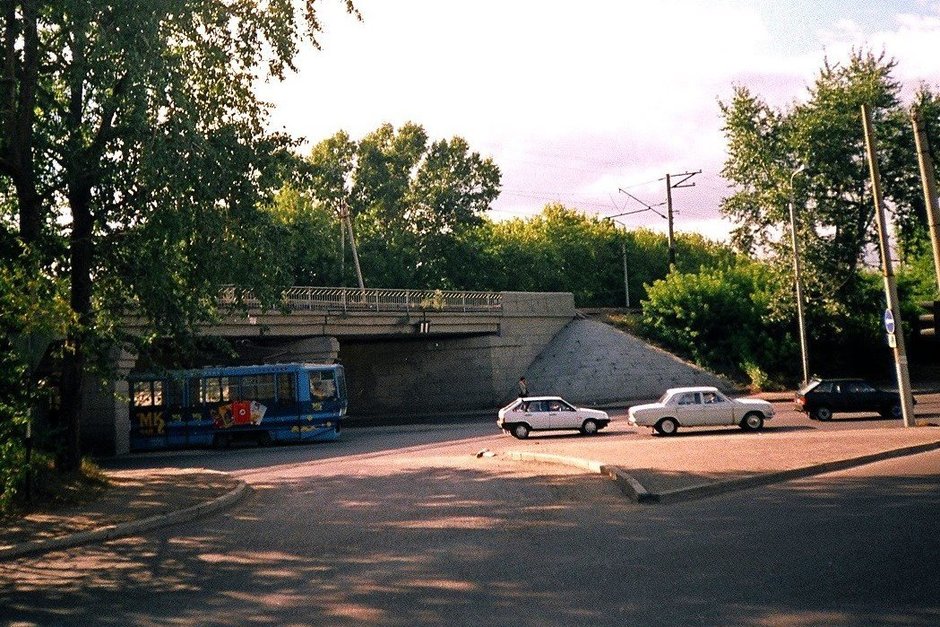
A tram goes along the Kirovskaya Dam and then turns left. Note that a kind of safety island has been built here. The railway appeared in Kazan in 1893–1894, when the city became part of the general railway network. At that time, Admiralteyskaya Sloboda found itself somewhat divided in two, and its transport accessibility remains a question of serious transformations to this day, considering the volume of housing planned to be built here. In the early 2000s, several new houses were already built in the sloboda, but this, of course, cannot be compared to the current scale.
If you don't turn left but go straight, you'll follow another route, over the “Hunchback Bridge” closed in 2009. From 1929 to 1937, a tram ran over it, and from 1951 until the 1970s — a trolleybus.
Chapel
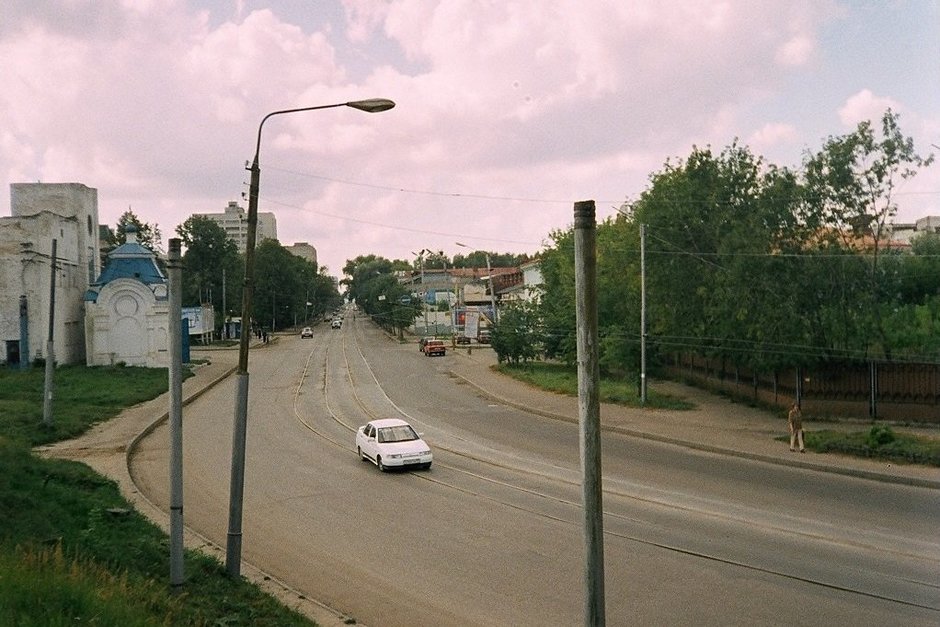
In photographs from the second half of the 20th century, you can see wooden houses on both sides of the white chapel, as well as on the right side of the road. The Chapel of the Kazan Icon of the Mother of God and Seraphim of Sarov is a reminder of the Mariinsky Almshouse, opened here in 1872. It housed the elderly and young orphans. The chapel was designed by Fyodor Malinovsky, who rebuilt the Varvara Church and the Cathedral in the Kazan Kremlin.
The later building behind it is a transformer box in the constructivist style.
“Zvezda” (Star) Cinema
Admiralteyskaya Sloboda is an area with many meanings. From 1718 to 1829, shipbuilding took place here. Later, the district became a major industrial center. Nearby was Dalneye Ustye, the old river port of the city. Klara Zetkin Street is the former Moscow Highway, along which travelers arrived in Kazan.
And the photo shows the “Zvezda” cinema. Built in 1956, it inherited the traditions of the 1911 cinema for workers of the Sveshnikov factory. It was reconstructed in 1984. At the time of the photograph, the “Variant” TV channel operated here, opened in 1997 and closed in 2007.
In 2025, the Committee for the Protection of Cultural Heritage Sites, through the Arbitration Court of the Republic of Tatarstan, demanded the demolition of an annex to the cinema building, which was made by the founder of the “Buket Stolitsy” and “Klumba” flower retail chains, Luiza Senkovskaya. In court, it was noted that even before the purchase by the current owners, the Soviet-era object had changed significantly, for example, the columns had disappeared.
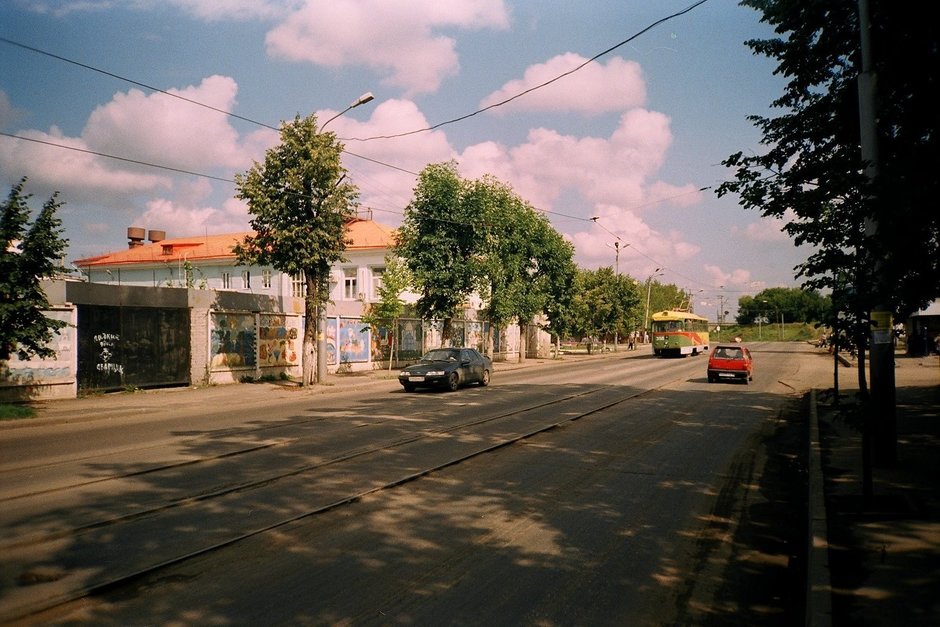
Near the “Serp i Molot” (Sickle and Hammer) Factory
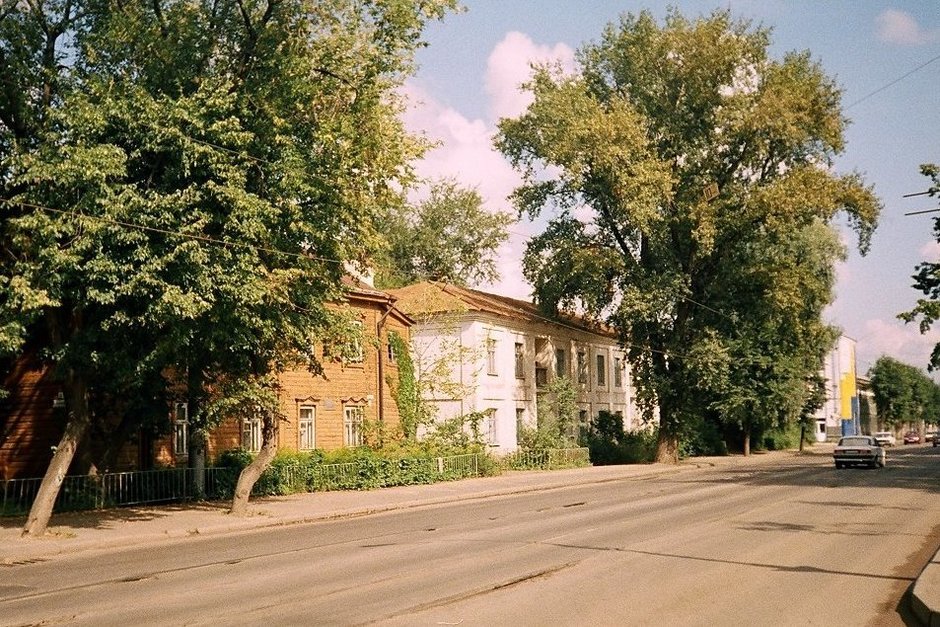
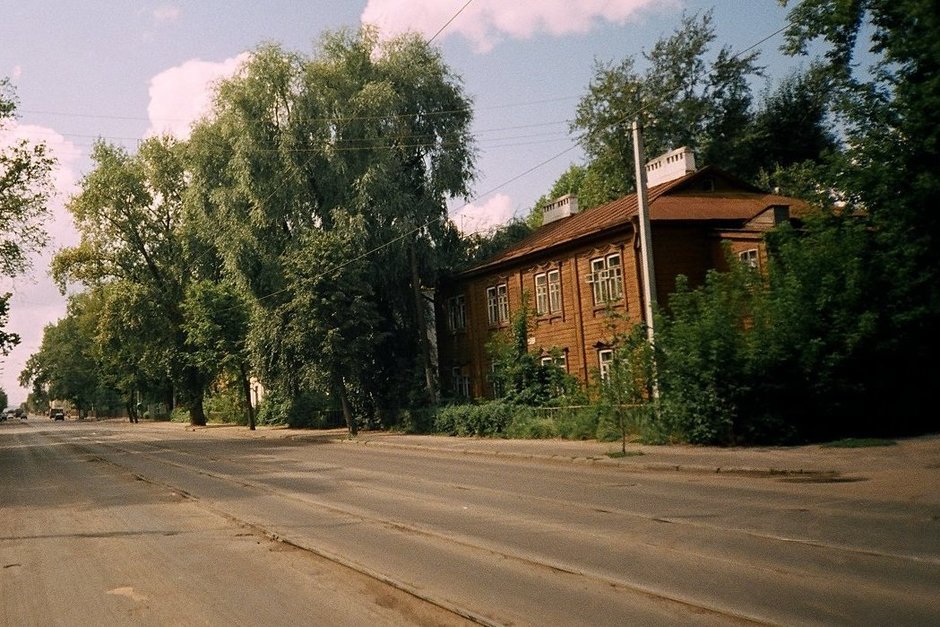
This part of the street is connected to the “Serp i Molot” factory. It began operations in 1851. Old Believer Alexander Nikiforovich Sveshnikov founded the “Iron Foundry, Machine-Building, Forge-Boiler and Mechanical Plant of A. Sveshnikov” here, and it was nationalized in 1918. By the time of the photograph, the “Admiral” shopping center, which burned down in March 2015, should have already appeared behind these quiet wooden houses. Nowadays, a residential complex is planned on its site. The buildings captured on film (another one can be seen on the article's poster) disappeared a few years later; now there are private business pavilions here.
Alafuzov's House and the River School
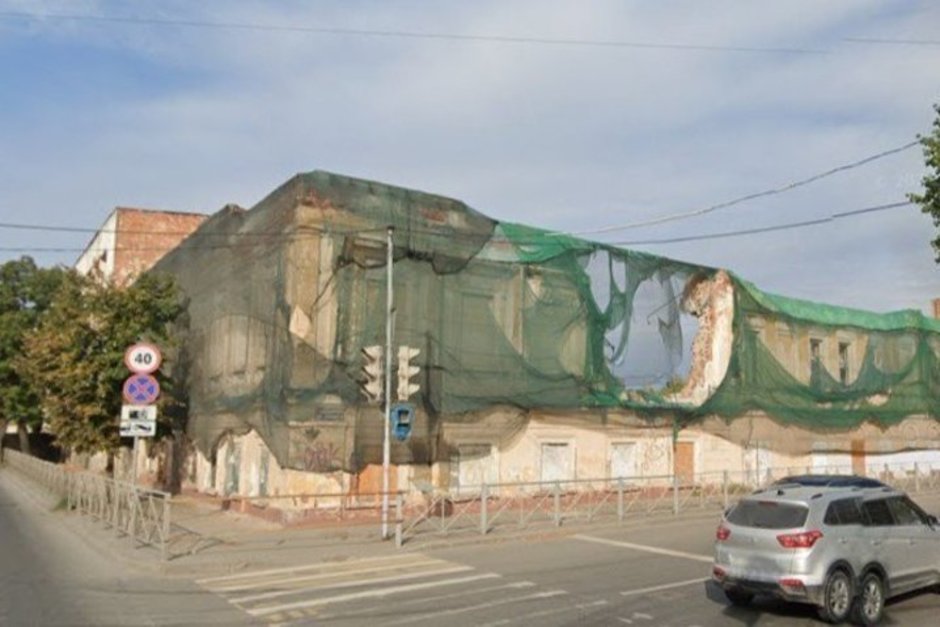
Now, passing the intersection with Uritsky Street, you can see an ugly structure, or rather a wall with a hole at the second-floor level. In the photo, this is the yellow building: “The own house of I.I. Alafuzov, until 1863 the house of Ganevilken.” This is also part of the “Santekhpribor” (Sanitary Equipment) factory, which began to be dismantled for bricks in 2012, but the process was later stopped by the prosecutor's office of the Kirovsky District. It is known that the office of the “Partnership of Alafuzov's Factories” was also located here; they worked behind the old bed of the Kazanka River, and now they could turn from the Soviet Linen Mill into elite housing.
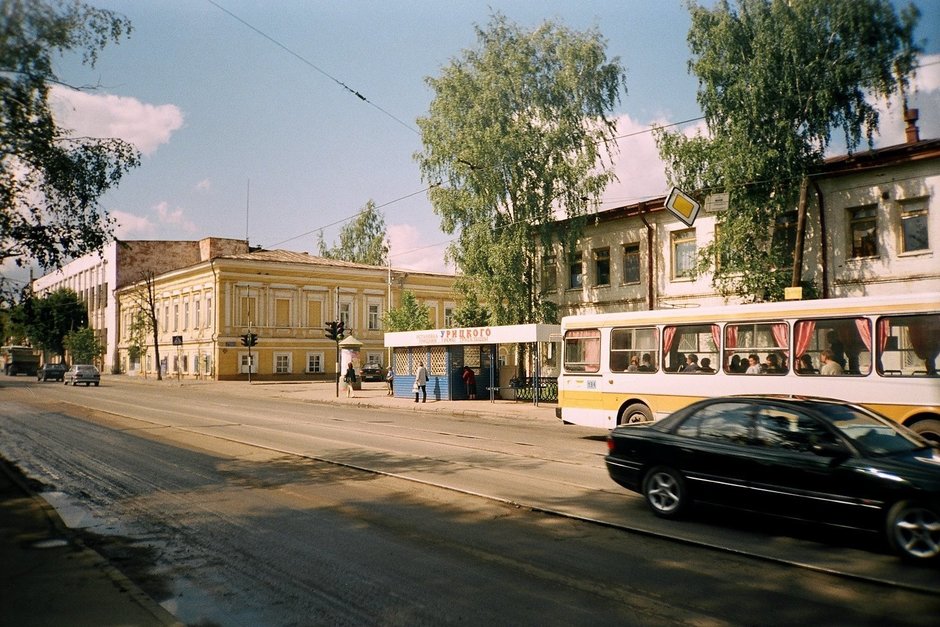
But let's not forget the building on the left. It resembles a heavily rebuilt river school. Its construction began in 1904. The initiator and later the head of the school was Mikhail Cherepanov, inspector of navigation for the Kazan section of the Volga River.
The construction was sponsored by merchant Sergey Zemlyanov, owner of seven tugboats and 54 wooden barges. Zemlyanov allocated 25,000 rubles for this. Zemlyanov's house, by the way, stands at Moskovskaya, 37. And the river technical school moved to its current location — at Nesmelova, 7.