The big game in AI: the UN takes control, China catches up, hackers don't sleep
A new era of cooperation, breakthrough alloys, and digital threats — in the digest of the brightest events in the tech world

While 29 countries, including Russia, signed a charter on the decentralization of AI technologies under the UN flag, Canadian engineers, using self-learning algorithms, began stamping super-strong alloys for jet engines, and attackers turned GitHub into a breeding ground for info-stealers with bypasses of Chrome's protection. To top it off, the Chinese startup Moonshot rolled out the most powerful open-source neural network in history, challenging the closed ecosystems of the West. The main news from the tech world over the past week is in the Realnoe Vremya digest.
Russia and 28 other countries established the World Artificial Intelligence Cooperation Organization
The agreement was signed on July 16 in Shanghai. The new structure, under the auspices of the UN, is aimed at abandoning technological monopoly and developing AI solutions on the principles of equality.

On July 6 in Shanghai, Russia, together with 28 states, signed the Agreement on the Establishment of the World Artificial Intelligence Cooperation Organization. The document was signed on behalf of the Russian Federation by Minister of Digital Development Maksut Shadayev. The main goal of the new structure is to create fair mechanisms for international cooperation, develop national AI technologies, and harmonize technical standards under the central coordinating role of the UN.
The organization's activities will focus on increasing the accessibility of technologies and promoting safe, ethical, and trusted AI solutions. To achieve these goals, the participants agreed to increase the coherence of technical standards and ensure the functional compatibility of software products from different countries. Special attention in the founding tasks is given to encouraging the development of ecosystems based on open source code. This approach promotes the transparency of algorithms and ensures equal access of states to modern innovations.
The Russian side views this agreement as a strategic transition from the model of technological monopoly of a narrow group of countries to a model of modern development. Deputy Prime Minister Dmitry Grigorenko noted that Russia already has its own large language models and advanced platform solutions, Interfax reports. This allows the country not only to adopt global experience but also to effectively promote domestic developments in foreign markets. Deputy Head of the Presidential Administration Maxim Oreshkin, who led the Russian delegation, emphasized that technological sovereignty is achieved precisely through the unification of competencies of states in the context of the end of the era of a unipolar world.
Researchers at the University of Toronto used AI to create new 3D-printable alloys for the aerospace industry
Materials based on nickel, cobalt, and chromium surpass the industry standard Inconel 625 in heat resistance and oxidation resistance, opening up new opportunities for additive manufacturing of rocket engine parts.
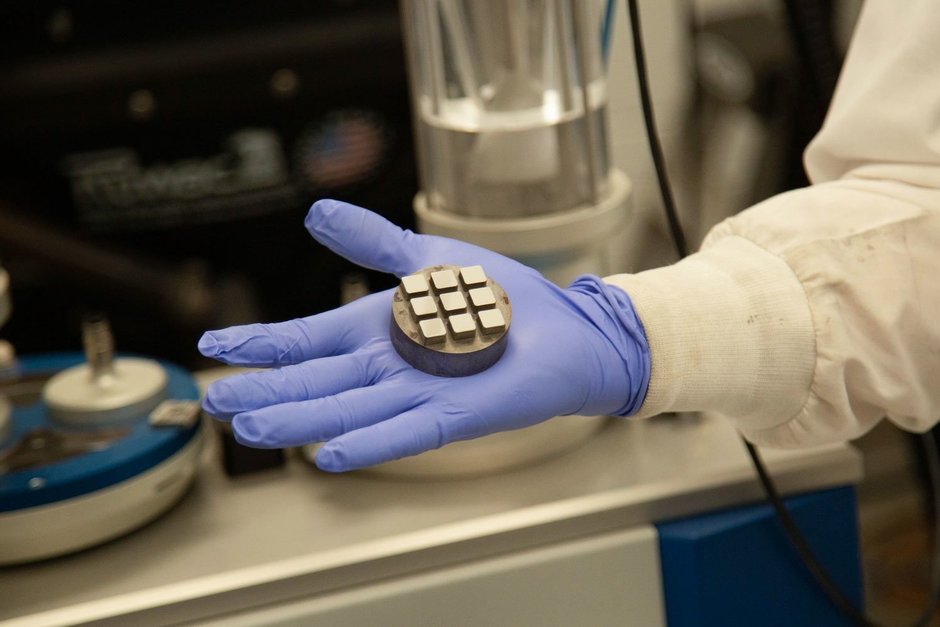
Researchers at the Faculty of Engineering at the University of Toronto (Canada), using artificial intelligence, have developed new metal alloys that retain strength at extreme temperatures. The materials are optimized for additive manufacturing (metal 3D printing) and are intended for use in the aerospace industry and energy, where traditional steel cannot withstand high temperatures and critical pressure drops.
The traditional search for new alloys among tens of thousands of possible combinations of elements represents a complex computational and physical task. To solve this problem, the team, led by Professors Yu Zou and Jason Hattrick-Simpers, applied the “active learning” method. This technology combines computer simulation, machine learning, and robotic manufacturing into a single “self-driving laboratory.” This approach allows the system to independently select samples for synthesis and testing, and then use the experimental data obtained to adjust subsequent steps with minimal human intervention.
In the experiment, the researchers focused on compositionally complex alloys containing three main elements: nickel, cobalt, and chromium. Graduate student Ajay Talbot, lead author of the study, noted that this method allows bypassing the problem of a lack of initial data for training neural networks in unexplored areas. As a result, over several weeks, the laboratory identified six new promising alloys.
One of the developed materials, consisting of 12% nickel, 62% cobalt, and 26% chromium, surpasses the industry standard Inconel 625 in maintaining hardness at temperatures up to 600°C (typical for the front section of a jet engine) by 4.5%. The second alloy, including 36% nickel, 14% cobalt, and 50% chromium, demonstrates increased oxidation resistance at temperatures up to 1000°C. According to Talbot, this material surpasses Inconel 625 by 85% in this parameter, preventing metal burnout in the rear sections of engines.
About 300 fake repositories were found on GitHub for distributing the BotyptGrab info-stealer
Researchers at Arctic Wolf have identified a campaign targeting the theft of data from browsers and crypto wallets through the DLL side-loading mechanism and a new technique to bypass Chrome's protection.
Cybersecurity company Arctic Wolf has uncovered a massive campaign to distribute malware through 292 fake repositories on GitHub. The attackers disguised them as popular projects in the fields of cybersecurity, cryptocurrencies, financial instruments, and developer utilities. The goal of the attacks was to distribute an info-stealer belonging to the BoryptGrab family, which is activated when a user attempts to download supposedly legitimate software.
To carry out the attack, the attackers used template landing pages that dynamically generated trusted branding based on the URL. The user downloaded a ZIP archive whose name and payload were updated approximately every minute to bypass signature analysis. The archive contained a trojanized lubcurl.dll file and a legitimate signed WinGUP installer renamed to the target product. When the executable file was launched, a side-loading (DLL side-loading) of the malicious library occurred, which decoded and executed the info-stealer directly in the infected system's RAM.
The program collects passwords, cookie files, and payment data from 19 web browsers, information from 32 crypto wallets, as well as session tokens from messengers (Telegram, Discord) and gaming platforms (Steam). The researchers noted a previously undocumented ability of this variant of BoryptGrab to bypass the App-Bound Encryption mechanism in the Chrome browser by directly injecting code into the browser process. The collected data is compressed and sent to the command server, whose infrastructure is reported to be located in Russia.
Arctic Wolf experts emphasize that this malware does not persist in the system and does not use anti-analysis techniques. It is designed to collect the maximum amount of data in a single run, leaving artifacts in temporary directories, which simplifies digital forensics.
The world's largest open-source neural network, Kimi K3, has been released, second only to top Western models
Chinese Moonshot AI has unveiled a model with 2.8 trillion parameters that promises to finally close the gap between open and closed AI systems, although its launch has already led to rising prices and surge demand.
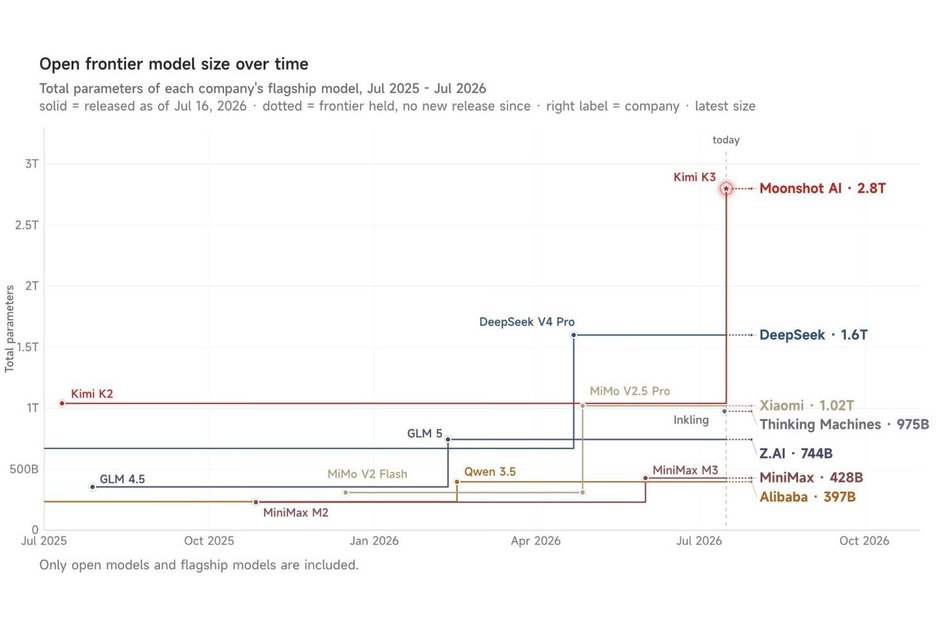
Chinese company Moonshot AI has unveiled Kimi K3 — a new flagship artificial intelligence model with 2.8 trillion parameters capable of processing up to one million tokens at a time. It became the first open-source neural network of this scale in history. According to the developers' estimates, in terms of overall intelligence, the new model is second only to new versions of Claude from Anthropic and GPT from OpenAI, outperforming the rest of the competitors.
Kimi K3 is positioned for long-term tasks: code generation and support, analysis of large data sets, and work with images and video without the use of third-party adapters. The model's documentation has already been published, and there is a proprietary chat application, although due to high server load, users are offered to switch to a paid subscription. The open weights of the model are promised to be released by July 27, 2026. At the same time, the cost of K3 compared to previous versions has increased several times and approached the tariffs of Western providers.
The release of Kimi K3 is considered by some experts as an attempt by Moonshot to regain lost positions in the open model market, where leadership has recently passed to competitors such as Z.ai (GLM), as well as against the backdrop of the expected release of DeepSeek V4. At the same time, the company is attracting a new round of investments: its valuation has grown from $20 billion in May to $31.5 billion. Investors expect that open Chinese developments will continue to narrow the gap with closed Western ecosystems, reducing the justification for premium prices on the latter.
It is important to note that all the benchmarks and performance evaluations provided were made by Moonshot themselves, and there has been no independent audit or publication of a detailed technical report yet. In addition, due to architectural features and the size of the model, its local launch will require not just a powerful workstation, but a full-fledged server cluster.