At the Kul Sharif Mosque, they told about Islam through postage stamps
The program “Kazan — the cultural capital of the Islamic world” continues
In Kazan, which this year became the cultural capital of the Islamic world, they proposed to look at how the pillars of faith and important dates are reflected on postage stamps. For a month, staff of the Museum of Islamic Culture of the Kazan Kremlin Museum-Reserve, together with Kazan philatelist Albert Kadyrov, sorted through exposition options right in front of visitors, resulting in the exhibition “The Palette of Islam on Postage Stamps.” For more details, see the material by Realnoe Vremya.
“Work was in full swing right in front of visitors”
The exhibition opened at the Museum of Islamic Culture of the Kazan Kremlin Museum-Reserve, which is located on the basement floor of the Kul Sharif Mosque.
— Unfortunately, I think many of us have stopped writing letters; the only letters we receive are from the traffic police, — said Lenar Hazrat Khammatov, head of the education department of the Spiritual Administration of Muslims of the Republic of Tatarstan, half-jokingly at the exhibition's opening.
He advised visitors to study their archives, “because everything that is considered normal today will become history in a few years.” And it will already be difficult to explain to children what these pieces of paper were for.
— More than once, Albert [Kadyrov, philatelist and exhibition organizer] came to us with his cherished briefcase; we sorted through the stamps, thinking about what themes and what sections there would be, — recalled the museum's director, Ilnur Nizamiyev. “Then we decided that wouldn't work; we needed to see everything, lay everything out. For about another month, work was in full swing here, right in front of the visitors. We were assembling the exhibition, the sections, the meanings. Using the example of this exposition, where every exhibit is a miniature work of art, we can talk about a variety of topics.
Albert Kadyrov himself recalled that at the turn of the millennium, as a student, he often wrote letters home. After that, he discovered that he had a considerable amount of written heritage from that time, including messages from foreign acquaintances — with their own stamps.
It all started with a message
Kadyrov unobtrusively began the tour, talking about the word “Risala” — meaning “letter, message.” Incidentally, the word “messenger” comes from the same root. That is, Kadyrov pointed out, at one time a message was sent to Earth. And how it was received by the Arabs and other peoples can be seen at this compact exhibition.
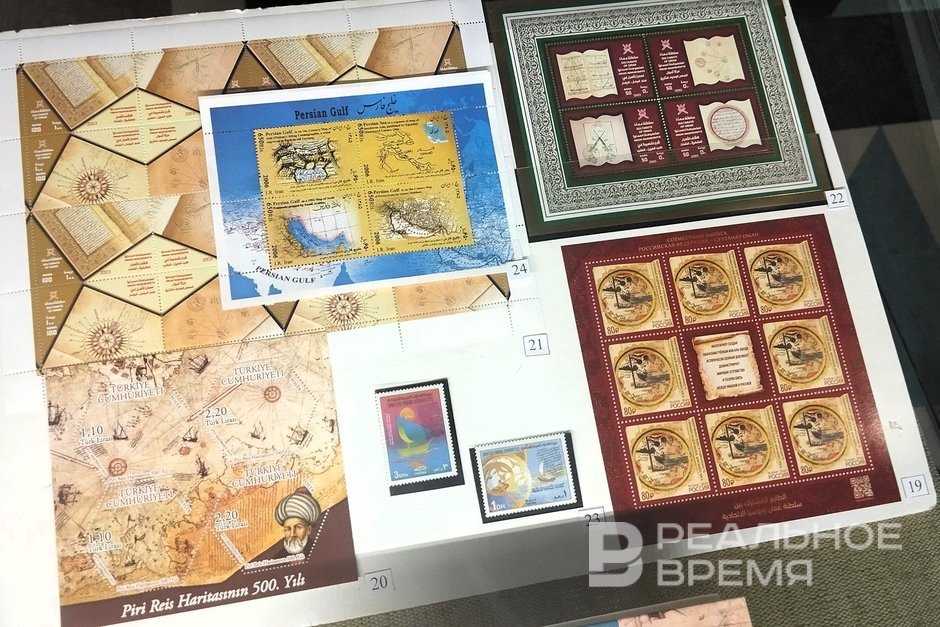
Among the themes covered are writing, diplomatic relations (between Russia and Oman, Indonesia and Bosnia, Turkey and Pakistan), book printing, the 1400th anniversary of the revelation of the Koran, the Hijra (the migration of the Prophet Muhammad), celebrities (including, for example, navigators), and the Hajj. A separate section covers Tatar scholars, stamps dedicated to other cities that have been named cultural capitals of the Islamic world (Mecca and Medina, Jerusalem and Aleppo, Bukhara, Doha and Shusha), as well as numismatics, post, and banking.
Considering that the first stamps appeared in the 1840s, and the oldest in Kadyrov's collection dates from 1867, it can be said that the entire history of philately over three centuries is represented here.
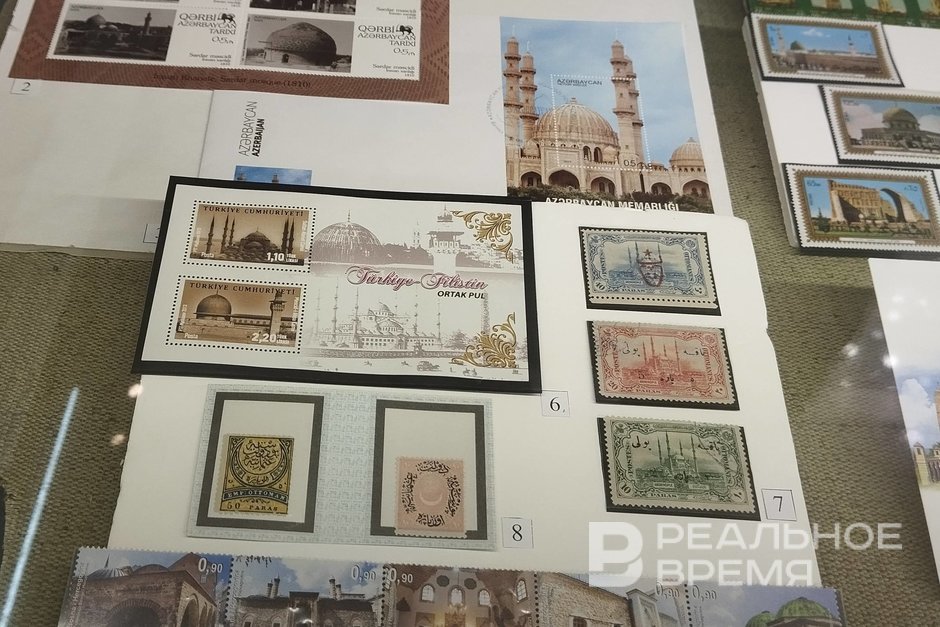
In 1867, two postage stamps depicting a crescent moon were issued in the Ottoman Empire. They are not easy to spot right away, nor are, for example, three stamps depicting the Sultanahmet Mosque in Istanbul (also issued by the empire).
From the Maldives to Uzbekistan
Let us list some other exhibits that demonstrate both the spread of Islam around the world and its long-standing culture of illustrating its pillars and history.
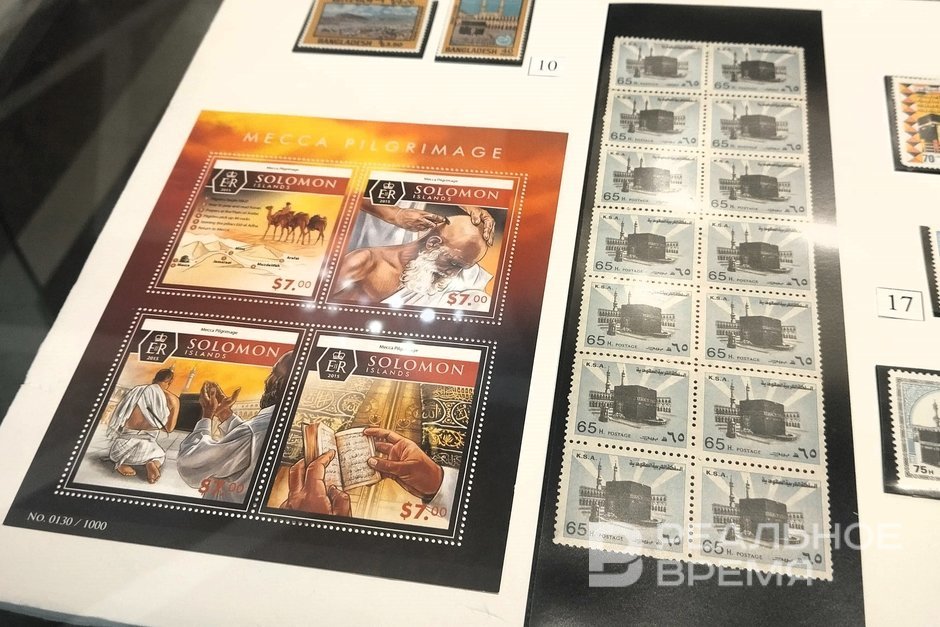
These include, for example, stamps with silver dirhams of the Umayyad dynasty. A block dedicated to the 848th anniversary of the adoption of Islam in the Maldives. The Gazi Husrev-bey Mosque in Sarajevo (Bosnia and Herzegovina post, 2021). The Khan's Mosque in Bakhchisarai. A Soviet stamp commemorating the 50th anniversary of the death of Kayum Nasyri. Two blocks showing Hajj rituals, from the Solomon Islands. Jubilee stamps dedicated to the 1400th anniversary from Brunei, the Maldives, Guyana, Mauritania and other countries. Stamps about the Hijra depicting only the first letter of the word. Letters of the Prophet Muhammad to the Byzantine Emperor Heraclius I and the ruler of Alexandria, Muqawqis (Iran). Numerous depictions of the Kaaba.
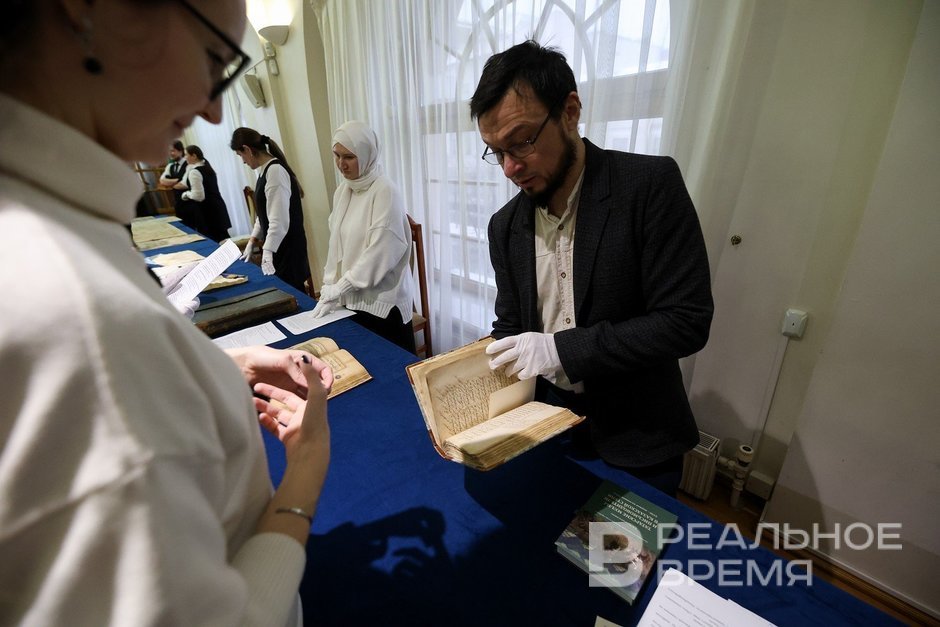
In total, about 200 items. In addition to stamps, there are envelopes and an 18th-century Ottoman letter-writing manual, a calendar with Muslim holidays for 1979, a Braille Koran printed in Kazan, and a facsimile of Ahmad ibn Fadlan's manuscript “Risala.”
The last exhibit is, of course, no coincidence, because the history of the adoption of Islam in the territory where modern Tatarstan is located also began with correspondence — between the Volga Bulgars and the Baghdad Caliphate, which sent an embassy (messengers!) here, whose secretary was Ibn Fadlan.
The exhibition will last until September 24. Albert Kadyrov has equipped some of the display cases with video explanations, so even a neophyte can learn a lot of interesting things about a world that connects the postal sphere with the art of oriental miniature, for a stamp is indeed a miniature.