Brazil is losing its harvest, the coffee business is under attack: what should the consumer expect?
New forecasts no longer leave doubts that the rise in coffee prices will continue in the near future
The coffee market in Russia is going through a period of instability. Back at the beginning of 2026, prices for natural coffee declined by 2%. Experts linked this with a favorable harvest in the producing countries and a decline in world quotations of arabica. However, by the end of the year the situation changed — now a rise in prices is forecast. How much coffee costs now and what influences the dynamics — in the material of “Real Time.”
How much coffee costs in Russia: prices in stores and on marketplaces
Prices for coffee in Russia differ noticeably depending on where one buys it — in an ordinary store or on a marketplace, and also on the format of the product and the brand. The cost is influenced by promotions, regional differences and logistics, and the spread of prices can be very wide — from cheap own brands to premium varieties.
In stores bean coffee on average costs from 1,200 to 2,300 rubles per kilogram. However, own brands cost several times less — from 200 to 300 rubles per 200—250 g pack. Ground coffee is sold at a price from 300 to 700 rubles per 250 g, instant — from 200 to 600 rubles per 100 g, and a pack of 10 capsules — from 300 to 600 rubles.

On marketplaces the price picture differs, but not greatly. At the same time it is worth noting that the assortment on these platforms is broader: different producers, types of roast and unusual varieties are presented that are often not to be found in stores.
The price of bean coffee on marketplaces is from 600 to 2,400 rubles per kilogram. Ground will cost 300—800 rubles per 200—250 g, instant — 250—600 rubles per 100 g, and a pack of capsules — 250—800 rubles.
Coffee got cheaper not for long: what changed on the market
The coffee market is one of the most unpredictable in the world economy. The cost here changes constantly: now it grows smoothly, now it declines, reacting to yields, logistics, climate and the political situation. A few months ago it seemed that the situation had leveled out and the fall would continue, however the dynamics turned in the opposite direction. We sort out how prices changed and what became the cause of the new round of growth.
The decline in cost began in January 2026 and continued for several months. Anton Trenin, an expert of the corporate ratings group of ACRA, noted that the market had stabilized after the noticeable growth of 2025. With a favorable harvest and the absence of weather risks prices could have continued to fall. However, these forecasts were not destined to come true.
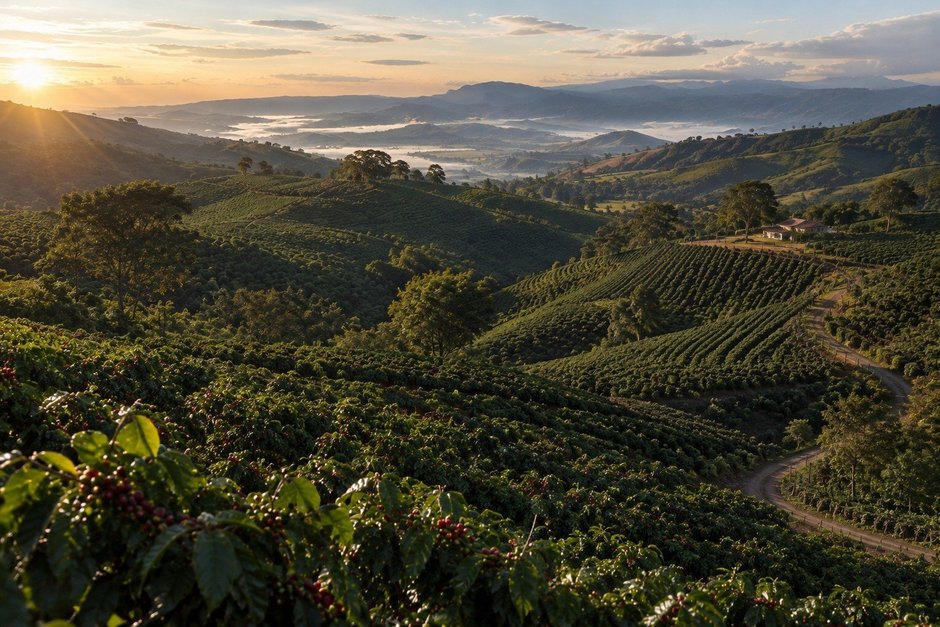
Already in August Bloomberg warned about the impending deficit of quality coffee. The arabica harvest in Brazil suffered from heavy downpours: the precipitation not only delayed the harvest but also worsened the quality of the beans. About 20% of the berries were washed off the trees by the tropical rains — 12—15% above the average indicator. After the harvest a second wave of downpours fell on the country, which forced some producers to begin drying anew. According to the meteorological service, the amount of precipitation reached 250—500% of the norm in some parts of the country in June and July, and in individual districts 8 times more precipitation fell than usual.
The CEO of the Brazilian agricultural cooperative of coffee producers, Siman de Lima, stated that the overwhelming majority of the harvest in the end has quality problems. Usually the beans meeting the ICE criteria constitute 30—35%, and this year the indicator may decline to 10—15%. Futures for arabica grew by approximately 35% since June, and the stocks in certified warehouses in the USA and Europe are approaching the lowest level in the 21st century.
Coffee Costa raises the alarm: the coffee market awaits a new rise in prices
New forecasts no longer leave doubts that the rise in coffee prices will continue in the near future. Climate and economic factors press on the market simultaneously, which make the situation ever more tense. Major players of the industry have also begun to speak about the seriousness of the situation.
In October 2026 the British chain of coffee houses Costa Coffee warned about a price increase. The head of the chain, Philippe Schaillee, noted that usually after a rise the cost of coffee declines, but in recent months this had not happened. A latte at Costa now costs £4.4 (494.5 rubles), whereas five years ago it cost £2.9 (325.9 rubles).

One of the causes of such a situation was problems with suppliers. Quite recently Brazil again faced climatic challenges and this time suffered from drought: the stocks of arabica beans dropped to the lowest level in the last 26 years. At Costa they warned that climate change could reduce the availability of beans, and political instability is capable of disrupting exports.
An additional blow was dealt by the earthquake in Colombia. It disrupted the work of the country's main port of Buenaventura and led to the closure of roads, because of which the export of Colombian coffee was suspended.
“We have immunity to shocks”: business on the rise in coffee prices
The rise in coffee prices is not only a problem for consumers, but also a challenge for business. Coffee houses and restaurants are forced to seek a balance between preserving quality, retaining clients and growing costs. To understand how the industry reacts to these changes, we talked with experts.
In a conversation with “Real Time” the Q-grader manager of the coffee house “Neft” Egor Barinov noted that coffee for Russia remains an imported product, and that means its cost always depends on external circumstances and is subject to fluctuations.
— Coffee has always been considered an imported product. It does not grow in Russia, therefore it is very dependent on external factors, and its price is always highly volatile: sometimes it falls, sometimes it becomes more expensive. This is almost always reflected in the market. The only thing is that business or the consumer may not notice this, because the changes, as a rule, are not sharp, but very smooth, he says.
In his opinion, the rise in prices is unlikely to lead to a reduction in the number of coffee consumers. The habit is so strong that giving up one's favorite drink is unlikely, even if it becomes more expensive.
— The habit of drinking coffee today is so strong in people that it is hard to easily break it. Moreover, business reacts quite quickly and offers interesting solutions that cover such moments. Home consumption also influences strongly — probably even more than prices. People have begun to drink coffee at home more often than in coffee houses and hotels, notes Barinov.
The restaurateur, owner of the family restaurant “Skazka," Mikhail Sharipov, also doubts a sharp fall in demand, but notes possible pressure on business:
— I think businessmen in our country are already used to the fact that something constantly changes and is indexed. Therefore, possibly, there will be another indexation. The players of the coffee business will have a hard time, because it is ever harder to raise prices for the end consumer. That means one must resort to operational efficiency — look for other methods somewhere, but without lowering quality, because quality is now already taken for granted. One needs to find ways to reduce costs. As for the demand of visitors of coffee houses or users of coffee machines, for now there seem to be no prerequisites for it to fall strongly. I, of course, do not follow statistics, but as far as I understand, the demand for coffee is growing.
Sharipov also noted that business in the country has learned to work under conditions of constant changes and this helps the industry adapt.
— We grow in such conditions and are used to constant changes and shocks. We already have immunity to all this. Therefore, I think everything will be fine. And those who live on the coffee business will also pass this path. The producers themselves, I think, also raise prices thoughtfully — they will not sharply raise them by 50%, he stated.
Thus, the coffee market in Russia is going through another cycle of decline and growth of prices. Business adapts to the changes, offering new formats of consumption, and consumers retain the habit of coffee, despite fluctuations in cost. The question is only how long the current rise in prices will last and what other factors will influence the market in the near future.