15 million years of laughter, organics on Mars, hope for defeating Parkinson's
Interesting science news of the week
Macromolecular carbon has been found in Martian rocks — complex organic matter that could have been produced by living beings. All great apes laugh the same way — the first “ha-ha-ha” was made by our common ancestor 15 million years ago. Moscow biochemists have synthesized a molecule that may restore motor function in people with Parkinson's disease. Liquid water is not a single state but a mixture of two aggregate states — denser and less dense. Excess weight and related metabolic disorders negatively affect the brain and make a person less intelligent.
Complex organic compounds found on Mars
Since 2021, the Perseverance rover has been roaming the Jezero Crater — the bottom of an ancient Martian lake. By the end of May 2026, it had traveled nearly 42 kilometers there. This rover and its colleague Curiosity were sent to Mars with a primary goal: to determine whether the Red Planet was once habitable and, if so, whether life existed there.
Two years ago, Perseverance found a rock with “leopard spots” and markings resembling poppy seeds. Scientists hypothesized that the spots formed from iron— and sulfur-containing minerals during redox reactions. On Earth, such reactions are often caused by the activity of anaerobic bacteria. This is why the mysterious rock has been the focus of scientists' attention for many months. The rover itself carries instruments that can conduct primary mineral analysis. For example, the SHERLOC laser spectrometer can determine the chemical composition of the rock's surface.
An international team of planetary scientists studied data from SHERLOC. On the spotted rock and on boulders 100 meters away, signs of macromolecular carbon were found — something resembling a natural polymer, a complex organic substance. Macromolecular (organic) carbon is usually destroyed by high ultraviolet radiation and cosmic radiation, but if it is isolated inside sedimentary rock, it has a chance to survive for billions of years.

Organics have been found on Mars before, but this time it is the first time that the same complex organic polymer has been recorded on several rocks of the same geological formation. This means it was widespread here billions of years ago and could have been a common substance in the prehistoric Martian lake. The question is, what is the origin of the find? For example, macromolecular carbon on Earth can form without the involvement of bacteria or other life forms. More detailed data will come from laboratory studies on Earth when the precious rock finally arrives from the Red Planet.
Primates have been laughing for 15 million years
Scientists from the University of Warwick (UK) have discovered that 15 million years ago, a creature lived on Earth that could laugh like we do: rhythmically, at different tempos, in short bursts. In other words, it made “ha-ha-ha” like any seasoned merrymaker — and, incidentally, like absolutely all modern great apes. This, by the way, is the only sound common to all higher primates, the last remnant of ancient vocalization inherited equally by humans, bonobos, orangutans, and chimpanzees.
Why do scientists need to know this? Primate laughter may also provide clues about the evolution of human speech — which is why it began to be studied. Our ancestors didn't use tape recorders, and we haven't invented a time machine yet. So scientists can only compare the sounds made by modern apes and, based on that, build hypotheses about how future humans learned to speak and use their voices millions of years ago.
The same was done with laughter. They analyzed how all five species of modern higher primates laugh: orangutans, gorillas, bonobos, chimpanzees, and humans. They recorded 140 sequences of various “ha-ha-ha” sounds from apes living in zoos. To make them laugh, they resorted to play and tickling (by people familiar to the apes).

The pattern identified is this: “ha-ha-ha” repeats evenly, at a certain time interval, in almost all apes. Only humans can laugh more controllably, variably, managing the rhythm and intensity of their own laughter depending on the situation.
The researchers concluded that ape laughter is a basic rhythmic structure preserved from our common ancestor. It lived, as earlier genetic studies show, no later than 15 million years ago — that was when our genetic lineages began to diverge, one of which led to the birth of Homo sapiens.
“Cellular cleaner” could restore movement in Parkinson's disease
Parkinson's disease is a formidable incurable disease in which nerve cells die and a person loses the ability to move. Doctors and biochemists around the world are trying, with varying degrees of success, to develop a way to stop the progression of the disease and reverse its effects. No major breakthroughs have been seen yet.
This week, interesting research became known from scientists at Moscow State University and MIPT, who assembled a molecule potentially capable of slowing the progression of the disease or even restoring motor function. This compound activates autophagy in neurons — a kind of “cleanup” during which the cell destroys accumulated toxic proteins and defective elements (such as “broken” mitochondria). One of the causes of Parkinson's disease is the disruption of this “general cleanup” process in the cell.
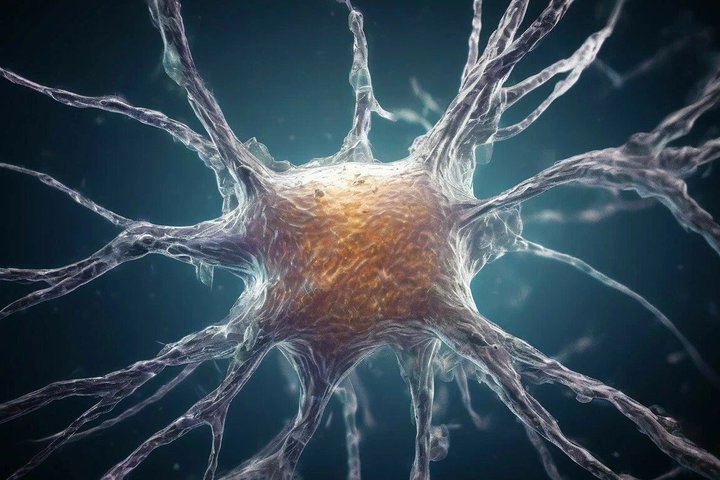
Moscow scientists decided to create the “cellular cleaner” based on a known natural compound — urolithin A. It is found in pomegranates and strawberries and is known as a substance that promotes autophagy. The biochemists decided to enhance this property, took a synthetic analog of urolithin — serratin — and synthesized 27 new molecules based on it.
All these compounds were tested for their effectiveness in triggering autophagy. The best performer was the molecule OPA471. It was tested on neuroblastoma cell lines — and it activated autophagy in cells more actively than the others, while being less toxic than its “colleagues.” Safety was tested on three living models: nematode worms, zebrafish embryos, and mice. Mice can tolerate the drug at a dose of 300 mg/kg of body weight — this classifies the molecule as a moderately hazardous substance, meaning it can continue to be studied.
But the main experiment was performed on zebrafish. They were first injected with a neurotoxin that causes the fish to swim worse and lose coordination. Then they began “treating” them with the new molecule — and all the Parkinson-like symptoms disappeared. After “treatment," the patient fish showed the same results as the fish in the control group.
This means the molecule has high potential for further research. Who knows — perhaps a drug will be developed based on it that will revolutionize medicine and restore the ability to live and move to millions of people with Parkinson's disease.
Physicists prove that water has two liquid states
Since childhood, we have been taught that water can exist in nature in three states: solid (ice), liquid (water), and gaseous (steam). But that would be too simple for a modern physicist. A hypothesis has long been discussed that liquid water is actually a mixture of water existing molecularly and energetically in two different states.
Physical chemists from City University of Hong Kong, in an attempt to prove this theory, used a neural network capable of finding hidden patterns in huge data sets. The Chinese physicists ran simulations of the dynamics of hundreds of thousands of water molecules and accumulated a monstrously huge amount of data. It took the algorithm a year and a half to analyze it, and it turned out that the structure of water “switches” between two states: denser and less dense.

The main thing the physicists discovered was the exact pathways by which this energy and molecular transition occurs. Normally, the transition occurs with a single energy barrier — when the structure changes upon reaching one certain level of particle energy. But, for example, at zero temperature, when ice melts, molecules “jump” between two liquid states in “circles," leaping over three energy barriers at once.
In the future, the Chinese physicists will refine their neural network and make it clearly link the transition between the two liquid states of water to temperature, density, and viscosity.
Why is this needed? Because all biological processes on Earth are unthinkable without liquid water. And precise knowledge of its deep microphysical properties will allow us to understand in detail, almost at the atomic level, how proteins, salts, and drugs interact in solutions. This is very important for understanding the functioning of living cells and for developing new drugs with high bioavailability.
Excess weight makes a person dumber and causes the brain to age faster
How is a person's physical health related to their intelligence? Scientists are partly exploring this issue when working with age-related changes in the nervous system. The older a person is, the thinner their cerebral cortex, the smaller the volume of white matter, and the worse their memory. It was also already known that obesity can cause thinning of the frontal lobes.
A study by Canadian physiologists published this past week showed how metabolic disorders not related to age affect the nervous system. The scientists took medical data from two groups of people: 597 aged 36 to 100, and 2,013 aged 51 to 83. The calculation model included data on their weight, blood pressure, and biochemical blood markers, plus brain tomography readings (tissue structure, neural connectivity density, and blood flow speed). The neural network was supposed to find hidden patterns between two arrays of numbers in these groups. And patterns were found along two axes.

The first was quite expected, related to classical aging, which describes all the usual changes in brain structure.
But the second came as a surprise — it reflected the influence of metabolism on the brain. Excess weight, high blood pressure, elevated blood sugar, and low levels of “good” cholesterol became an “organized criminal group” that significantly reduced the volume of blood reaching brain cells per unit of time. This affected people's behavior and cognitive abilities — as shown by the tests.
The conclusion is simple — even a young person can experience signs of cognitive decline if they are overweight and have high blood pressure. Because the brain is experiencing a lack of blood. So, to avoid dementia, the Canadian biochemists recommend protecting your metabolism from a young age.