Iranian caricature returns to the national library
Artists from the Islamic republic, together with colleagues, reflect on the phenomenon of reading
Following a new tradition this year, some exhibitions have begun working long before their official opening. For example, “Book Caricatures” by artists from eight countries can be viewed at the National Library of the Republic of Tatarstan. The official opening, with the participation of high-ranking guests and consuls, will take place on June 1. Realnoe Vremya reports on what the artists from Iran are satirizing.
Political, poetic, humorous satire
The exhibition primarily features works by Iranian participants of the 5th International Book Biennial, organized by the Iran Public Libraries Foundation. We have written about Iranian caricature before, when the library showed works by participants of the International Caricature Contest about Books in 2024, during the All-Russian Library Congress. The official opening had to be postponed — it coincided with the death of Iranian President Ebrahim Raisi.
In Iran, a country where the Shiite madhhab is widespread (while Sunnis predominate in Russia), there is no complete ban on depicting people, which has led to the development of book miniatures and portrait painting. Caricatures began to appear in Iran at the beginning of the 20th century, when the Constitutional (bourgeois-democratic) revolution took place in Persia, leading to the development of media, printing, and the arts in general. In 1906, the first issue of the satirical magazine “Molla Nasreddin” was published.
Another important voice of satire was the magazine Towfigh (“Success, Luck”), which began publication in Tehran in 1923 and finally closed in 1971, already under the name Fokāhi (“Humoristic”). To this day, caricatures in Iran have a mass effect and serve as a tool of propaganda.
In Kazan, however, the focus is not on acute problems, but specifically on reading and books. Besides Iranians, the exhibition features works by caricaturists from Colombia, Cuba, Serbia, India, China, Indonesia, and Russia (including our magazines “Chayan” and “Krokodil”). Thanks to the common theme, it is noticeable that different authors depict problems related to the perception of information through text in different ways. The exhibition opens with a series of caricatures dedicated to digital addiction.
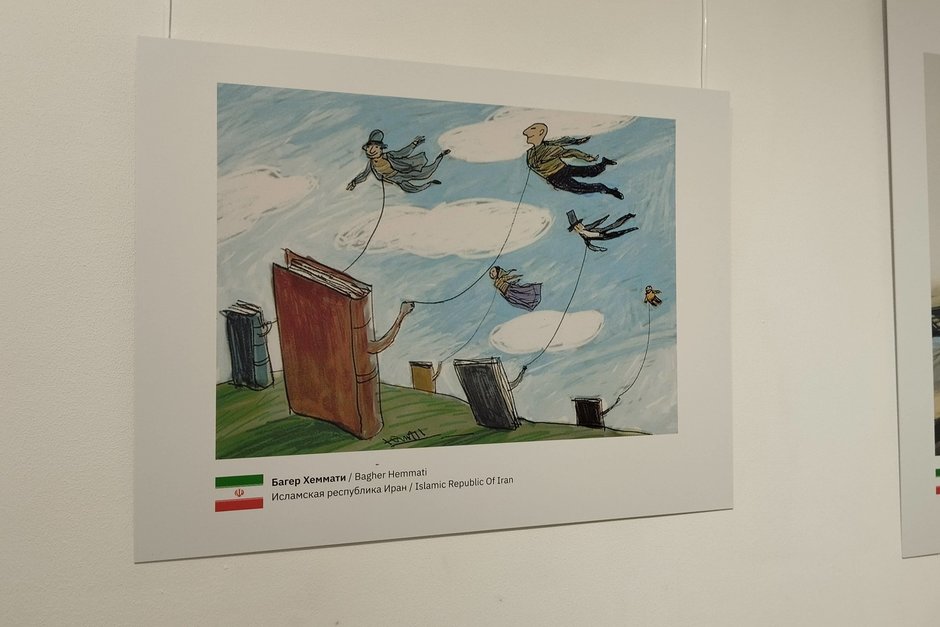
Artists invent new metaphors related to reading. Iranian Salat Eshratkha turns a bar into a book club, where instead of glasses, the bartender shakes tomes (Cuban Brady Izquierdo works similarly — a reader drinks from a book as if from a glass, and his head acquires new colors). His compatriot Bagher Hemmati shows how books launch people like paper kites (since reading uplifts). Indonesian Anon Anondito places a library in a ruined wall.
It's impossible not to note that, besides poetic images, there are also purely humorous ones. How can one not appreciate the work of Saeed Banazadeh (Iran) about beetles that gnawed pages so diligently they ended up with master's degrees?
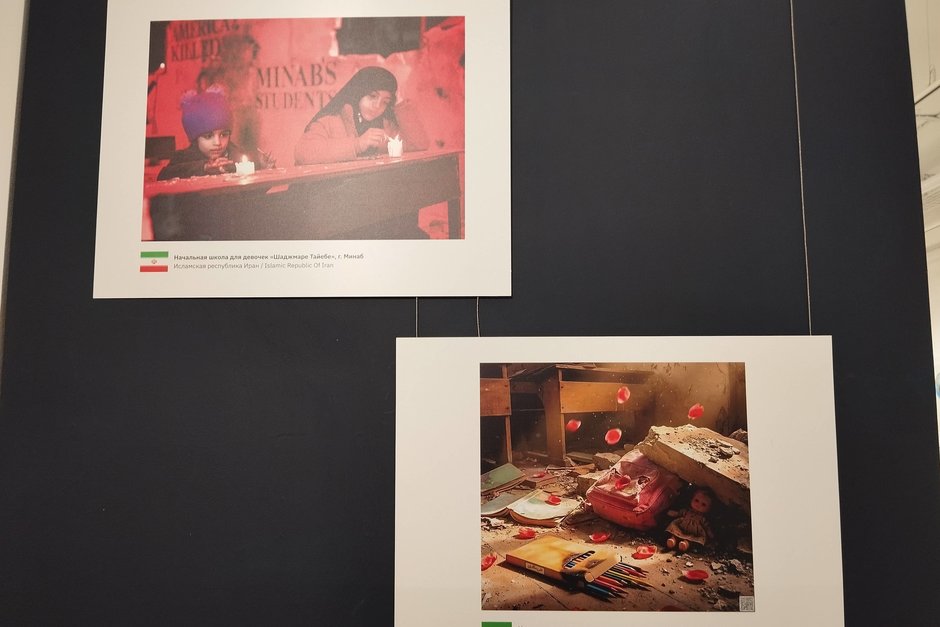
Photos from the Shajareh Tayyebeh School
At the same time, political motives are discernible in some caricatures. For instance, Iranian Alireza Pakdel depicts a man with a flag who meets a reader — and then carries him on his back instead of the banner, followed by dozens of others. And the flow of reflection is clearly not accidentally interrupted by two photographs — one shows the difficult learning conditions at the Shajareh Tayyebeh school in Minab — and another shows the same school after an Israeli attack (which resulted in over 150 deaths, 120 of them children).
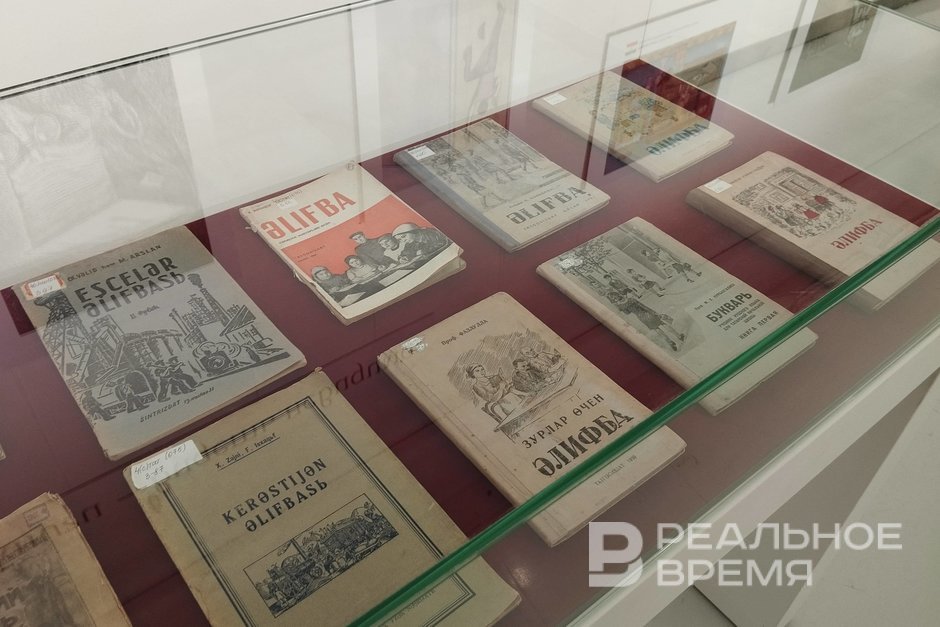
A separate section of the exhibition features display cases with textbooks from the 19th–20th centuries. First, one can see artifacts of missionary activity: Cyrillic alphabet books for baptized Tatars, Chuvash, Mari, Udmurts, Kazakhs, Altaians, and Koreans. Also on display is a unique “Alphabet and Grammar of the Tatar Language” from 1809 for students of the First Kazan Gymnasium.
Also here is Kayum Nasyri's manual “Instructions for Friends in Learning the Alphabet," which promotes the syllabic method of learning (later replaced by the phonetic method).
A whole series of alphabet books (in Arabic, Latin, and Cyrillic scripts) by Mukhitdin Kurbangaliev is featured. A graduate of the Kazan Teachers' School, the first secular educational institution for Tatars in Kazan, he worked as a rural teacher, later served at Kazan University, wrote for magazines, and compiled a curriculum for the first Tatar girls' gymnasium. After the revolution, he continued to work as a lecturer in the Tatar language at the Faculty of Soviet Law and headed the interdepartmental department of the Tatar language.
Furthermore, the exhibition shows how diasporas cared for their native language; for example, one can see an alphabet book published in Manchuria in 1936.
Finally, visitors can try fortune-telling using one of the real books dedicated to the mystery of reading. And, in “The Charm of the Paper Book," learn how the country estate library in Trigorskoye, where Pushkin hid from his father, saved him from thoughts of fleeing.
The exhibition runs until July 12; admission is free.