Nikolay Stryukov: “You have to work with pleasure — that is my deep conviction!”
What the man who developed the GLONASS system in the 1970s and now creates wooden “lace” for the soul has to say
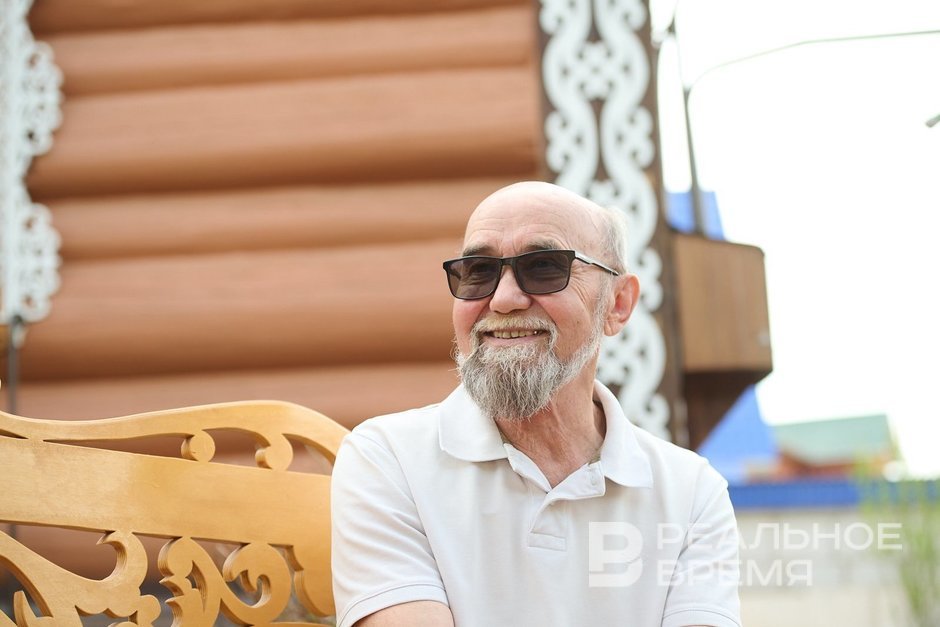
Nikolay Ivanovich Stryukov seems like an ordinary Kazan pensioner who has retired from business and lives on the outskirts of the city. But he has a hobby that makes every passerby stop near his house and gasp in admiration. Carved window trims and cornices amaze the entire neighborhood. Add to that garden furniture and interior items, a sled for his grandson, and the finest, almost lace-like details of facade decoration — and Nikolay Ivanovich makes all of this with his own hands, in his free time. He has led an interesting life — in his day, he was at the origins of the creation of the GLONASS system at a secret enterprise in the Krasnoyarsk Territory, then he was involved in business, and now he fills his free time with the art of artistic fretwork. Here is an interview with the master.
“My colleagues and I were at the origins of the development of the GLONASS system”
— How did you come to your amazing hobby?
— First, I need to pay tribute to the memory and respect of my father. He was a first-class wood specialist, a carpenter, a cabinetmaker. He made amazing things — including carriages, elegant winter sleighs (a type of sled). Not to mention furniture.
— Did he do this for his neighbors?
— Yes, I grew up in Almetyevsk, my parents lived in a private house, and my father did whatever the neighbors ordered for them. As a teenager, I made my own hockey sticks — we loved playing hockey, and sticks weren't sold in stores like they are now! So we made them ourselves. Then I entered the university, the Faculty of Mechanics and Mathematics. After graduating, in 1976, I was assigned to work in Krasnoyarsk.
— Across the entire country?
— Out of youthful maximalism, I wanted to go as far away from my native region as possible, to see the country. I actually wanted to go to Petropavlovsk-Kamchatsky, but there was no place for me there.
I worked for four years in the Krasnoyarsk Territory — the city is now called Zheleznogorsk, but back then it was Krasnoyarsk-26. In the seventies, it was a city behind six rows of barbed wire, an hour and a half drive from Krasnoyarsk through the taiga. It was one of the development sites for the Soviet space program. My colleagues and I were at the origins of the development of the GLONASS system! At that time, it was just beginning. At the preliminary design stage, I participated in choosing the trajectories of the satellite constellation. We determined how many satellites were needed so that any consumer could “see” three of them at any given moment. Otherwise, coordinates cannot be determined.
And I defended my diploma on underground hydrodynamics. I thought I would stay at the department, working with oil workers to increase oil recovery from reservoirs. After all, there were no oil fountains in Tatarstan even then. Can you imagine? I studied subsurface processes here, and there I worked on the space program…
— How did you get into the space program?
— Through the job assignment system; there was such a system for young specialists, university graduates.
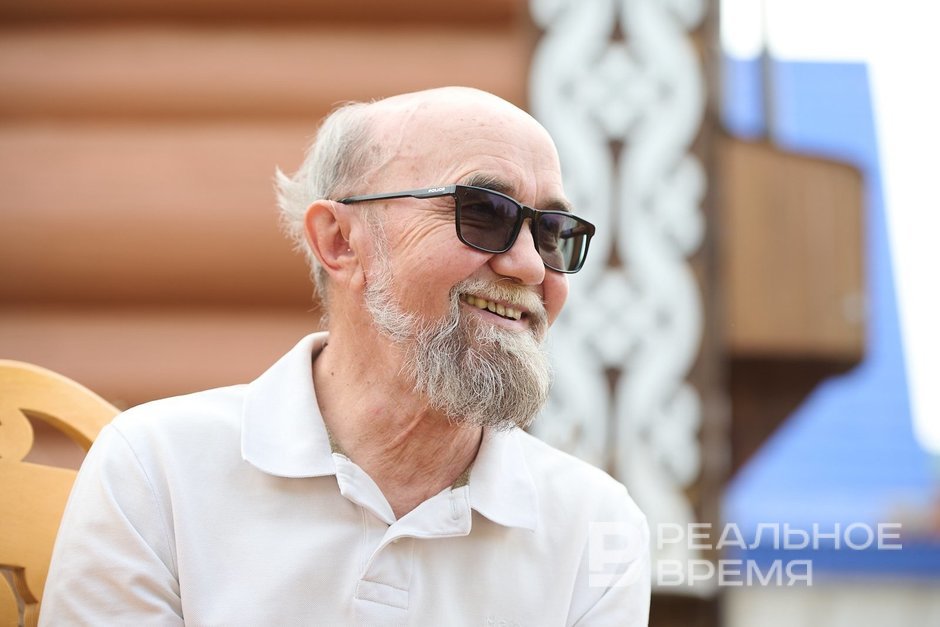
“Here, by my preliminary estimates, I have sawed about 5 kilometers”
— But in the end, you came back to Tatarstan?
— Yes, after four years — my elderly parents remained in Almetyevsk, and one of the children needed to live near them. We lived in our hometown for some time, then moved to Naberezhnye Chelny and lived there for 35 years. I worked at the State Statistics Computing Center — I left there as deputy director of the computing center for mathematical methods of information processing. Perestroika began, I went into business, founded a software development and implementation company.
I wanted to live in a private house all my life. So, when our children grew up and moved to Kazan, they persuaded us to move as well. I retired from business, sold it, and we moved — we purposefully chose a house, specifically a wooden one, specifically on the land. And then I faced the fact that I had a lot of time on my hands. And even my beloved hobby — fishing — did not take up all my free time. But when you live in a private house, if you don't hammer in one nail a day, the house will fall apart in a year.
— How did you eventually come to fretwork?
— It seemed to me that the decor of our house looked somehow unpresentable. And I invited a company that makes figured wooden elements for facades — trims and other things. They quoted a price comparable to a significant portion of the cost of the house. Then I thought about it and said: “But I have a jigsaw.” The builders replied: “Well, the internet is at your service.” And I started looking for information.
— What were you looking for?
— I was looking for patterns, first of all. I discovered that a lot of beautiful ancient Russian patterns are available online. There is an author named Afanasyev. He collected half-decayed trims and wooden house finishing elements, collected those patterns, restored them, and drew in the chips. Credit must be given to him; thanks to him, a great deal has been preserved.
I found patterns, chose what I needed, started working, and tried to realize my own ambitions in terms of how to compose everything. At first, I wanted to do it very finely and beautifully, then I realized that too fine a carving wouldn't look very good. I searched, adjusted, assembled patterns…
— How long did all this take you?
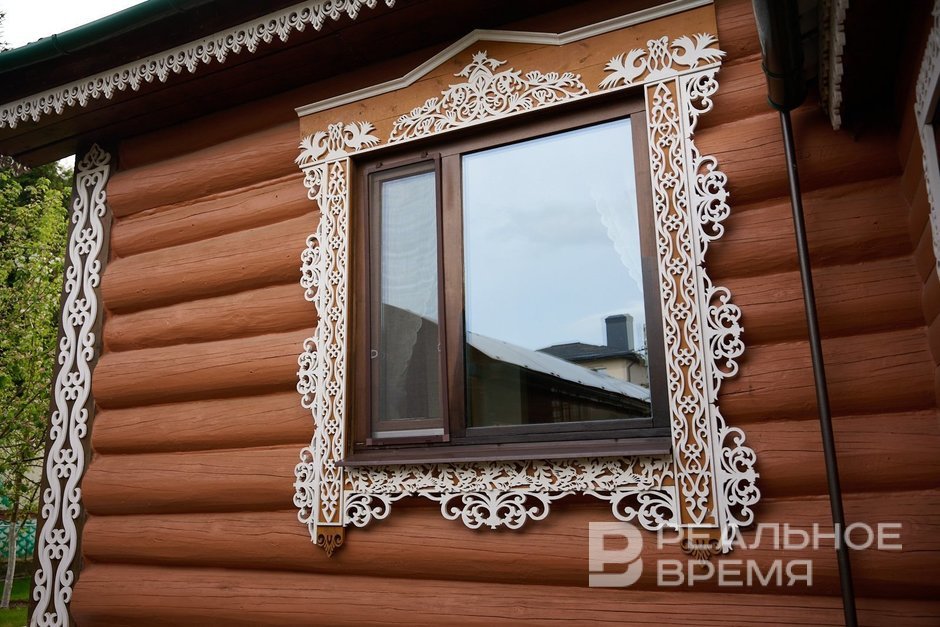
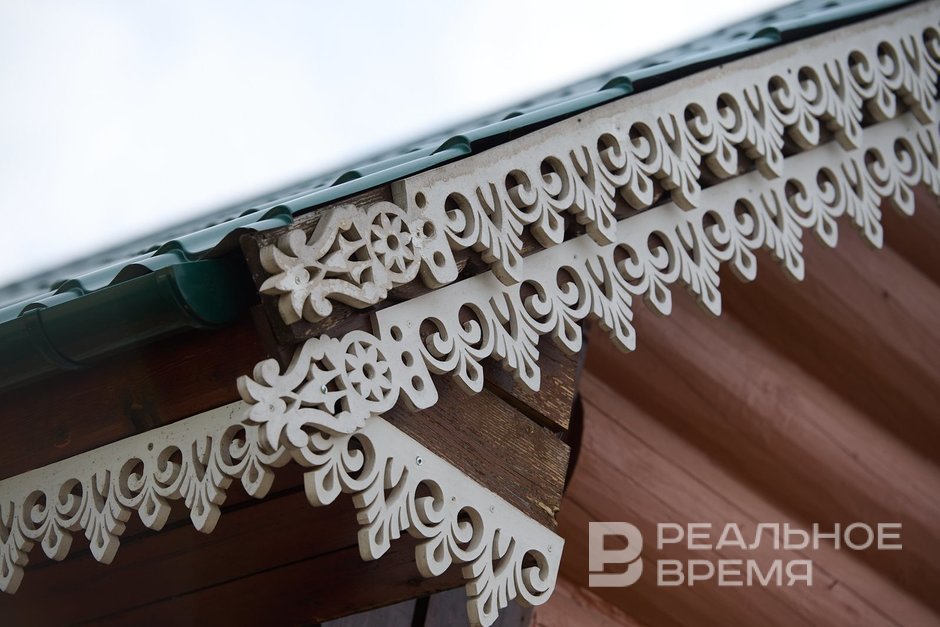
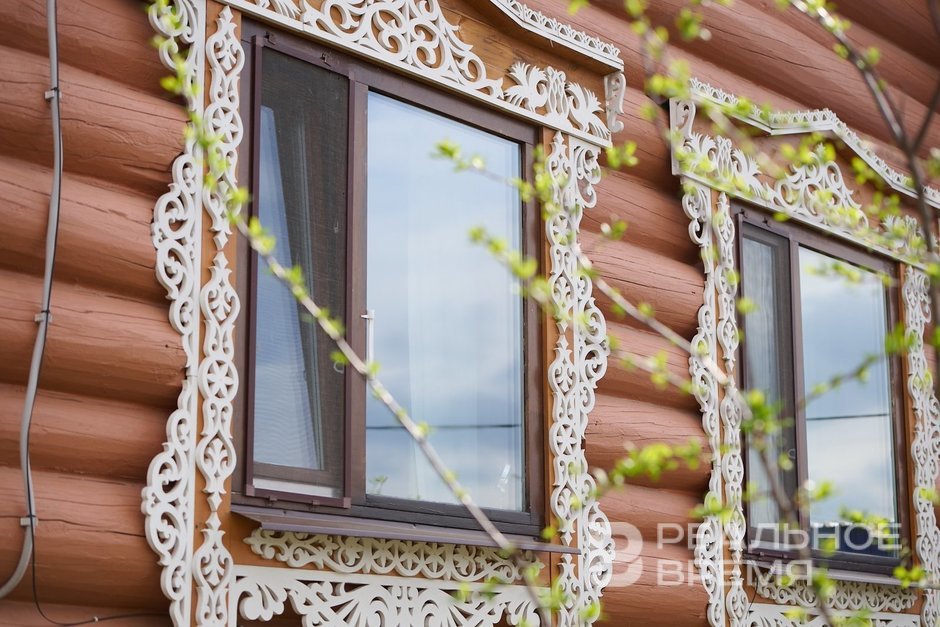
— I sawed for two years. During that time, I made all the trims and all the edging for the house. Of my 10 windows, only 5 are identical. The rest are original. It turned out not to be as fast as it might seem.
On one website, I saw statistics: on average, this kind of fretwork proceeds at a speed of 1 centimeter per minute. And here, by my approximate estimates, I sawed about 5 kilometers. Just the planks for the cornices are about 90 meters — you see, they go in two rows: some thicker, some thinner.
“This is a non-commercial project”
— And you didn't give it up afterward?
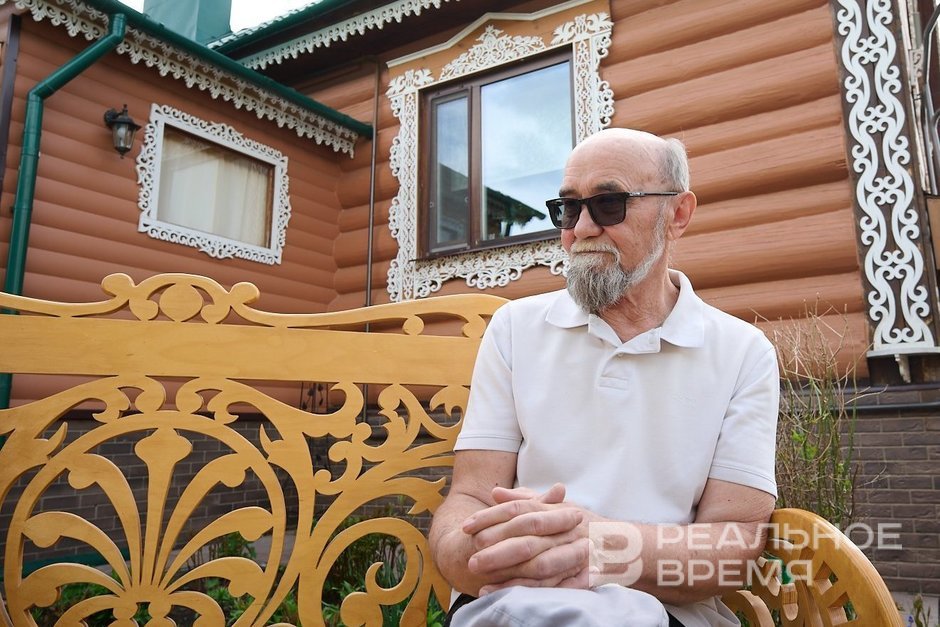
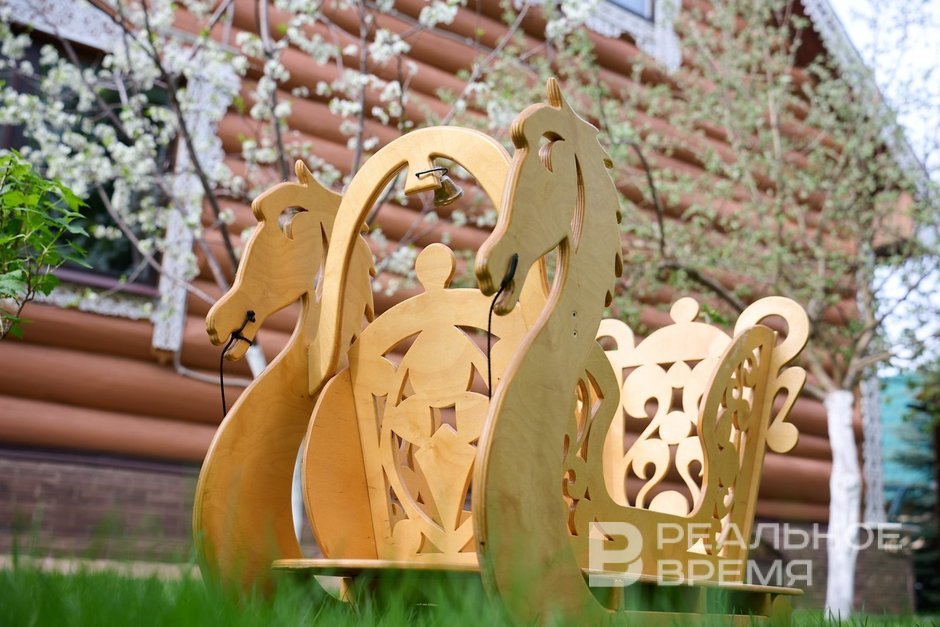
— Yes. I started with the trims, then I saw garden furniture online — carved benches, tables. I thought, “Let me try too.” I made a bench first; I didn't really like it. Then I made this one — it turned out well. I made a table with carved legs for it.
Then my grandson was born, and I sawed him a very beautiful sled. Then I started sawing stands for water coolers, other things… I proceed from the position of “I saw something, I liked it — I made it.” I don't like working to order; I do it for the soul, for myself. I don't remember ever making something for a complete stranger — if acquaintances ask, only then. This is a non-commercial project.
I remember when I finished everything on my facade, cars would stop near the house every day to take pictures. At New Year's, my grandson and I set up an installation near the house — we harnessed a glowing reindeer to the carved sled I had sawed for him. Few people passed by without stopping; someone was always taking pictures there.
— Do you also saw trims for the Tom Sawyer Fest for the soul?
— Yes, Anastasia (Gizatova — editor's note) asked, so I took it on. She found out about my hobby and recruited me several times. The Tom Sawyer Fest team gave me a ready-made pattern and material; all that was left was to saw.
— When you choose a pattern, what is your starting point?
— I consult with my family. With my daughter, for example. She says: “I want something Russian, traditional.” That's how, for example, the doves and tits on the trims appeared. I won't say that some design is born in my head immediately. I just see a picture and think, “This element, in my opinion, will combine well with that one.” Then I model the resulting composition on the computer, adjusting it to the window size. I print it out, glue it together, cut out the pattern from paper, lay this stencil on a wooden base, trace it. And I work on the traced outline with a jigsaw.
“Nothing rushes me except the desire to realize an idea”
— The Russian style and ethnic components are in fashion now. Do you notice this?
— Yes, recently there has been interest in this craft. It is discussed on websites where people communicate on this matter.
— Do you communicate a lot on specialized forums?
— I read several resources and gather information. I wouldn't say I'm particularly active there — I only go in when I need to find something. People there help each other: for example, before sawing this bench, I couldn't find a stencil for a long time. I contacted a craftsman who does this kind of work and asked him. He replied: “No problem. What format should I send it in?”
— What if you make a mistake while sawing?
— That happens too, it's not without it. The main thing is not to saw off too much. When you're making something integral — for example, a mirror frame — the cost of an error is very high. You have to start from scratch. With composite compositions made of individual planks, it's easier — you only need to re-saw the fragment that didn't work out. Like, for example, in the window casing of the cornice.
— Did it take you a long time to equip your workshop?
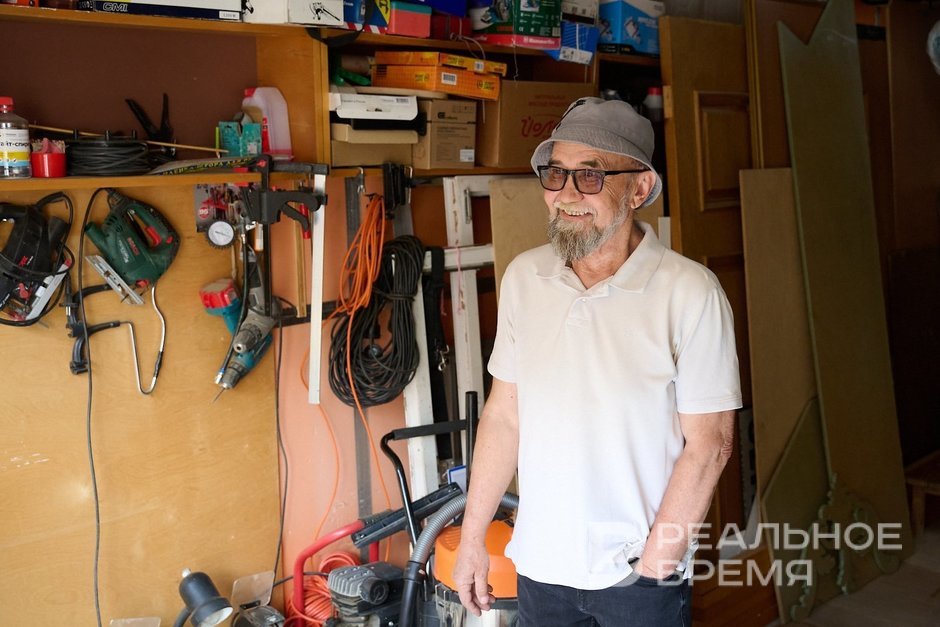
— There are many jigsaws in it; I bought them gradually. Different materials require different tools. One for thin material, another for thick material. You select the blades; all of this comes with the work, with the process. Then I bought sanding equipment. After all, you also need to sand the surface so that no roughness or splinters remain. Everything needs to be removed and smoothed.
I don't have complex machine equipment — I could afford to buy it, but I consider it impractical to purchase one, make one thing on it, and then leave it idle. And I don't work on an industrial scale. Milling machines and circular saws are for production lines. But power tools — I have practically everything that is sold in hardware stores. Everything related to manual fretwork, I have. Nothing rushes me except the desire to realize an idea, so I don't need industrial equipment.
— What happens after sawing and sanding?
— The main, longest job is to finish the part. After sanding, you need to treat the surface with varnish or impregnation. For example, for this bench I used yacht varnish — it is durable and protects the surface from moisture. And on my trims, I have paint. I tried different ones, and I once found so-called rubber paint. It has a warranty period of 8 years, but look: these trims are already 9 years old, and nothing has happened to them yet. Neither the sun nor the moisture has damaged them yet. But I don't think anything in the world lasts forever, and sooner or later everything will need to be renewed.
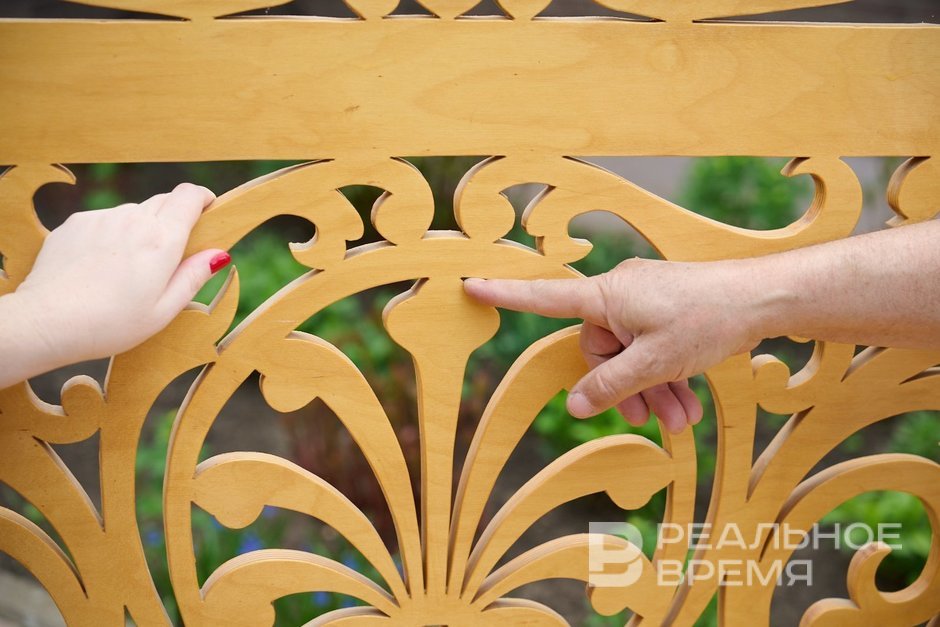
“An idea can be born at any moment — even tomorrow”
— You have no “empty” elements on your facade; everything is decorated. Was that the original plan?
— No. But I made a trim, and then I thought, “Why does my window above the porch look so shabby?” I made carving for it. Then I sawed the cornices under the roof. Then I decorated the corners of the house. And that's how it turned out.
— Do you have any plans for the near future?
— Not yet. But an idea can be born at any moment — even tomorrow. I saw an advertisement once — a serving table. I thought, “I can make a better one.” And I made it. Tomorrow I'll see something else — I'll get excited and make it. You see, it's all about the idea. If it appears, matures, and you soberly assess your strength — then the passion to do it arises.
When everything falls into place, it becomes clear what to make it from. I mainly use wood-composite boards. They are very durable, easy to work with, and easy to saw.
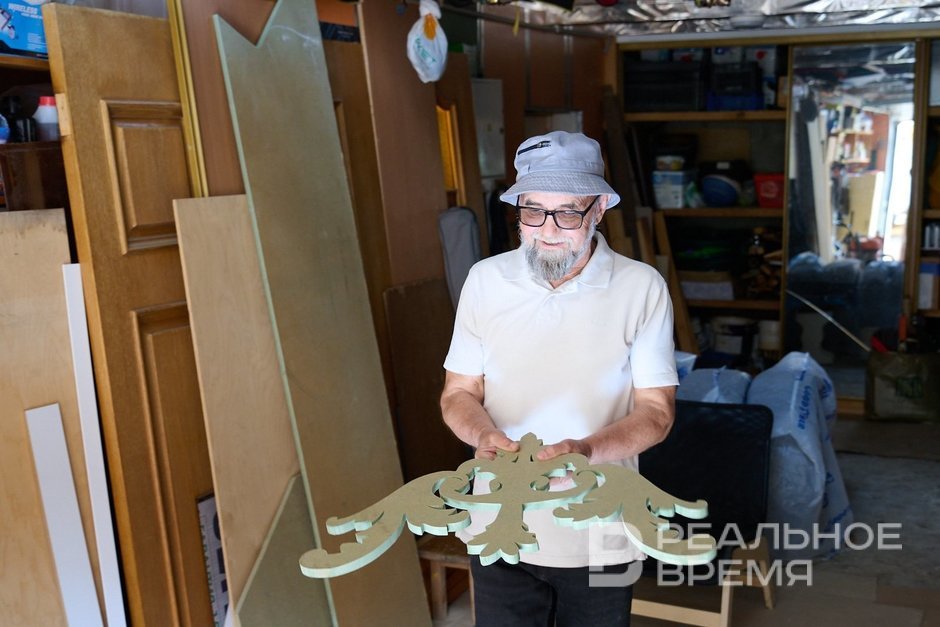
I also work with plywood — but not just any plywood will do. When you start working, the top layer can peel off. So, through practice, I determined which factories produce suitable plywood for my projects, and now I buy material with specified characteristics.
— Does your education help in this matter?
— Only ordinary school arithmetic is needed here; that is quite enough to work with wood. No differential equations or theory of functions of a complex variable are needed here (laughs — editor's note).
— Do you consider fretwork your main occupation now?
— No! It's more of a winter hobby. And my main hobby is fishing. People don't go fishing for the fish — you can buy fish in a store. They go for the process, for the adrenaline. When there's no bite, there's no adrenaline. But you have to catch this bug once and for life. I caught it.
I also do gardening. And I have a billiard room. And I love “quiet hunting” — picking mushrooms. In general, I have plenty to do (laughs — editor's note)!
There is nothing unique about my hobby. You just need desire and perseverance. You can't do it quickly or by force. Either it will be abandoned halfway, or you'll end up with a crude piece of work. You have to work with pleasure — that is my deep conviction. So I try not to overexert myself — I only work when my soul sings!