Evgeny Yaroshchuk: “We are expecting a classic, fiery final with Volgograd”
The final of the Eurasian Water Polo League championship begins
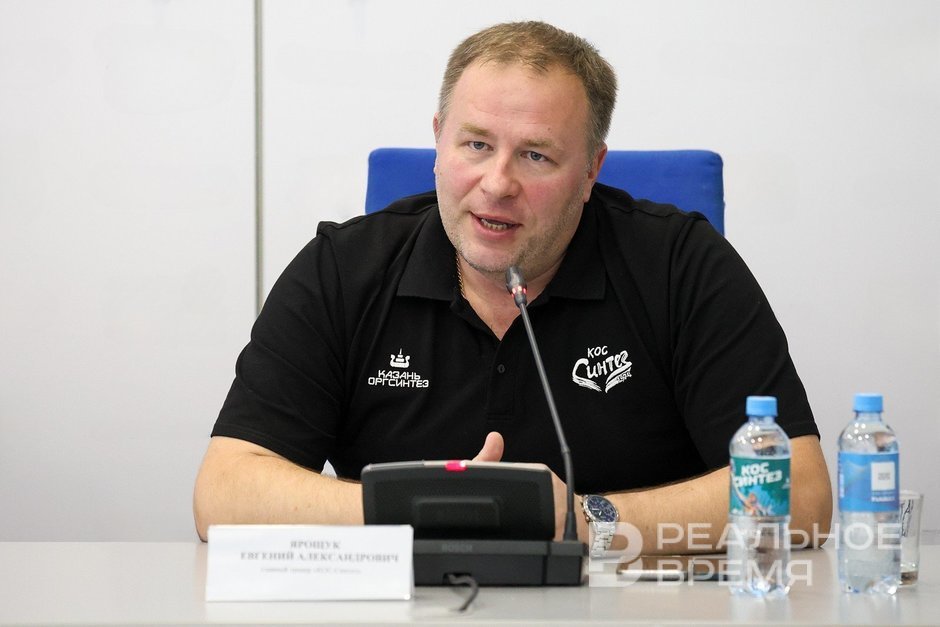
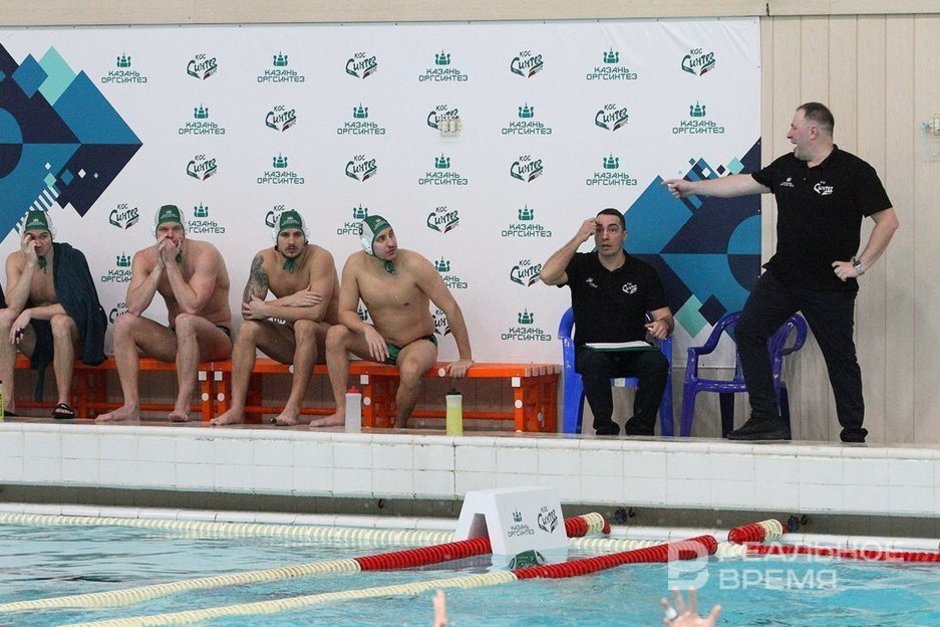
On May 22 and 23, the final series of the Eurasian Water Polo League championship will begin at the Orgsintez pool in Kazan. The traditional rival, Volgograd's Spartak, will visit the hosts of the KOS-Sintez pool. Before the start of the final, Realnoe Vremya interviewed the head coach of the Kazan team, Evgeny Yaroshchuk.
“Because the Russian national team participated in the World Cup, the playoff schedule had to be shifted”
— Evgeny, how are your players preparing for the final showdown?
— We will play the first two matches in Kazan, after which two more games are scheduled in Volgograd, on May 29 and 30. The series itself is to three wins, so if it drags on, the date for the fifth game is set for June 6 in Kazan. After that, the Russian Cup will begin with eight teams according to the final table of the regular championship. Since the eighth team was the Belarusian national team, the leadership of the water polo federation decided to invite the Russian youth national team to the tournament. This practice has been used before, and now it is being resumed.
— It needs to be clarified that the players of this national team will be participating in the Youth European Championship in Oeiras, Portugal this summer.
— Yes, exactly. Since the second team “Vostok” from Moscow will be among the participants of the Russian Cup, these players will not be involved in the youth national team, which is composed of players from KOS-Sintez-UOR, as well as Astrakhan, Moscow region and St. Petersburg, under the guidance of Serbian specialist Dejan Milakovic, Zivko Gocic, and the coaching tandem of Evgeny Kalashnikov from Astrakhan and Volgograd native Pavel Khalturin, who currently works with Moscow's second team. We play from June 11 to 14 in Astrakhan.
We initially had a slightly different calendar, and the championship should already be finishing now. But because the Russian national team participated in the World Cup, the playoff schedule had to be shifted.
— How do you plan to get to Volgograd?
— Currently, direct flights between Kazan and Volgograd have resumed for the summer period, and we are ready to depart much earlier. As a “fallback” in case of unforeseen circumstances, we see traveling by train from Nizhnevartovsk to Volgograd. In turn, our rivals from Spartak are also discussing their travel routes, because if force majeure occurs, game postponements are not provided for, and there has already been a case in the women's championship where Muscovites could not come to Zlatoust and received a technical defeat.
Previously, we played it safe before the semifinal with St. Petersburg, arriving not on the eve of the games, as had been the case, but almost two days earlier. By the way, we considered the path to the semifinal from first place in the regular season during the national championship, as we assumed that a large number of KOS-Sintez players would be involved in the World Cup. That is what happened; even more of our players were at the training camps, then up to seven players from the team were involved in the World Cup matches, which naturally affected game fatigue. In the end, we shook off that game fatigue, defeating the Belarusian national team in the quarterfinal, and in the semifinal we faced Baltika, which accomplished an important task for itself by beating Moscow's Vostok-1. The most difficult game of the series was the first match, which we won only in a penalty shootout.
“If only you knew how long and carefully we practiced penalty shots before Volgograd”
— Which seems somewhat surprising, given the difficulties with penalty conversion for the current team's players and the historical problems with this issue. I immediately recall the disappointing loss to Baltika in the Russian Cup five years ago.
— Yes, I remember that too, although the team lineups were completely different, but that thorn remained. This season, we also had an exceptional case where we started a home match against Volgograd's Spartak with a penalty shootout, which we lost, thereby ending an unfinished confrontation from a month earlier. And then we took penalties again because the Kazan game also ended in a draw in regulation time.
If only you knew how long and carefully we practiced penalty shots before facing Volgograd back then... In the end, it didn't help. But now we went into it without working on this element at all, except that we replaced goalkeeper Evgeny Kostrov with Igor Chirkov, who saved two shots, while his teammates were accurate in all their attempts. As a result, the first penalty shootout win, as was the case last year against Astrakhan, and then it was easier for us to win the remaining two matches, thanks to which we got an extra day of rest compared to our final opponent, Volgograd.
— By the way, one of Baltika's players, Arseny Sizenok, arrived for this showdown, so to speak, straight off the boat, having played the first part of the season in the Serbian championship.
— Yes, for the second team “Sava” of the local superclub “Sabac.” Sizenok, by the way, will now prepare as part of the youth team for the European Championship. There's another guy who should be coming from the Serbian championship — Georgy Panfilov. In general, there is huge interest in our youth from European championships; some are leaving. It should be noted that these are very small amounts of money; rather, they leave for playing time. Obstacles can also include resolving study issues and completing military service.
Our final opponent, Spartak, had a more difficult path in approaching the decisive matches, as they had to play four games against Astrakhan, a team that has been steadily progressing over recent seasons. Volgograd itself has a very strong goalkeeping line; their number one, Pyotr Fedotov, can achieve a save percentage of up to 70%, which I saw during the World Cup matches while being on the coaching staff of the national team under the guidance of Dejan Stanojevic.
— In other words, consistently saving three out of four shots.
— Yes, and that is currently a very serious indicator for achieving success. Now we are expecting a classic, yet interesting, fiery final.
“We entered this tournament ranked 32nd in the world, and now we have risen to 14th”
— Returning from the “fiery” final in our memories to the “cold shower” following the World Cup, with losses in the last two matches to France and Romania.
— I disagree about the “cold shower”; in fact, we realized that men's water polo in Europe has moved far ahead. There have also been serious changes in the world, but European water polo has truly made a leap in the last four years, while we were not competing. In this regard, it was easier for our women; such a serious transformation did not occur there, and after beating our main rivals in the tournament, the Chinese national team, our women confidently solved the task of qualifying for the first group of the World Cup. And even there, they will face opponents who are going through a generational change and a tactical restructuring, so our female water polo players can confidently compete for the highest places.
— I understand that you have a far more professional view from the poolside, while I am a layman on the couch; nevertheless, I did not expect such a level of resistance, for example, from France, who beat us in the quarterfinal. With all due respect to their scorer Romain Marion-Vernoux, I remember how the French clung to the previous generation of leaders who were supposed to shine at the home Olympics. Ultimately, Bodegas, ex-Sintez player Marzouki, Bjorch, Krusillat, Saudadier took fourth place at the World Championship, and at the Olympics they couldn't even reach the quarterfinal. And now the complete rejuvenation of the national team has led to the fact that guys born in 2007 were sitting on the bench, the same age as those playing on our youth national team.
— I want to draw your attention to the fact that after his scoring exploits in the match against us, Marion-Vernoux scored six goals against the Montenegrin national team, which, in fact, won this tournament. The French may have youth, but it is youth seasoned with experience playing for junior and youth national teams, in European cups, of which there are currently four in water polo, and up to half of the top league of the French championship participate in them. We did not have that international experience; we were restoring it from memory among the veterans, and gaining it for the debutants in friendly matches against Serbia and the Netherlands during training camps, and then through the games at the World Cup.
Currently, men's water polo, to which we have returned, if we draw an analogy, is like the NBA versus Russian basketball, whose decisive games we are now watching. In terms of game thinking and decision-making, we were two or three seconds behind our opponents, and that often affected the final part of the matches. Nevertheless, we entered this tournament ranked 32nd in the world, and now we have risen to 14th. That is the number of teams participating in the European and World Championships, and in order to rise from there into the top eight, which is the quarterfinal level, we have to work hard, rolling up our sleeves.
The expansion of geography is pleasing; there were no Iran or Japan representing the Asian continent, but there were teams from Hong Kong and Singapore.
“The expansion of water polo's geography is pleasing”
— Singapore, understandably, is on the momentum of assembling a national team for the home World Championship and has already managed to beat their peers from Kazakhstan in youth competitions. Also, we must not forget, if we are talking about Europe's top 8, then Asia's top 8 is also very honorable for them. And there are Japan, China, Iran, Kazakhstan, and whoever will now progress against the general backdrop.
— Yes, yes, that is why these countries are inviting specialists from the former Yugoslavia to work with their national teams, counting on further progress.
In turn, we note that we water polo players were finally able to feel a surge of interest in our sport from the media and fans as the first national team to return to the international level. Upon returning from the World Cup, we were solemnly greeted by representatives of the federation and Moscow clubs. Airport employees were surprised, saying, “We haven't seen such formal welcomes for a long time; did you win something?” “No," I replied, “we took seventh place, but we moved up significantly in the rankings.” And then I thought that our football players, for the same result at a home World Cup, were rewarded with the title of Honored Master of Sports...
— Yes, but by not qualifying for the 2027 World Championship, since qualification was based on the European Championship in Serbia held this past winter, we risk fading back into obscurity until the start of the next European Championship. And that is the beginning of 2028, a year and a half of waiting.
— We have good personal relationships with our Serbian colleagues, fortunately, there are many specialists from there on the coaching staffs of the national and youth teams. Excellent relations with the Montenegrins, who are successively led by former Kazan players, previously Vladimir Gojkovic, now Dejan Savic. Things are going well with our Hungarian colleagues. So, relying on interaction with at least these three leading water polo schools, we can conduct a competent training process, combining it with friendly matches.
Now it is important not to lose this interest in our sport. Organizationally, we need to understand that we have one attitude from World Aquatics, within whose competence both the past World Cup and the upcoming World Championship lie. There, we are on an equal footing with everyone, with flag, anthem, and so on. But in LEN, the European confederation, the attitude is ambiguous, and a state of turbulence continues.
— Your colleagues in diving are being blocked by Polish authorities from participating in the 2027 European Championship.
— Exactly. And LEN is our main field of activity, including through European cups, of which, as I said, there are currently four. It is clear that we are currently in a state of deliberation regarding many factors. This includes the tournament formula, where it is more convenient for us to play in a tournament format, roughly like the one that will be used at the upcoming Russian Cup, where eight teams will gather and play three matches in three days. Playing international matches with travel, as is customary in the Champions League or the Europe Cup (formerly LEN Trophy), may be unacceptable for several reasons. Both logistics, difficulties with the visa process concerning unfriendly states, and budgets. After all, the majority of our teams are state autonomous institutions, whose budgets are set from January to December, and the costs for European cups, which start in autumn, are currently simply not budgeted for. There are many questions...