“The love for three oranges”: a children's fairy tale or a family morality lesson?
The Kachalov theater turns once again to Gozzi and Svetlov
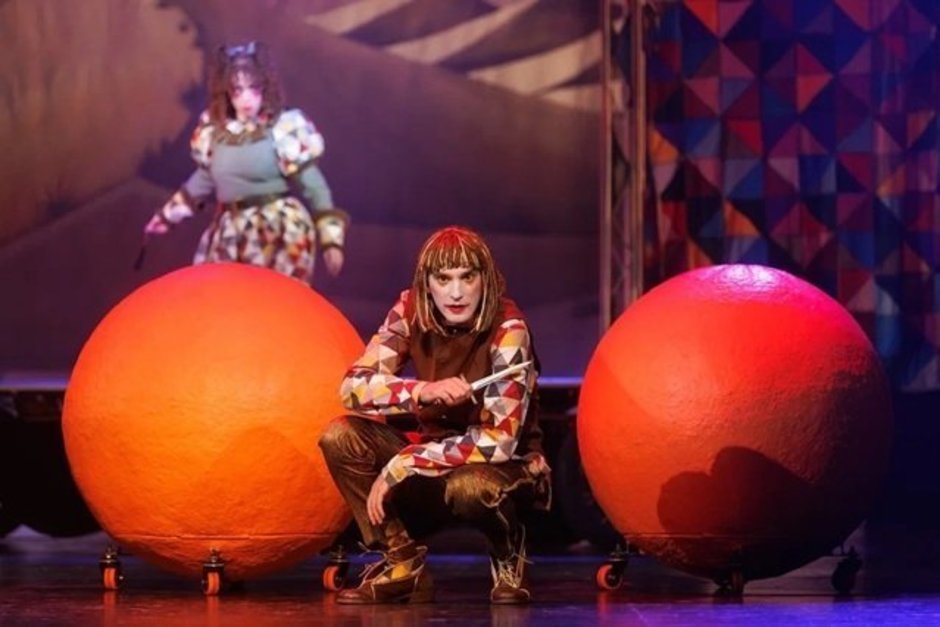
After 30 years, the Kachalov Theater has returned to the theatrical fantasy based on Carlo Gozzi's “The Love for Three Oranges” (6+), written by Mikhail Svetlov. Has Alexander Slavutsky once again managed to create a children's fairy tale that is interesting for a family audience? Viewers will have to endure the first act to find out.
How a poet became a playwright
Gozzi's play is a fiaba, a tragicomedy, which, according to legend, the author created at the end of 1760 after a bet with Carlo Goldoni.
Several major works based on it were created during the Soviet era. Sergei Mikhalkov wrote the play “Laughter and Tears.” Sergei Prokofiev, while living in the United States, composed an opera. In 1997, Leonid Filatov created a comedy with several sharp passages aimed at his compatriots.
Mikhail Svetlov, the poet who wrote “Grenada” and after whom a real ship (and the fictional one from “The Diamond Arm”) was named, turned to drama in the second half of the 1930s. In 1962, he wrote the play “The Love for Three Oranges”: “We repeat again and again: We are the best squad... Freedom, Loyalty, and Love — These are the three oranges!”
Svetlov's play takes place in a Soviet school and in the fairy-tale kingdom of Clubs. It begins with a prologue in a physics classroom, where a new teacher arrives and gives the students a book by Gozzi. The students object, saying it's not interesting to anyone. But the teacher convinces them to act out a fairy tale — and a fantasy on Gozzi's theme begins, in which the physics teacher becomes the magician Celio. The original text allows for this because it essentially contains no dialogue, only a detailed description of the plot, as commedia dell'arte presupposes improvisation.
Oranges 30 years later
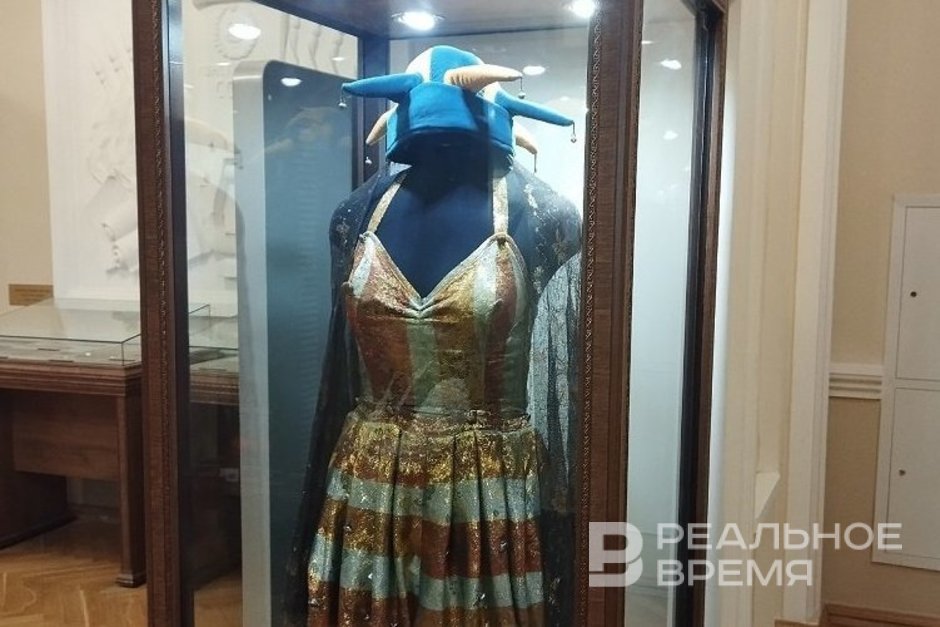
The Kachalov Theater staged Svetlov's play in 1996 — costumes by Alexander Patrakov are preserved in its museum on the first floor. It was also the debut of Ilya Slavutsky, who joined the theater that same year; he played Tartaglia (Truffaldino was played by Marat Golubev). The elder Slavutsky spent almost a year preparing the new production.
— I dedicated this performance to my grandson. Today's audience proves that such performances are needed for our children, for our grandchildren, for our sons. Because, of course, it's not easy to find love, freedom, and loyalty all in one place in life, but we must try to seek them, think about them, and dream of them, — he said at the premiere.
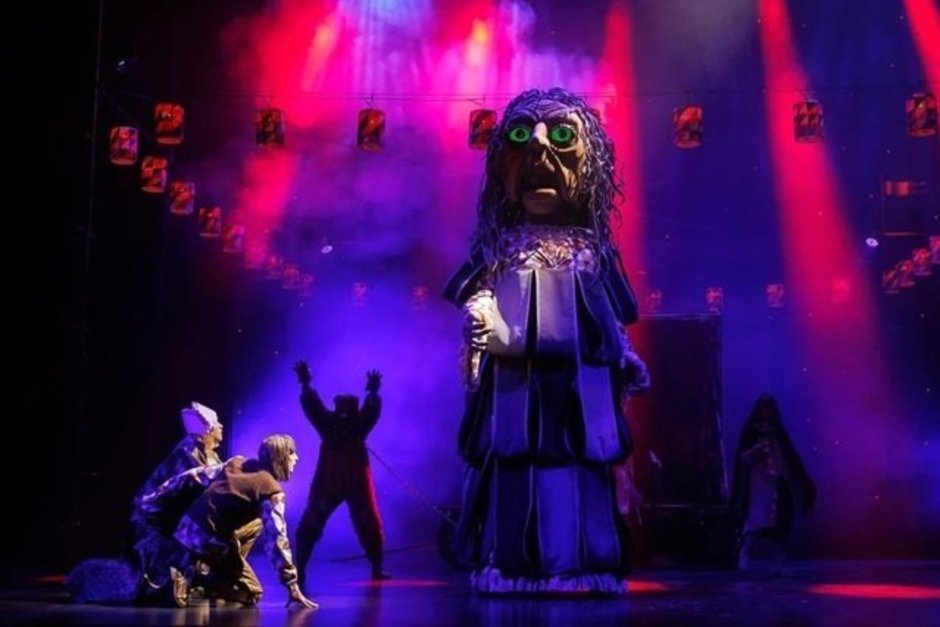
“Oranges” is the first performance since Patrakov's death in November 2024 that does not bear his name. Alexander Slavutsky is responsible here for both the direction and the scenography — lanterns around the perimeter, a small mobile stage, a giant doll of the Giantess, and, of course, oranges (not as huge as in the Bolshoi Theater's version, but large enough for actresses to fit inside).
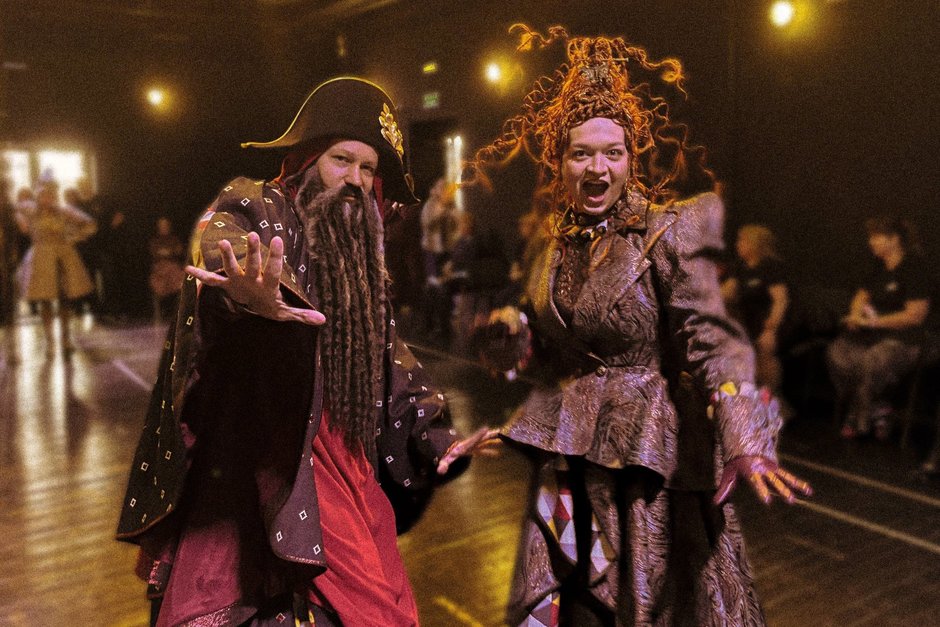
The Golden Mask laureate is also listed as co-costume designer alongside St. Petersburg artist Elena Chetvertkova. On one hand, the costumes are rich in carnival atmosphere; on the other, gray tones predominate, so Princess Clarice (Anna Makarova) stands out in red among the many characters.
Also noteworthy is the work of lighting designer Denis Solntsev: as part of the premiere preparations, he also conducted a week-long theoretical training course for colleagues called “Internships for Creative and Technical Staff from Foreign Cultural Institutions in Leading Cultural Institutions of the Russian Federation," with participants from Abkhazia, Belarus, Kazakhstan, Kyrgyzstan, Tajikistan, and Uzbekistan.
The performance features melodies by Goran Bregović arranged by Anastasia Kostyukova. The sound is live, but no ensemble is seen on stage. The show begins with a mass entrance and a song. The episode with the schoolchildren and all of Svetlov's framing device is absent; Slavutsky creates a performance à la street theater — but with strictly calibrated mise-en-scènes and lines learned by heart. Thus, an adult tension is felt within this children's fairy tale.
There are attempts to play at being a children's show. In the prologue, the magician Celio (Ivan Krushin) and the evil fairy Morgana (Regina Gabbazova) appear, explaining what is about to happen. Then the first act begins, focusing on the King's son (Ilya Skryabin), named Tartaglia (Vladimir Pirozhenko), who is ill, melancholic, and won't get out of bed. His relative Clarice, along with her loyal first minister Leandro (Georgy Loginov), lays claim to the throne. To cheer up the prince, Truffaldino (Alexey Kruchinin) arrives at the palace, famous for his ability to make anyone laugh.
When children don't laugh
“So what's funny here?” remarks a boy next to me and demonstratively begins to get bored. “Yes, the costumes are beautiful, the actors play well, but the plot is for children," an older spectator shares with his companion during the intermission. “The Love for Three Oranges” has an unclear target audience. If it's for children, why do the actors play with extreme seriousness, and even the funny moments are performed as if they have no desire to make anyone laugh? Rather, it's a demonstration of certain examples of ancient humor.
Most actors do not wear masks; their faces express serenity. They are all in wigs and heavily made up, so some can be identified more by their characteristic diction (e.g., Kruchinin).
There is more emotion in the musical numbers. “We heal, not maim," sing the courtiers along with the plague doctors holding syringes and wearing beak masks. The audience laughs for the first time here — the prince squeals when he gets an injection. The next time is when Truffaldino's donkey spits water and farts. Then, when the guard Brighella (Viktor Shestakov) painstakingly memorizes a message for the king.
The prince and the jester resemble each other in face and behavior; it's a big question which of them is even slightly funny. “Oranges” drowns in a rigid structure, contradicting the original atmosphere of improvisation. It seems that this is where one could play truly theatrically, going over the top, and it would be beneficial.
After more than an hour, following the intermission, Tartaglia and Truffaldino set off in search of the proverbial oranges (Lyudmila Sidorova, Diana Elizarova, Anastasia Yugova) — and this part, more like a fairy tale, is more interesting and lively. Here, the giant puppet of the giantess Creonta (Anatoly Gorelov and Irina Vandysheva) roams. Here, Anastasia Koroleva vividly portrays the witch Smeraldina. The devil Farfarello (Radmir Ziyatdinov) jumps on bungees. A dog barks (Anton Kachalov). Here, the actors address the children, and the children respond. Here, the oranges are “cut," and Truffaldino cries out: “Oh, what have I done! I have killed Freedom, I have killed Loyalty!” In short, in the second part, the actors transform into living people, and if not clowning, then an atmosphere of fun reigns, which is sorely lacking in the drawn-out first part.