We view Syuyumbike's fate not as personal drama but as tragedy of great dynasties' collapse.
A Kazan team has prepared a sound drama about the queen at the Nogai theater
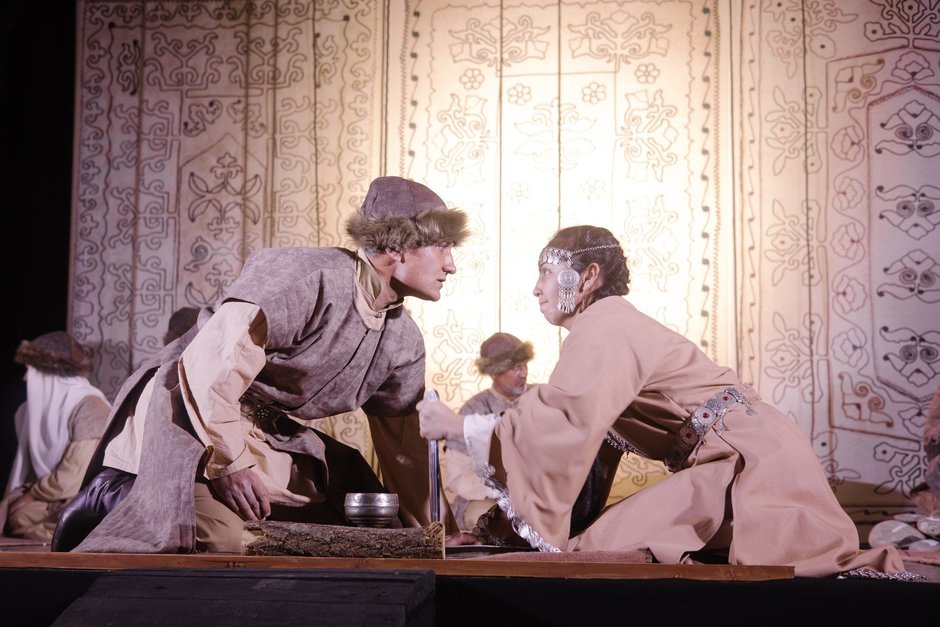
The State Nogai Drama Theater hosted premiere screenings of the play “Syuyumbike. Daughter of the Steppes” (12+). The director is Kazan-based Bulat Minkin, who, together with Marina Shishkareva, a teacher at the Kazan Theater School, also wrote the text. The production designer is Guzel Garipova, and the composer is Ilnar Fayzutdinov. How did the Kazan team work in the village of Terekli-Mekteb?
“To make Syuyumbike's story cease to be just a legend”
The Nogai Theater was established in 2001 in the Nogai District of Dagestan, with its troupe comprising graduates of the acting department of the Faculty of Culture at Dagestan State University. In 2014, incidentally, the theater came to Tatarstan with the play “You Are My Mother” by Batulla Turay. In 2024, Gulphiya Kokoeva, an Honored Artist of the Republic of Dagestan, became the theater's director.
As Bulat Minkin related, last May they were contacted by Ramiya Shabanova, the head of the literary department at the Nogai Theater, who offered several topics related to Nogai history and culture for selection. Among them was the story of Syuyumbike — the daughter of the Nogai ruler Yusuf and the regent of the Kazan Khanate. The play tells the story of the “Nogai princess” within the context of 16th-century history.
— This play is the result of a synthesis of deep respect for Nogai history and bold theatrical technologies, — notes Kokoeva. — We have created a tapestry where every sound, every seam on the costume, and every line works towards one goal: to make Syuyumbike's story cease to be just a legend and become a living, pulsating experience for every viewer, reminding them of great roots and an indomitable strength of spirit.
— It was not easy, as I wanted to explore this topic in a new way and from an unconventional angle, — says Minkin. — Thus, akyns appeared in the play, transforming into various characters throughout the performance. Then I complicated the task further: I realized it all had to be in verse. For that, I brought in my colleague Marina Shishkareva. In total, creating this play took 2–3 months. The result is an original, free-form biographical play in verse. A special place is also given to the image of the steppe — it plays a key, meaning-forming role in the play.
Dombra, swords, stones
In this production, the actors not only act but also create the musical score. For this, Minkin invited composer Ilnar Fayzutdinov, who had worked with him in a similar format on the play “Bugulma / Bends / Convolutions / Life," first shown at the Almetyevsk “Karash” laboratory.
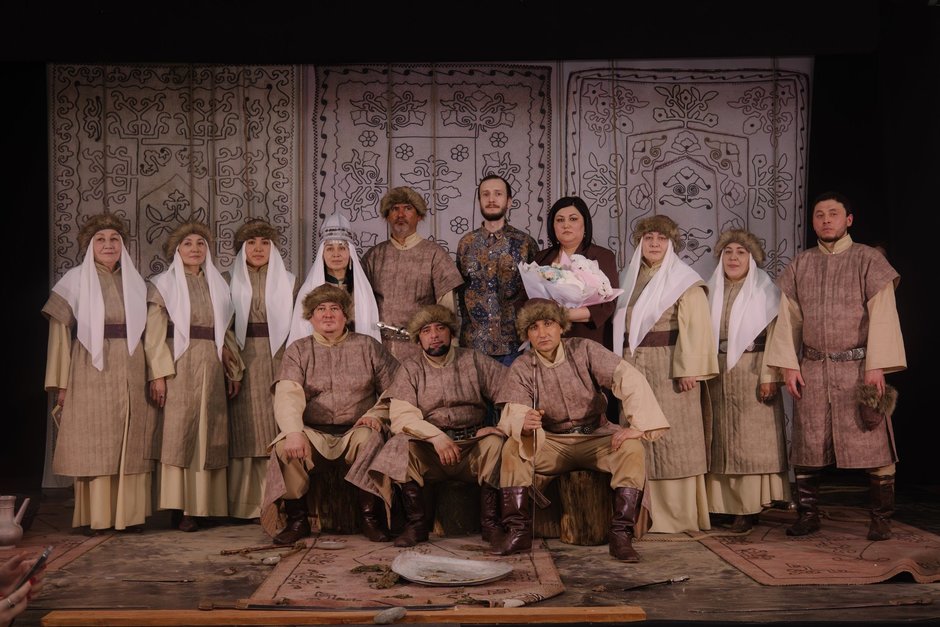
— In our play, there is not a single recorded melody — the actors create everything themselves using swords, whips, a cauldron, sticks, stumps, stones, jewelry, and metal chains. Plus, there are three musical instruments: the dombra, the kyl-kubyz, and the def. This format, it seems to me, provides a deeper immersion into antiquity, — said Minkin, who spent over a month in Terekli-Mekteb. It should be added that rehearsals lasted 10–12 hours a day.
Production designer Guzel Garipova worked remotely. She notes that the most complex and voluminous part of the scenography was the preliminary preparation:
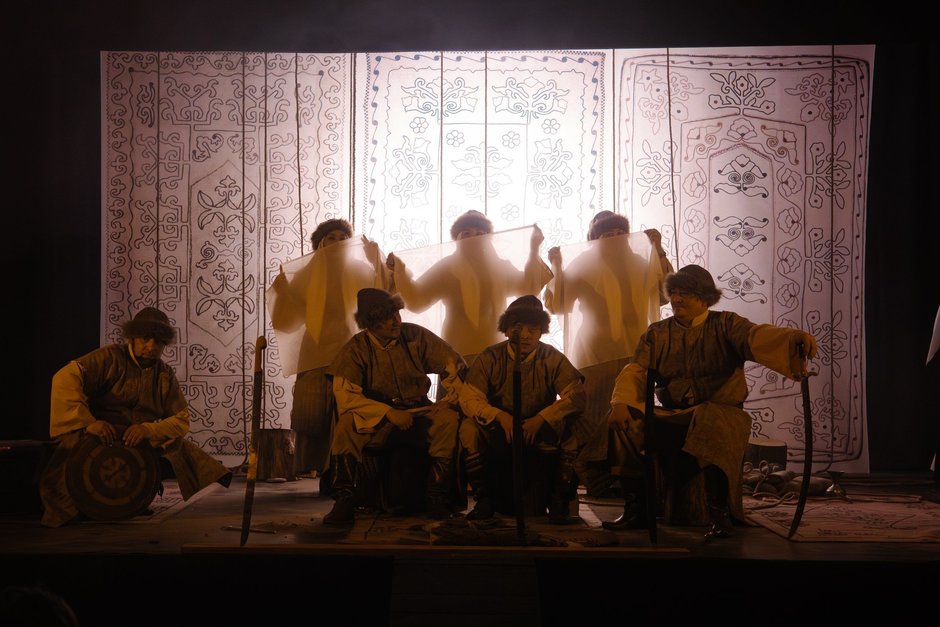
— I knew little about the Nogais, so I had to study quite a lot of literature about their decorative and applied arts (here Dina Gatina-Shafikova helped me with advice), costumes, and the people in general, and to review a lot of visual material they create about themselves: videos, documentaries, photos. Initially, the play was called “Daughter of the Steppes," so the steppe as a phenomenon, its colors, and the Nogais' way of life in the steppe were the main references in my work. The stage itself turned out to have a complex configuration, so Bulat and I decided to create several planes and depth by using several curtains, backlighting, and silhouettes. This led to the semi-transparent panels based on traditional Nogai felt carpets — kiizs.
Regarding the costumes, all the characters' looks, except for Syuyumbike's, were designed so that transformation occurred through the attributes and props used in specific scenes:
— Here it was important to develop a unified silhouette for such characters so that they could work together as a backdrop, as a chorus, as individual heroes, or become participants in a “shadow theater," — says Garipova. — Therefore, the traditional Nogai quilted captal (braid) was taken as a base, while bright colors, shiny fabrics, gold galloons, and formalization were avoided, but more references to authentic jewelry and decoration were added.
The steppe code
— For Nogai culture, this play has a special, sacred significance, — says Kokoeva. — Recently, the image of Syuyumbike has been perceived primarily through the lens of Kazan history, but we decided to focus on her roots.
Key aspects of the novelty:
- The return of the daughter of the steppes. Syuyumbike is the daughter of the great Nogai biy Yusuf. In this play, for the first time, we so boldly declare her “steppe code.” This is the heroine's return to her native cultural space.
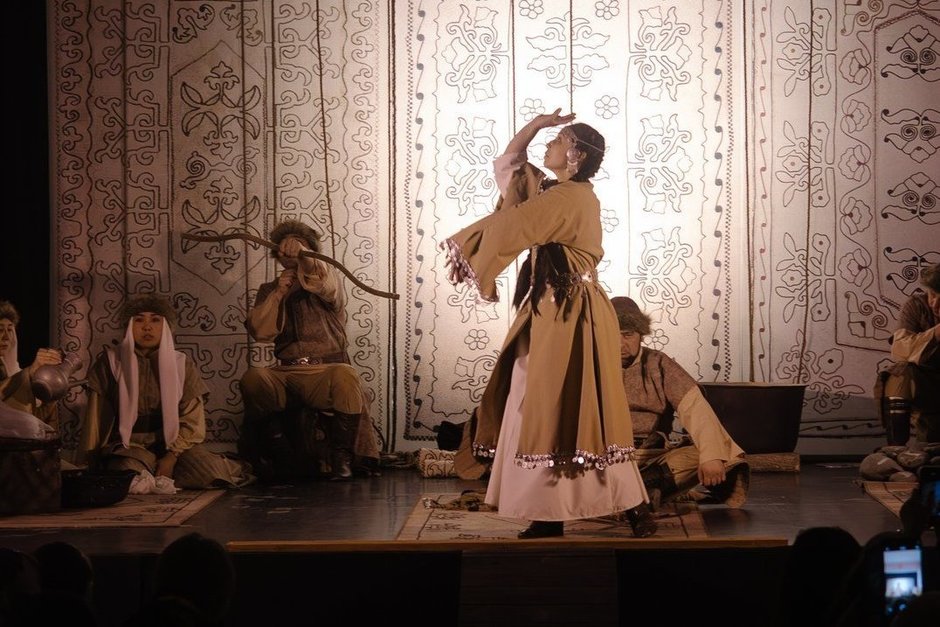
- Nogai identity through sound. The sound drama uses traditional Nogai motifs: the sounds of the steppe wind, the clatter of horses' hooves, the resonance of ancient instruments. For the Nogai people, this is an opportunity to hear their history, sounding not from a textbook, but through the living energy of sound.
- The tragedy of lineage and people. The novelty lies in the fact that we view Syuyumbike's fate not just as a personal drama, but as the tragedy of the collapse of great dynasties. It is a profound reflection on what the Nogai spirit is, loyalty to roots, and self-sacrifice for one's people. For the Nogai viewer, this is a play of reflection, a play of memory.