The art of seeing Berger: artist, writer, art critic, screenwriter, philosopher or documentary maker?
For the centenary of John Berger, “Real Time” tells who he really was

Today, November 5, marks one hundred years since the birth of John Berger. Who was he? It is hard to answer this question in one sentence. An art critic? Yes, his work “Ways of Seeing” became one of the most important books about visual culture of the 20th century. A writer? Of course, Berger wrote dozens of works, and for one of them he even received the Booker Prize. An artist? Also true. He had an art education and was engaged in painting. A screenwriter? And this too, yes, Berger wrote screenplays and worked on films. A documentary maker? Unquestionably. His books about a country doctor and labor migrants united literary text with social research. But none of the definitions can be sufficient in describing John Berger. The literary reviewer of “Real Time” Ekaterina Petrova tells how Berger consistently went beyond the framework of customary genres.
How Berger changed the conversation about art
John Berger was born on November 5, 1926 in London. At 16 he left St Edward's School in Oxford in order to study at the Central School of Art. But the studies were interrupted by the war. In 1944 Berger was called up into the army and sent to a training camp in Belfast, where he served as a lance corporal in infantry regiments. It was then too that his first encounter with the working class occurred, which formed Berger's political views. After military service he continued his art education at the Chelsea School of Art, was engaged in painting, participated in exhibitions and gradually entered the artistic environment of London.
An education in the sphere of art formed in Berger a special way of perceiving reality. He was used to working with composition, space, body, light, movements and details. If the artist organizes the space of the image, and the writer — the space of the narrative, then Berger used both methods.
In the 1950s the young artist began to write articles about contemporary art. His critical publications came out in the British press, including in New Statesman. Fairly quickly a reputation was fixed for Berger as an author with a sharply expressed political position. He cut his way through the inert world of post-war Britain and demanded political engagement in everything. If the majority of critics were interested in the formal perfection of a painting, then Berger sought the connection of art with public life. He wanted to explain how works of art arise and what they say about modernity. Art criticism became for Berger a way of talking with a mass audience.

In 1969 the series Civilisation by Kenneth Clark, dedicated to the history of Western art, came out on British television. It was a large-scale television project in which art was considered through the development of European civilization. And then the head of the BBC art department, Stephen Hearst, proposed that John Berger make a kind of response in the form of another television project. Thus in 1972 the documentary mini-series “Ways of Seeing” appeared, which consisted of four episodes of 30 minutes each. And Berger turned from a respected critic of the British press into a television star.
“Ways of Seeing” had a deceptively modest goal — to use the tradition of oil painting, which Clark revered, but to learn with its help something about oneself and about the time in which Berger's contemporaries lived. This was an experiment in every sense, including in television documentary making. In essence Berger invented all those principles by which today's modern vloggers work.
In a traditional documentary film the off-screen voice of an “omniscient” expert comments on what is happening on the screen while the spectator examines works of art. The spectator here is a passive recipient of information. Berger, however, looked straight into the camera, as if talking personally with each one sitting on the other side of the screen. He turned the spectator into an interlocutor and proposed that they reflect together.
Clark in Civilisation showed paintings as a sequence of masterpieces illustrating the progress of Western art. Berger turned the visual series into an argument. He showed works one by one and placed next to them something from modernity: old painting neighbored with advertising and television clips. It immediately became clear that the same techniques were used in both. Imagine that you are shown a portrait of an 18th-century aristocrat, and a second later you see an advertisement for expensive watches. Through such a juxtaposition it is well visible that both images demonstrate status, wealth and power.
Berger literally dissected works of art. In the first scene of the series he took out a knife and cut up a painting by Botticelli. Of course, it was a staged scene in the studio, but it looked shocking. The gesture with the knife is a metaphor that says that an image can and must be taken apart in order to understand how it is made and what it hides.

In his series Clark conveyed the idea that the meaning of a painting was always fixed regardless of how and where it is shown. Berger, however, considered that context influences everything and can radically change the perception of a work. If for Clark a reproduction was a way of conveying the meaning of a work to the spectator, then Berger considered that a reproduction tears the painting out of its original context (a church, a palace, a specific client, a time). Imagine that you see a photograph of a smiling woman. If it hangs in a frame on a wall in a house — it is a family portrait; on an advertisement for perfume — an image of desire; in the news with the caption “wanted by the police” — a completely different story. At the same time the photograph itself is the same in all cases, but with the change of context the meaning has completely changed.
After the release of the series in that same 1972 the book “Ways of Seeing” was published, which became an independent cultural phenomenon. It is written in accessible language with provocative argumentation. But Berger did not simplify complex questions for the sake of popularity and attracting a mass reader. He simply changed the format of the intellectual conversation about art.
Experiments on the borders of genres
In 1972 John Berger received the Booker Prize for the novel “G.” This is the story of a young man with a very stormy sex life. The action unfolds in Europe at the beginning of the 20th century against the background of political and social upheavals. “G.” is far more than the story of yet another Don Juan. Berger investigates the hearts and minds of both men and women, and what happens during sex.
The author shows the deep loneliness of the hero, the tenderness that permeates even fleeting meetings, and how women feel their own uniqueness in the moments spent with him. Berger seems to enter the territory of the very personal, the intimate, but even this turns out to be connected with the external background. Here one can see the same interest in social relations that Berger showed in his critical articles about art.
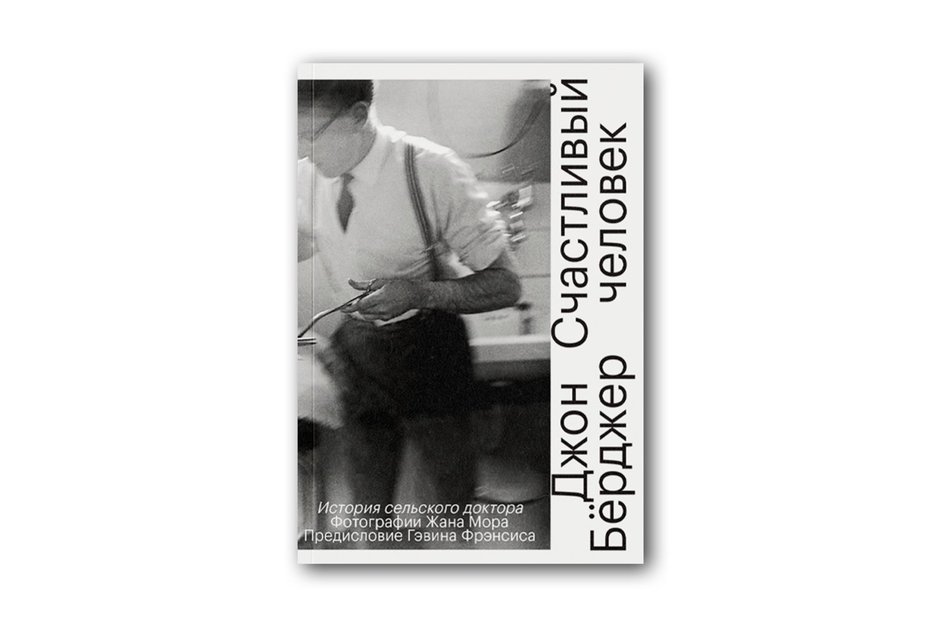
But in the book “A Fortunate Man. The Story of a Country Doctor," which came out in 1967, Berger completely renounces the customary literary form. A year before the release of the book, together with the photographer Jean Mohr, he observed for three months the work of the country doctor John Sassall in the English county of Gloucestershire. Sassall is a happy man; he has found a business that has absorbed him. The border between work and personal life here is absolutely blurred. And if today many would say that this is a categorically wrong and even harmful way of life, then Berger destroys such a position. He shows a selfless person who has become the center of the rural community.
— We grant the doctor access to the body. Besides the doctor, we voluntarily grant such access only to lovers — and many are afraid to do even this. Although the doctor is a comparatively unfamiliar person.
This is not a classical biography and not a journalistic report. Berger observes his hero, talks with him and his patients, and then unites biographical details and reflections on medicine, a social portrait of rural society and a philosophical investigation of the profession. The result is a story about a person whose life is formed by caring for others. To this are added the unique photographs of Mohr, which create an independent visual narrative. The reader sees the space of the doctor's life and the people among whom he works.
In 1975 John Berger together with Jean Mohr released another book — “A Seventh Man.” At first glance, this is a documentary investigation about labor migrants who came to Western Europe from other countries. But the book is far more complex than ordinary social publicistic writing. Berger and Mohr investigate the experience of migrants as people who are influenced by external circumstances (poverty and humiliating labor) and internal ones (fear, hope, separation, loss of identity). Usually migrants are shown as people on the margins of life, but here they are at its very center. After all, it is precisely migrant labor that makes the Western way of life possible, but the migrants themselves remain invisible.
— To describe the experience of a labor migrant and to relate it to what surrounds him — physically and historically — means to understand more precisely the political reality of the modern world, Berger writes in the preface to the book.
In “A Seventh Man," as in “A Fortunate Man," the text is united with photography, creating a parallel narrative; personal stories are intertwined with economics and politics. But the experience of one person already passes to the collective and becomes a way of understanding the structure of the world.
Text alone was not enough
Berger did not limit himself to literature and visual art. He also wrote screenplays for films and participated in theater projects. Especially fruitful was Berger's collaboration with the Swiss director Alain Tanner. In 1976 the film “Jonah Who Will Be 25 in the Year 2000” came out; Berger and Tanner wrote the screenplay for it together.
The film tells about eight young people. They are from different social classes, they have completely different professions, desires and temperaments. But they have something in common — the events of May 1968 in France. Many of them are worried about the future, work, self-development, the fear of compromising with the existing order of things. They constantly reflect and doubt their ability (or inability) to build relations with others, call into question politics and the way of life. In short, they do not know how to live further.
In cinema Berger had the opportunity to work not only with text but also with moving images, montage, space and collective history. The free attitude to form and genre is especially vividly visible in the documentary film “The Seasons in Quincy: Four Portraits of John Berger” (2016). For one of the scenes of the conversation about art Berger proposed to film a game of table tennis.
— This is what Silver and I loved to do most of all, he wrote to Tilda Swinton, the co-producer of the film.

Silver is the nickname of Susan Sontag, which she received from Berger for a lock of white hair. She wore it as a sign of the first victory over cancer. Sontag came to him in a small village in the Alps, where Berger then lived, and they played table tennis together, the table of which stood in the hayloft. This game required maximum involvement, attention, concentration and readiness to return what the other gave. Sontag and Berger tossed to each other not plastic little balls at all, but ideas about the meaning of stories and images.
The storyteller as a philosophical position
Berger all his life did one and the same thing, even from the time of his artistic experiments. He told stories. In a conversation with Sontag he once said: “A story is always a rescue operation.” And in the film “The Seasons in Quincy” he expanded this explanation:
— If I know how to tell stories, it is only because I listen to them. For me the storyteller is like a ferryman who carries contraband across the border.
The British historian and literary critic Mike Gonzalez considered that in understanding the word “storyteller” John Berger relied on Walter Benjamin's essay of 1936, in which the storyteller was opposed to the novelist. If the latter, according to Benjamin, is a solitary figure who cannot ask for advice and give it, then the storyteller is a representative of the oral tradition; he is rooted in collective experience and in the living speech of many nameless people. For Berger to be a storyteller is not to create from one's own imagination but to listen and transmit other people's stories.
It was people who were in the center of Berger's attention, moreover those whom mass culture and the intellectual environment left on the periphery. These are the peasants from the trilogy “Into Their Labours," the country doctor John Sassall, the labor migrants from “A Seventh Man” and even the artists and people of art in the critical essays. Gonzalez emphasized that the position of the storyteller became for Berger an ethical and political choice:
— The task of the writer is not to express sympathy and not to speak on their behalf, but to give them the possibility to speak directly, to work together with them. Berger called this a transition from empathy to solidarity.

It is enough to recall his speech at the awarding of the Booker Prize in 1972, which was more like a political manifesto and an exposure of the cultural industry. Then Berger announced that he would give half of the money to the British “Black Panthers” movement, and use the other half for work on the research of the life of labor migrants.
Today interdisciplinarity is often perceived as a combination of several competencies. But in Berger it was arranged differently. He did not transfer knowledge from one profession to another; he simply sought the best form for a specific story.
Ekaterina Petrova — literary reviewer of the online newspaper “Real Time," host of the Telegram channel «Булочки с маком».