Nurbek Batulla did not explain how to understand a dance performance
The Nizhnekamsk Tatar Theater is on tour in Kazan
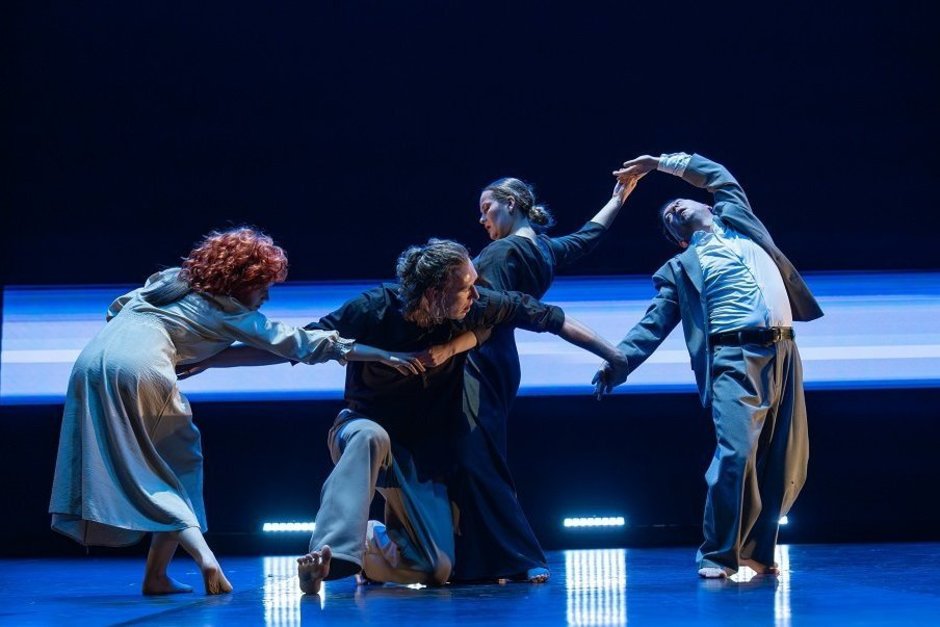
At the Nizhnekamsk Tatar Theater, the Golden Mask laureate Nurbek Batulla had another debut. He staged a performance as director-choreographer based on Bulat Minkin's play “Biyu spektaklen nichek anlarga”/“How to Understand a Dance Performance” (12+). Along with three other productions, he brought it on tour to the Kamalovsky Theater. Details — in the material of “Real Time.”
What Lilia Akhmetova has already managed to do
Previously Batulla made one-man performances, collaborated with directors, and had productions based on movement and music. But one day the chief director of the Nizhnekamsk Theater, Lilia Akhmetova, called him and proposed working with dramatic actors.
The work of Batulla and Minkin opened the tour of the Trans-Kama team, which also included the drama “Köz” (“Autumn," 12+) based on Gayaz Iskhaki and “Borhan yorty” (“The House of Burgan," 16+) staged by Akhmetova, as well as “Galia” (12+), a three-part work by Aidar Zabbarov. It is telling that these are almost all the theater's new performances that appeared after the arrival of Farid Bikchantaev's student to the post of chief director in 2025. And interestingly, there is not a single comedy among them. At the same time, all the slightly older productions were nominated for “Tantana," and the actress Guzel Shamardanova, who played in “Galia," received the prize as best actress.
Akhmetova notes that she carefully places difficult performances in the calendar plan, and that means the theater sells such productions too. The minimum plan is to fill the parterre. Sales worry all directors, and recently the Kazan people have been speaking about this openly. In particular, Aidar Zabbarov, pointing to the low sales of “Othello," said: “I am worried that this happened. We have already met and done work on the mistakes, why this is happening. We have many events, there is less advertising, that this is a good performance.”
On the internet one can already see footage from the shooting of advertising materials for Shakespeare's tragedy. Farid Bikchantaev in an interview with the “Teatral” website says: “We conduct a serious dialogue with the viewer on the chamber stage for 200 people. In the large hall, designed for 800 spectators, it is not always possible to please everyone. Therefore a lighter genre, a lighter conversation, is preferable.”
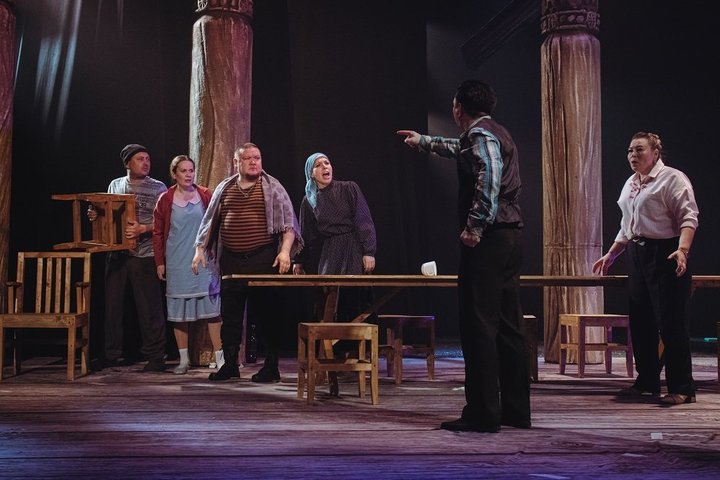
Body, tempo-rhythm, space!
Probably it is not easy to sell “Biyu spektakle," considering that the Nizhnekamsk Theater had a not particularly successful experience with a total experiment — Tufan Imamutdinov came here and staged “Taң vakity”/“At Dawn” (16+) based on a poem by Sagit Ramiev. It was nominated for the Golden Mask five times, but explaining to the public what the essence of the performance was proved not easy. The third showing, they say, had to be cancelled because of poor sales.
One of the nominees — a participant of the performance, Almaz Khusainov. He has an entrance here with stand-up, where he says that Nizhnekamsk is a city-pause, because there are many speed bumps in it. And he also reflects on why in 12 years he has had so few roles: all because he is tall and long-haired!
In the performance he plays with his wife Nursana. In June the house where their apartment is located came under a drone attack, and a floor slab fell on their car. The family had to move to a special camp. One wants the viewer to be aware of this when watching the production that explains what a dance performance is.
But in fact dance also articulates the personal — in passing and directly. Because the body — it never lies. Moreover, as Bulat Minkin and Nurbek Batulla explained, the text was born together with the artists, so in the play of the performers, who are named by their own names, there is not a little that is personal.
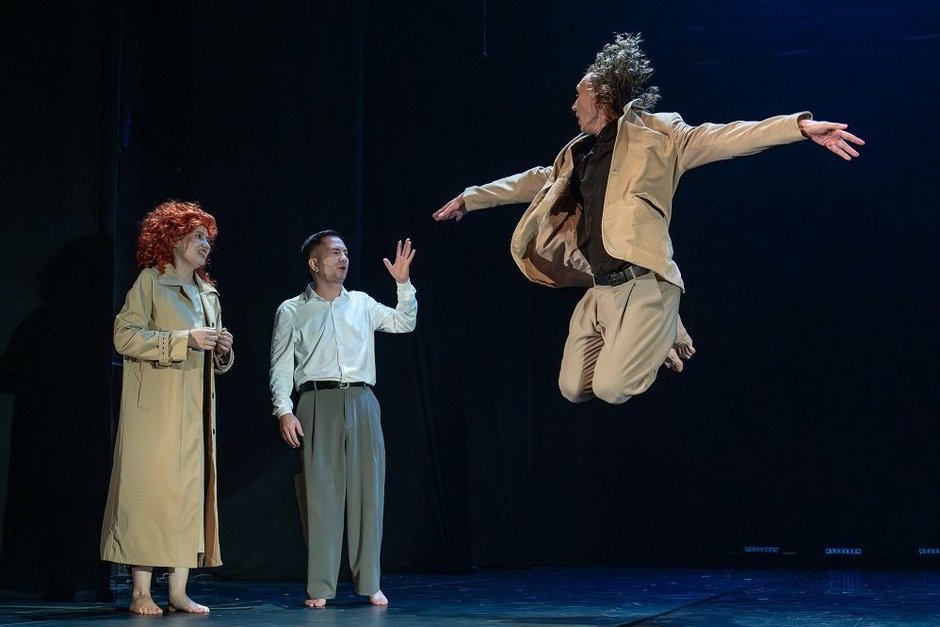
Everything begins with the play of light by the “Golden Mask” winner Emil Avramenko and the song by Alfiya Avzalova “Sineң öchen”/“For You," to which the Khusainovs enact a paired dance, into which bursts, like an injured black raven, Yuri Pavlov. A talented comic actor, on tour later he will show himself as the main hero in “The House of Burgan," but here he also plays for part of the spectators who, let us say, came to Batulla's performance and understood nothing.
Nearby runs in a red wig Tansylu Sibgatullina, taking on the role of lecturer (and at the end delivering a monologue about fear).
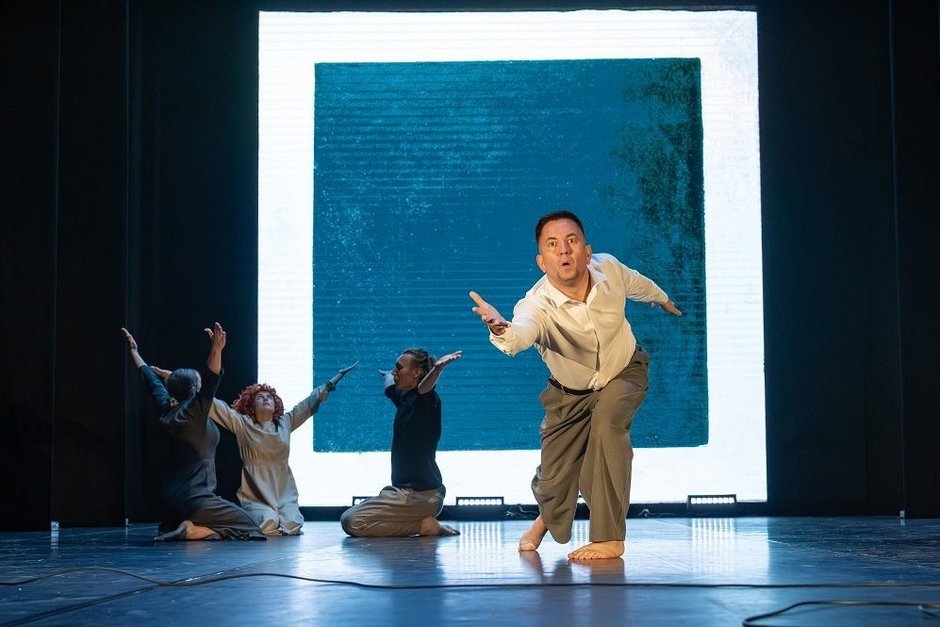
With the help of movements, the music of Islam Valeev, photo and video, Sibgatullina leads the performers and spectators through various aspects of contemporary dance. The action is explained at the beginning of the performance: this is the love story of Madina and Farit, which the rich Ibrahim wants to destroy. Spectators learn about the war dances of New Zealanders, the whirling of dervishes, butoh, Pina Bausch; they are reminded of Rudolf Nureyev. The dance seen in the introduction is not about love, the authors clarify, it is a plot about a girl's independence.
Yes, the body does not lie, they echo in the third part. “Discipline is respect for the body," Pavlov objects, turning to classical dance. No, it is fear, says Khusainov. And, in general, see, the body can say more than language!
And the spectator already sees works by Rubens, Michelangelo, Schiele (this is “Self-Portrait with Arm Twisted above Head”), as well as Baki Urmanche. Then about Picasso, Kandinsky, Malevich, Bacon, Hockney, Warhol, Zaha Hadid, Calatrava... Learns about pause, tempo-rhythm and space. And also about the fact that very modern-looking mosques are being built in Nizhnekamsk.
Just tea or not just tea — that is the question
Pavlov makes a joke of every second line; the others suddenly perform the song “Ezlädem, bägyrem, sine” (“I Searched for You, My Soul”). Everything goes along in the channel of a likeable independent theater, until Yuri Vitalyevich cannot stand it and discharges a ten-minute monologue with many rhetorical questions.
As if to say, tea is not the slow movement of waves and not an invisible meditation, but it is simply tea. And, in general, does one need to understand a dance performance? Take Lyubimov — Vysotsky delivers: “To be or not to be? That is the question!” And now, they say, Pavlov's namesake at the Moscow Art Theater walks around in a foil costume...
The main problem, Pavlov says (and rereading quotes from his interviews, one can say — here it is clearly not only the work of the playwright), is that authors now do not follow the people. And how good it is when the people came to a good comedy, came, laughed, sang. Everyone united — and went home in a good mood...
Pavlov plays especially penetratively at this moment; the spectator in Kazan, consisting, of course, also of the “enlightened” public, including choreographers, still chuckles. Because this is not the talk of some retrograde, it is the natural course of thoughts of any experimenter in the conditions of Tatarstan theater. What is he working for, where will all this lead? And at the same time experimenters are scolded for experiments, but there are not so many of them after all.
If one does not name as the main test the daily uttering of Tatar text in a theater with the expectation that the translator in the headphones will convey these words with the needed energy and intonation to a significant part of the spectators. By the way, they also spoke about energy in the performance. Everything is heading toward the fact that the lack of language will be compensated for, made up for by music, video, light. And dance.
By the way, Khusainov now leads the “Bishegem” studio, which Pavlov used to run. Maybe that is how we will win.