Andrey Leontyev: “Love for the country comes through getting to know it”
A State Duma expert and racing driver — about the record-breaking motor rally, Russia's roads and the future of auto tourism
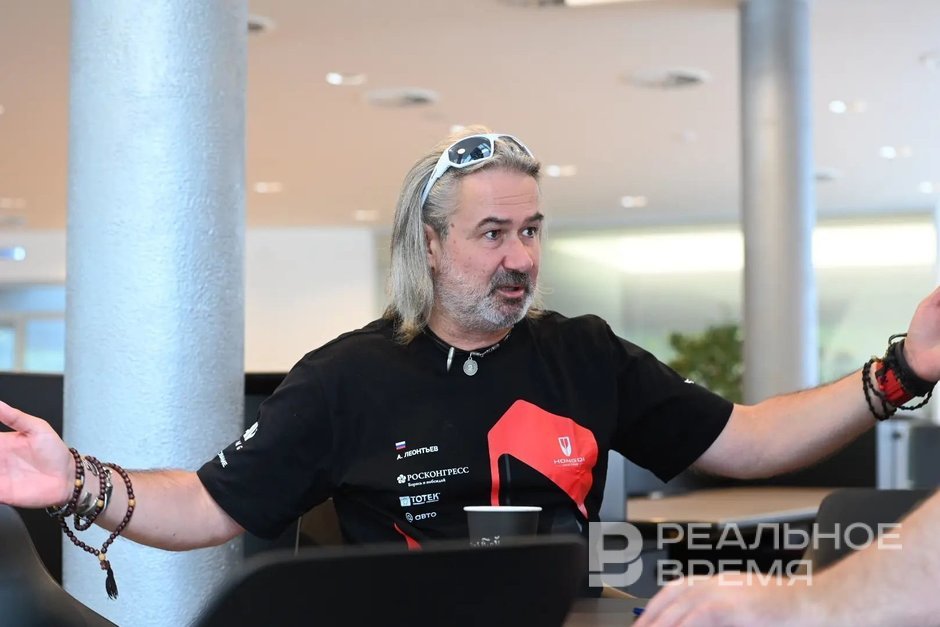
Russian racing driver and expert of the State Duma tourism committee Andrey Leontyev, together with the editor-in-chief of the “Auto Mail” portal Anna Levina, set a record: in 104 hours 33 minutes they covered 9,973 kilometers from Vyborg to Vladivostok in a HONGQI HS5 crossover. The non-stop run without a single pause, except for refueling and checkpoints, is being prepared for inclusion in the Russian Book of Records. In an interview with “Real Time," Leontyev told how the route through seven time zones went, why 80 liters of spare gasoline were not needed, and how this experience can become the basis for the development of automobile tourism in the country.
“Our non-stop journey became a record and will be included in the Russian Book of Records”
— Andrey Igorevich, tell us how your motor rally began.
— Honestly, I can talk about this trip for 104 hours 33 minutes — exactly that long was our road from Vyborg to Vladivostok. In other words, 4.5 days on the road without a single stop. On August 27 at 10:05 a.m. Moscow time, my co-driver, the editor-in-chief of the “Auto Mail” portal Anna Levina, and I started from the Market Square of Vyborg and finished on September 1 at 2:38 a.m. Primorsky Krai time, crossing seven time zones. Our non-stop journey became a record and will be included in the Russian Book of Records, becoming a continuation of the brand's history, which already has two Russian records to its credit.
Anna Levina and I drove, being alternately driver and navigator, changing as one of us began to nod off at the wheel, without a clear schedule regarding shifts in terms of wakefulness and rest. Stops were planned only at gas stations to replenish fuel, but here it is necessary to note an additional detail, that among the cargo we did not need along the way were 80 liters of gasoline that we took as a reserve from Vyborg, carried it to Vladivostok and back. For the purity of the experiment we did not use it at all, even when there were some problems. Namely — in one place we asked at a gas station to refuel us without a queue, and in two other places we bought gasoline at a price slightly higher, namely 102 and 106 rubles per liter.
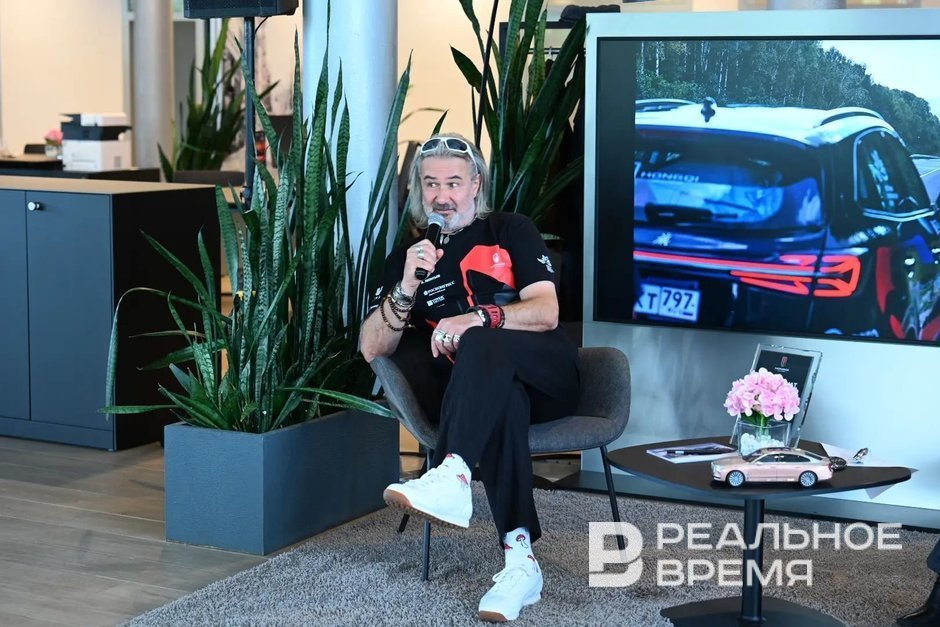
Moreover, this body already had 17 thousand kilometers of mileage, since it was at the disposal of various journalists who tested the car for three days each. The meaning of our non-stop trip was not some process of self-admiration, especially since earlier we already had similar examples of non-stop travels, in particular from Murmansk to Magadan — that was our first non-stop run, carried out in the 2010s. The second run we carried out in 2017 from Portuguese São Vicente — the southwesternmost tip of Eurasia — again to Magadan, as the northeasternmost point of Eurasia. Then we covered 16,124 kilometers in 180 hours.
“At the invitation of the Roscongress foundation we became participants of the Eastern Economic Forum”
— At first all your roads led to Magadan.
— Yes, this is a very interesting route. Kolyma is the most remote point in Russia where one can get by public roads. There are its own nuances, since the highway is not year-round, there are interruptions connected with the crossing of the Aldan River, when the winter road melts and ferries have not yet begun to run. Or when the ice sets in: ferries are no longer running, and the winter road is not yet open. I am telling about those trips, since they represented a kind of challenge on the edge of hooliganism, recklessness and partly self-admiration and self-affirmation. But now we had several goals.
First, at the invitation of the Roscongress foundation we became participants of the Eastern Economic Forum, and our arrival in Vladivostok on September 1 was timed to its beginning. Second, the choice of car was also largely timed to telling about our means of transportation at this forum. In this regard the choice of the HONGQI brand (“Red Banner”) was obvious. Right now this car is used by the top leadership of the People's Republic of China. And historically — this is the product of the “First Automobile Plant” in Changchun, built with the direct technical support of the Soviet Union. The general plan of the enterprise was developed with the participation of Soviet engineers, and the Moscow ZIS — the Stalin Plant (later renamed ZIL, the Likhachev Plant) — was taken as a model.
It was not only about machine tools, but also about the very logic of production: technological chains, the organization of workshops, the training of personnel. Besides, being an expert of the tourism committee of the State Duma of Russia, I think about developing the concept of automobile tourism. And one can talk a lot about this, or one can also implement it by one's own example. And when the main people of the country began to talk about the direction St. Petersburg — Vladivostok as one of the main transport, logistical backbones of the country, as the basis for the development of automobile tourism, we had a desire to update the information.
This was a challenge; on the other hand, we travel these roads with members of our team every year, to the same Primorsky Krai, Magadan, Yakutia; in principle it is a well-known path. But that is about covering a thousand to a thousand five hundred kilometers a day, while now we scaled the project, covering this route without stops, when the quality of the test shifts into a completely different mode of oneself, the car, a kind of audit of roads and accompanying infrastructure. If we take our experience as a basis, then any person can repeat our 4-day path, only covering it in 2—3 weeks, thereby turning it into an auto trip, with sightseeing of the beauties of our vast homeland. Plus it is an opportunity to see with one's own eyes what is happening in the country, to really see its transformations, since the degree of trust in someone else's opinion can be different, but you always believe yourself.
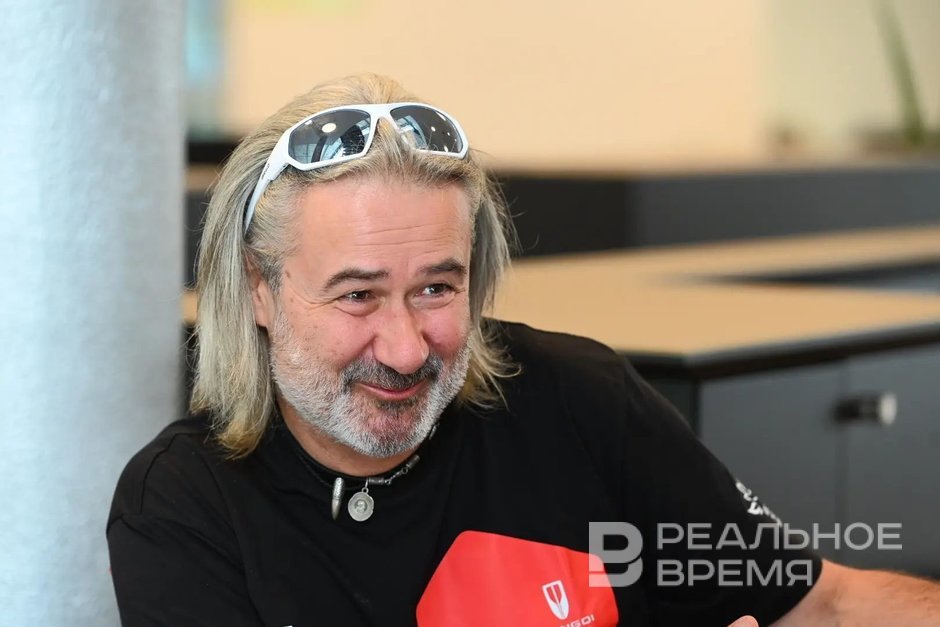
How mammoth tusks and Toshiba interactive boards lie in the same school
— You often visit remote corners of the country. And what of what you see now contrasts most strongly with the past? I remember, in childhood I was impressed by the names of cities that played in the USSR bandy championship — Karsakov, Magdagachi, Mogocha. Today they are almost not talked about.
— Everything is known in comparison. In the 1990s, when I first found myself in those parts, everything was completely different. For example, I was in Skovorodino in Amur Oblast and compared the picture that had been imprinted in my memory back from the 2000s, when at the local station a company of an old man of about 60, a man of about 45, a boy of about 14 was drinking vodka from plastic cups. And at the pouring was a policeman of about 25. It was August, Railway Worker's Day, a holiday for the residents, since Skovorodino is a junction station, and there the railway is the town-forming industry.
Now I came there as if not only to another city, but to a completely different life, and that picture was not from reality, but from a film of the absurd. Or I remember how in the town of Kirillov in Vologda Oblast in the 1990s the only advertisement concerned the provision of funeral services.
— I read about something like that somewhere. Even with the mention of a proper name, like Bezenchuk and “Nymphs.”
— Having arrived there now, I saw many young mothers with strollers, and even pregnant ones. I saw a modern House of Culture, dancing fountains with lighting, all the chain stores and mobile operators. The only difference from a megalopolis is the scaling and the absence of a traffic light, since it is simply not needed there.
Now we went to Tiksi — to a village located 70 kilometers from the Arctic Ocean, being situated on the bank of the Omoloy River, where there is no connection with the mainland except the winter road and a periodically arriving airplane. On the one hand, the 458 people living in this village are absolutely isolated; one of the entertainments is summer trips to the tundra and finds of mammoth tusks and tibia bones, with which even not a museum but a school shed is littered.
At the same time there is satellite internet, electron microscopes, Toshiba interactive boards in that very same school. Our people often simply do not believe in themselves, for example, wondering how one could get from Kazan to Baikal. And is there even a road there? There is! Which was proven by the people who got to Baikal on unicycles (in 2022 this project was carried out by three ordinary enthusiasts from Moscow, covering about 5 thousand kilometers — author's note). The length of our route turned out to be 9,973 kilometers.
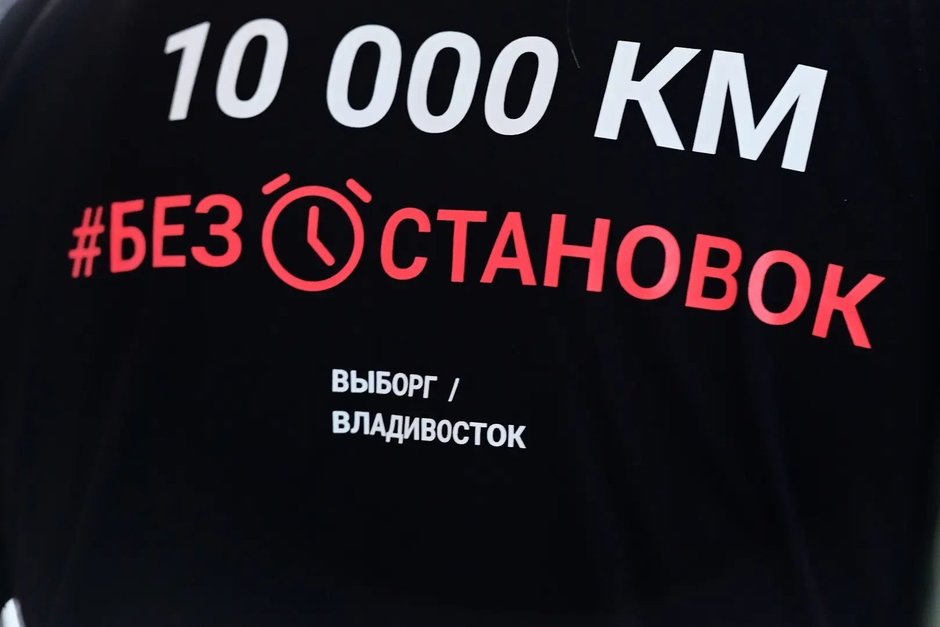
“Love for the country comes through getting to know it”
— Could you not have rounded your 9,973 kilometers by starting, say, not from the Market Square of Vyborg, but from the border of this city, adding those very 27 km missing to an even figure of 10 thousand kilometers?
— In any case Vyborg is a border point, an outpost located in the waters of the Baltic Sea, essentially the Atlantic Ocean. We laid the route to the Sea of Japan, in fact the Pacific Ocean. We stopped only at gas stations and at time control points, where licensed judges of the Russian Automobile Sports Federation recorded us. The achievement is registered by two independent satellite tracks, three full-fledged video files independent of each other were recorded. Soon we will edit the recordings of 104 hours into a 10-minute video telling about our trip. The only force majeure, in which there was a loss of three hours in the area of Khabarovsk, was when, having already covered a section with rather bad pavement at a speed of only 60 kilometers, we discovered that we had three tires punctured at once. We were prepared for something like this, although, of course, we did not suppose that it could concern three tires at once.
— The scale of what is happening is such that one begins to recall the 1930s with the transatlantic flights of Levanevsky and Chkalov.
— Here I would not want to compare; our risks are simply incommensurable, when people encountered the unknown and absolutely experimental and untested technology. Since I am myself passionate about this topic, I will note that Chkalov took off with such a bouquet of technical problems that he knew about even before takeoff. But we are driving a most reliable car that is certified in Russia — a premium manufacturer, I had not a single question about the car. And I would compare our trip from Vyborg to Vladivostok to, for example, going to a country dacha 100 times, except perhaps for covering small sections with rather “sick” asphalt.
Personally I have been involved in the topic of auto tourism since 1997, and for me the topic of automobile travel is a matter of principle. I sincerely believe that if we talk about the rise of patriotism, love for the homeland, then this cannot be done without studying it. Love for the country comes through getting to know it, through what you see with your own eyes, including the changes that are taking place in it. And only a car allows you to do this clearly, when kilometer after kilometer you see your native country, you begin to feel it, to understand it.
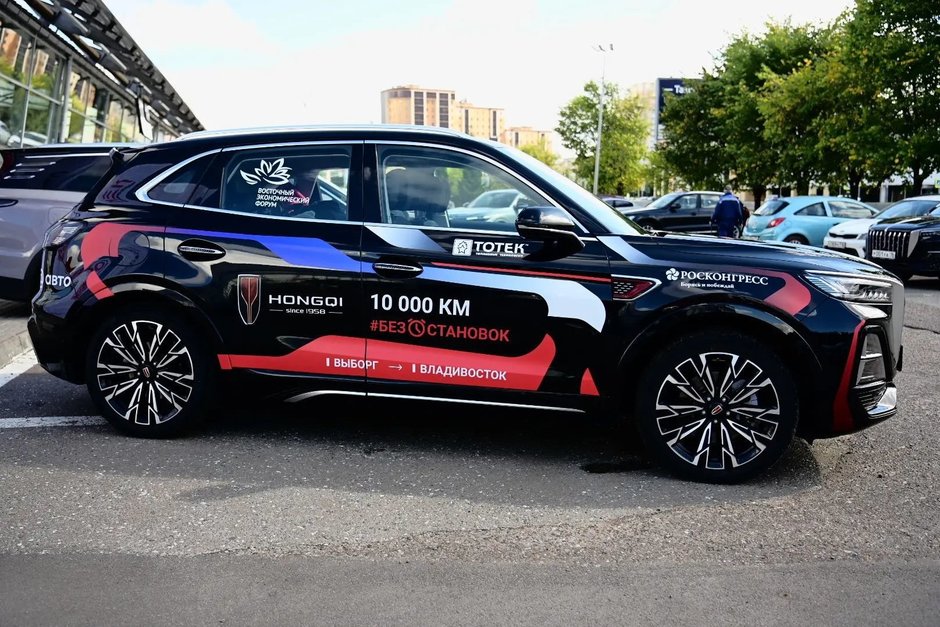
“We used an ordinary car from the dealership; moreover, it already had 17 thousand kilometers of mileage”
— Since we can rely on our own experience, I will note that literally this week we went to Tyulyachi and encountered the fact that the navigator does not work on certain sections of the highway; we asked for directions the old-fashioned way. Did you have any force majeure besides the punctured tires?
— No, including because we travel by navigation complexes not connected with the internet; in extreme cases a map and a satellite phone came to the rescue. For people who began traveling in a period when distances with absent mobile communication on the highway were about 200 kilometers, and now have shrunk to about 20 — this is not a problem. Besides, it is necessary to note that on today's federal highways there is very good visual navigation, and in order to get lost, one has to manage to do so.
At the same time I will clarify that the car was not specially prepared for this motor rally, no, it is an ordinary car from the dealership. Another one of the tasks was to study how the car would behave in an extreme mode. As a result, the 2-liter turbo engine and the 8-speed Aisin transmission never failed once; all-wheel drive with a 64-liter tank allowed covering long stretches with minimal stops.
We have completed more than 100 expeditions, but this marathon became one of the longest and most difficult. The car never failed: the engine worked flawlessly, the suspension withstood any road surprises, and the comfort of the cabin allowed maintaining concentration.