Takhtash, Kutuy and Their Friends
At the Kamal Theatre, they have staged a hilarious-to-tears performance about the turbulent 1920s: battles, weddings, and denunciations under torture
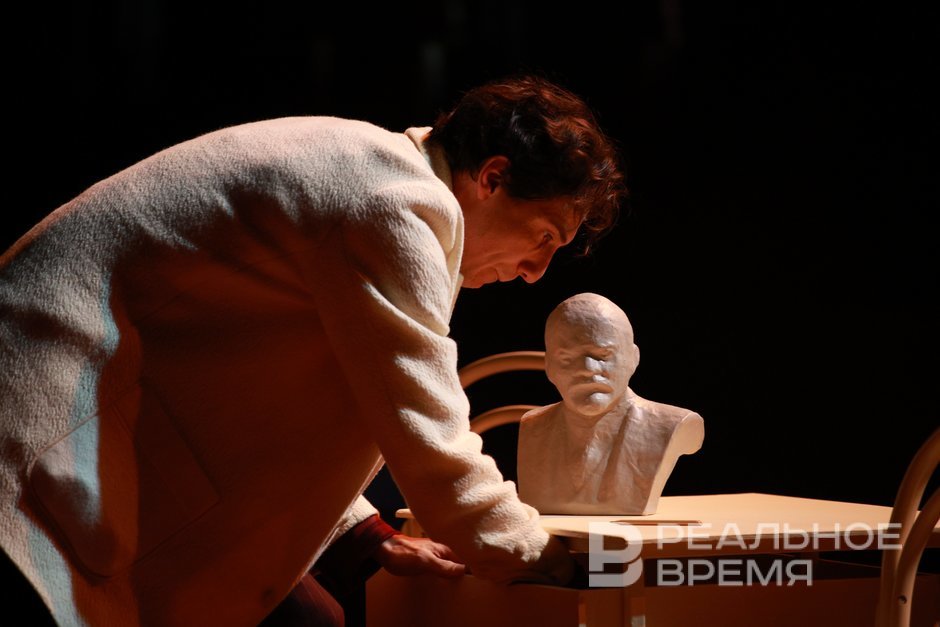
The Tinchurin Theatre has released a play about the poet Hasan Tufan and his wife, actress Luiza Salias¬karova — “Lu” (12+). The first major premiere of the Kamal Theatre was Lilya Akhmetzyanova-Nurel’s biographical play based on Yoldyz Minnullina’s “Takhtash. Yugalgan Maturlık” / “Takhtash. Lost Beauty” (16+), about another tragic poet of the Soviet era — Khadi Takhtash.
Khadi and Adel
Perhaps the two theatres should even make some kind of double ticket and stage these performances on two consecutive days. While Aidar Zabbarov and Ilgiz Zainiev created a work about sacrifice during the era of the Great Terror, Nurel and Minnullina have created a story about how that era is only beginning, and how destinies are crushed not only by people in military greatcoats, but also by bright slogans about freedom.
Muhammetkhadi Khairullovich Takhtashev was born in the village of Syrkydy in what is now Mordovia, officially on January 1, 1901. He had eight brothers and sisters. While still young, he left to work in Turkestan; in Bukhara, for example, he worked as an apprentice shop assistant in a textile store. In 1917, he began publishing articles. In 1918, his first poem appeared in the Tashkent newspaper “Olug Törkstan.” He then returned home, later found himself in Orenburg, Tashkent, and Moscow, and in the autumn of 1922 arrived in Kazan.
The performance takes place in the Eastern Hall, on a parquet circle filled with simple white furniture. The actors also often wear white, seemingly alluding to “white coats” and a clean biography.
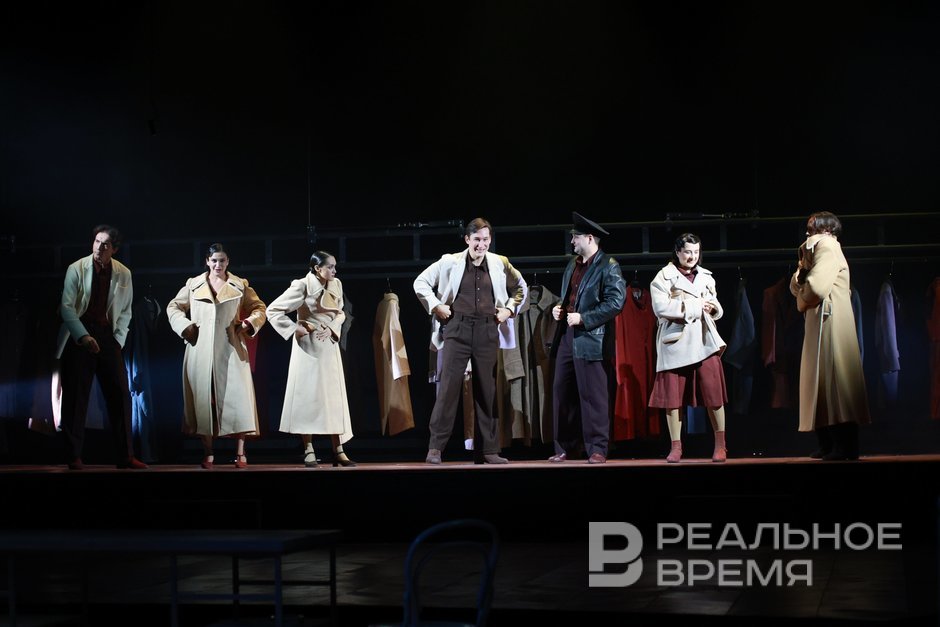
The performance begins with a rehearsal around a dinner table. The actors shout out both lines and stage directions, addressing one another by name, and then rush toward the numerous costumes in order to resolve the question of why, during interrogations concerning the fictional counter-revolutionary organization “Jidegan,” the writer Adel Kutuy (Rishat Akhmadullin) spoke so harshly about his friend Khadi Takhtash (Iskander Nurizyanov).
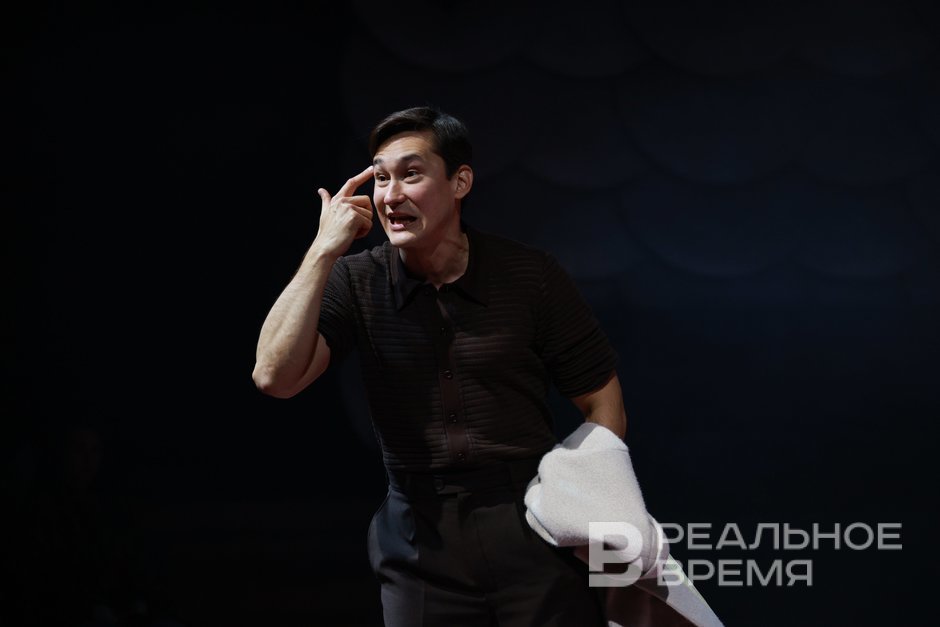
For the latter, this is not his first attempt at playing a poet — in “Sozvezdie — Yol¬dyzlyk,” he played Hasan Tufan. For Akhmadullin, however, this is already the second story, after “The Museum of Innocence,” about how a person goes insane under the pressure of circumstances. Both are very convincing in achieving their aims.
A Performance with Many Familiar Faces
Almost all the actors take turns conducting the interrogation, putting on black clothes and acquiring a limp. Kutuy denies that any organization was created in 1929. And he returns to the past, first to 1923, when he met the poet Takhtash.
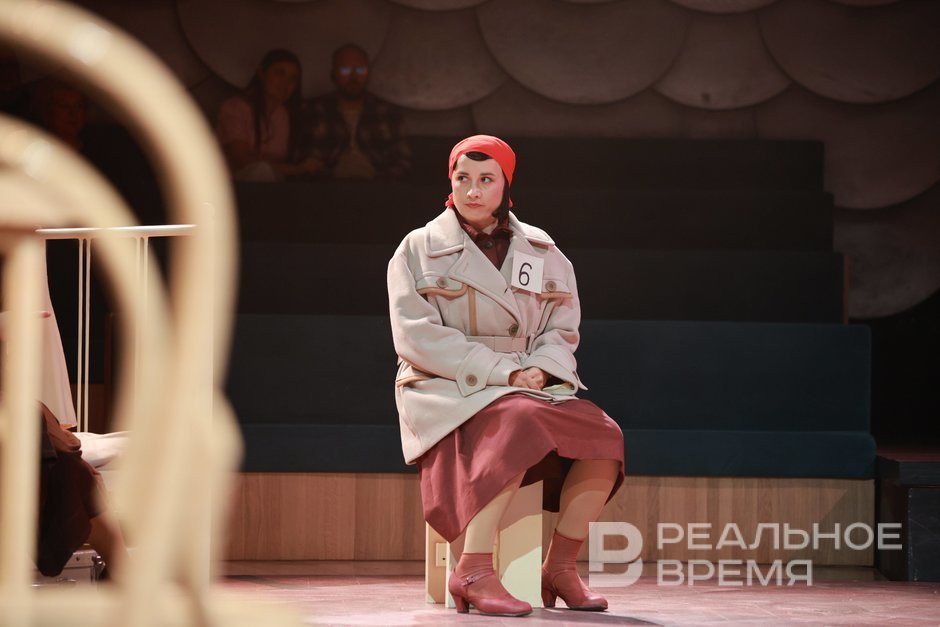
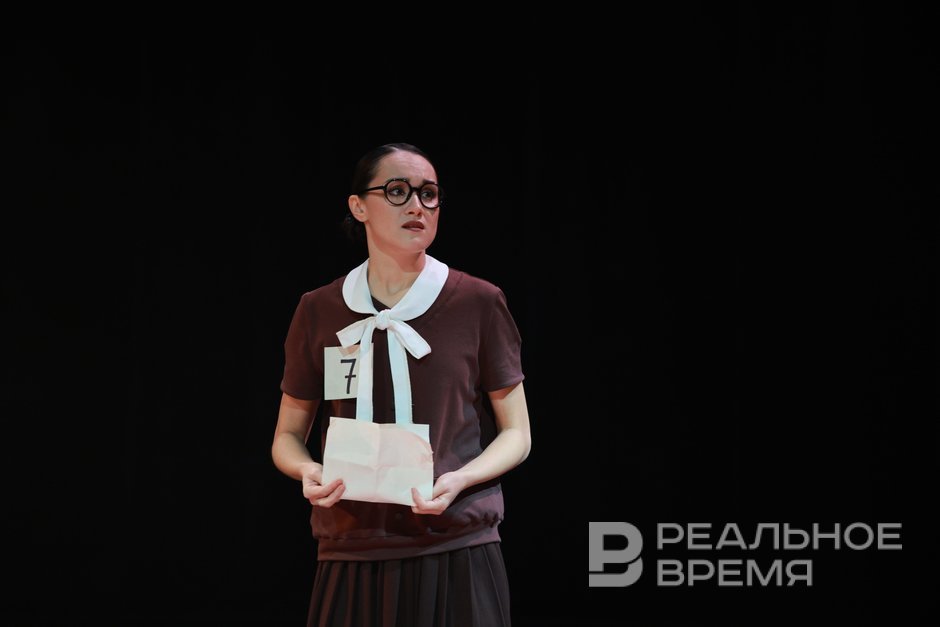
At their meeting with young people, we also learn about the other characters. Takhtash’s first wife, Gulchira Khamzina (the fashionista Raykhan Gabdullina). The poet and journalist Zainap Bashirova (the Komsomol member Laysan Faizullina). Gulchira’s friend Gazza (the frightened shy girl Leysan Gataullina). Some of the roles are difficult to identify at first glance, but gradually we understand that, for example, Kavi Najmi is played by Adel Ravilov, while Irek Khafizov suddenly turns out to be Hasan Tufan — although without any particularly memorable lines: we learn Najmi’s opinion of Takhtash, while Tufan is also awaiting Lu here.
At the same time, each of the actors has many episodic roles. For example, soon they all turn into actors from a proletarian troupe whom Takhtash encounters in Orenburg during the famine of 1920, feeds with sugar, and reads “Gazrails” to. A poetry battle between Khadi and Zarif Bashiri also takes place there; fortunately, the rap here sounds more confident than in “Lu,” and without beats.
Minnullina’s imagination sometimes makes the actors read love poems to one another, sometimes sends the entire male cast to the bathhouse, and sometimes turns almost the entire group of seven into the editorial office of the magazine “Azat Khatyn,” where a woman comes to thank the poet — a year earlier, his poem had persuaded her not to have an abortion. Slogans, ideas, and poetry in the 1920s were not simply words; they guided people’s destinies.
How the World Lost Its Beauty
At the same time, the poet himself lives in a conflict between the Soviet ideal and reality. He spontaneously marries Gulchira, and they have a son, Rafael, but his wife soon leaves alone to study in Moscow, because at that time it was impossible simply to force a woman into the kitchen. While the play’s main characters, Takhtash and Kutuy, are shown as victims of an era that twisted them this way and that, the story of Gulchira Khamzina is resolved here in a textbook manner — the poet’s letter is quoted, in which he calls her a promiscuous woman, a liar, and a drunk, whose right to the child will be decided by a court.
The play shows an excerpt from the work that gave it its title — “Lost Beauty,” in which the poet seems to have told the story of his own life. Critics thoroughly trampled on it: in “Azat Khatyn,” it is called philistine, and the poet is expelled from the editorial office. His belongings are sold at auction. And Kutuy is reminded that at that time Takhtash had spoken harshly about him at a literary trial, which, at the director’s will, has been transformed into a “roast.”
Exhausted by interrogations and driven insane, Adel writes an entire stack of confessions, stating that his comrade had been fascinated by false truths for a long time, but in the second half of the 1920s had taken the right path. After leaving prison, he does not shake Takhtash’s hand, and later cannot get through to the funeral for a long time in order to begin reading: “White flowers are falling from the sky. The world is beautiful. This is how beautiful it seems; The blue sky, and as if with white snow, the stars are scattering over the earth...” He would return to great literature with the novella “Unsent Letters” in 1936.
And closer to the finale, verses from the poem “Letters to the Future” are heard: “Every age has its own illnesses, And every illness has its own doctor, And its own scum — let it perish! Every era has one! I beg your pardon — That is what we called Bad people, And this scum, Which has disappeared from you, Tormented us terribly!” What are these verses about? About class enemies, or about something else?
Khadi Takhtash died on December 8, 1931, in Kazan. Once again, drama turns to the era of the 1920s and 1930s, when great people said unpleasant things about one another — publicly, in letters to each other, and to the authorities. Sometimes this gives rise to arguments: is it possible to raise these “personal” questions? But as a result, people ended up in prisons and were barred from working.
It is remarkable that the authors have managed to create not only a dramatic but also a cheerful performance about these bitter decades. Yoldyz Minnullina speaks about her characters as if they were her friends, who take part in battles and roasts, stage controversial plays, get married, separate. And they write poems that seem to have been written right here and now.
That is why the actors feel so confident on stage, while the minimum of scenery is enough to show a schematic world of the post-revolutionary era. Times are not chosen; people live and die in them.