Bulat Gataullin: the “playing coach” from the Kariyev Theater
A leading actor of the Tatar Youth Theater — about directors, directing and a knee injury

This season, several performances of the Kariyev Theater in Kazan have been put on pause: Bulat Gataullin, who plays the main roles in them, is undergoing a rehabilitation process. At the same time, the theater artist had a film premiere — audiences were shown the Tatarstan-Uzbek film “The Teacher," in which he played Shigabutdin Marjani. And this summer Gataullin again showed himself as a director, staging “Cancelled, dustym! The Performance Is Cancelled!” — about the founder of the Tatar Youth Theater Farit Khabibullin.
“I love the Kamalovsky, but as an actor I still do not see myself there”
— Bulat, do you consider yourself a city person or a village person?
— On social networks I once posted on this topic, with a village yard... I am a city person, born and raised in the city. As a child it was important to me that I was a city child. At the same time my mother is from Apastovsky and my father from Nurlatsky district. They met in Kazan, all three of us were born in the city. And my father jokingly told me: “Your father and mother are from the village, so you are a collective farmer too.” Now I understand that the village occupied a large place in my childhood; I spent absolutely all my vacations there, with my grandmother and grandfather. My view of the world, my religious views were formed there. My grandmother read namaz, my grandfather went to Friday prayers, to tarawih, played the bayan. The village environment seriously influenced me. And that is why I consider the village of my mother my native home.
— And where did you grow up?
— I am from Kvartaly. I came home from school, ate, went to music school, then to dance or to the folk instruments orchestra, where I played the balalaika. I had no time to get into any unclear situations.
— Where do you then get material for roles? For example, you played a hero who became a victim of a showdown in the play “The Cowardly Batyr / Kurkak batyr.”
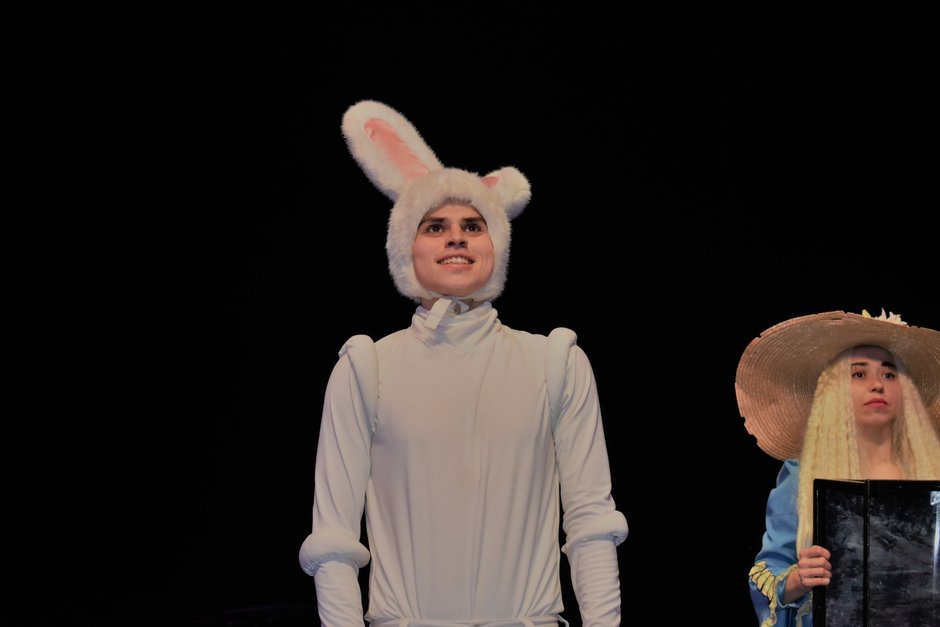
— I take much intuitively. “The Miraculous Journey of Edward Rabbit," for example. At that time my grandparents were still alive, I had not yet said goodbye to relatives. I did not have the experience of my hero. But I had some kind of memory of the heart. I believe in reincarnations, that this experience was acquired by me earlier. Perhaps I made it up, but it seems so to me.
— You then played Edward on the stage of “Ekiyat," where the Kariyev Theater was based for several years. What time was that?
— It was a good time. I had graduated from the college. And I wanted to play at the Tinchurinsky. My teacher Taslima Fayzullina suggested trying out for the Kamalovsky: let's invite Bikchantaev to the diploma performances! I love the Kamalovsky, but as an actor I still do not see myself there. I cannot explain why. Many invited me, but Renat Ayupov immediately offered me a role in the play “The Song of the Wonderful Bird / Asylkosh zhyr," which was to become a musical to the music of Zulfia Raupova. We learned the songs, but then it turned into another play. At that time there was no youth in the troupe, so we, several guys, were received very hospitably. At the same time Nurbek Batulla was the choreographer. It was an important time. The college gives you the base of classical theater. And with Nurbek I was discovering that theater can be broader. This experience still helps me.
— At first you played the main roles, and then for some time you participated in crowd scenes.
— Yes, for a year I played second-plan roles. At the college I was in the main ones, and in the theater at first too. When they began to give me episodes, it was as if I found a second wind. This gives the opportunity to fool around. In the main role you lead the line, you cannot go left or right. But in an episode, a crowd scene you have more air. It was an interesting experience.
I even got angry sometimes! “Shai-bu! Shai-bu” came out. There I am — Episode Epizodovich! And people write to me: you have such a role, you are such a talented artist. I did not understand why, but people remember such episodes.
Gorokhovskaya's schedule, existence according to Kulov
— You have worked with many directors. What do you recall in connection with this?
— I love every one of my performances and sketches at laboratories. I think that in the theater new directors, new methods must always be present. Perhaps this will not please audiences or journalists, but it is growth, it broadens your horizons. Each director comes with his own world. I take something needed from each. Perhaps I myself became a director because I perceived them as teachers.
Aesthetically, Soyzhin Zhambalova is close to me. In working with artists, the reference is Ekaterina Gorokhovskaya. In “Mio, my Mio!” she distributed time for the week very clearly. At 10 in the morning — this, at 11 in the morning — that, then lunch... And we changed nothing. Sometimes they say: this is creativity, what schedule? But it turns out this is also possible, when you know your schedule. I also try to do this. If I understand that an artist will not be involved today, why should I invite him to rehearsal?
— How did it go working with Ilsur Kazakbaev?
— With Ilsur we released three performances — “Long, Long Childhood," “Romeo and Juliet," “The Cowardly Batyr.” He works interestingly. Sometimes it is hard with him, because he is always searching. We do a scene, then discuss how great everything is. And he — bam — and does it differently, but also interestingly. He tries all the time. And searches until the last rehearsal. In “Childhood” our first run-through was at the premiere, on stage in front of the audience. And I got one monologue at five in the morning. And before that I had learned huge chunks — and he refused them. People asked me: “How do you put up with this?!” But if you believe the director, no questions arise.
— Can you play Romeo now? Do you miss the role?
— The feeling of nostalgia is little familiar to me. I love roles, but I do not miss them. Maybe I miss them, but adequately. If my physical capabilities normalize, then I will play Romeo. It is a performed play, it already lives inside.
— Probably it was also good working with Timur Kulov?
— Good and difficult. He did not change scenes, he worked differently. If you accept the director, then everything will be fine. It happens that actors get used to one director, I am constantly ready for a new one. With Kulov there was such a story. The theater is increasingly moving toward form, special effects, music, light, choreography. And we did “The Adventures of Rustem”: two artists and the correct classical school. You cannot hide. Even the music sounds from somewhere far away. With Albina Gayzullina we said that it was as if we had studied for four years at the college all over again. But Kulov is always with you, he always helps, leads you, and leads you as if you thought of everything yourself. Such a trusting, horizontal theater.
“Sometimes inexplicable things happen”
— Let's talk about your performances! How did you become a director?
— I believe that someone leads me. Because sometimes inexplicable things happen. I was not going to enter the institute of culture after the theater college. I wanted to study at the philology faculty. In the summer I worked at a camp, a groupmate called me who had started working in Naberezhnye Chelny: they say, music is needed, I am going to enter the institute, would you like to join me? Tomorrow is the last day! I asked my mother to prepare the documents, I came, chose the specialty “director of a people's theater.” I did not apply anywhere else. I passed three rounds with 95 points and began studying by correspondence. Sometimes later I thought: why. The sessions fell on premieres, I went with other courses to retake. No one met me halfway; on the contrary, they said: why are you studying, go back to the theater!
And so I need to submit a diploma performance. I decided that I would not do something for the sake of a checkmark; I like to keep myself in stress. I chose to stage a performance by the laboratory method. After all, I knew what that was, as an actor. And now I wanted to look at it as a director. I needed interesting non-dramatic material, space, tight deadlines. I wrote about the laboratory in my diploma — and I myself staged such a performance. The literary manager Leysan Faizova gave me the folk tale “Gulchachak.” At first I did not like the text, I did not understand how to stage it. I began to study what the characters were, who the “ubyrly” was, and fell in love with the material. I gathered the artists, our choreographer Lena Muzeeva and lighting designer Dima Solopov agreed to help. At the first rehearsal I said: “We are not staging for a diploma, I do not care what the commission says, I would like the performance to enter the repertoire.”
“Gulchachak” was taken to the “Craft” festival, and then the performance got into the long list of the “Golden Mask.” After that I thought: that is what all this was needed for, I want to work in this too, in parallel with working as an actor. Later Niyaz Iglamov invited me to a laboratory in Buinsk, then there was another, then I staged “He. She. Shaitan.” So it turns out that I stage what I want myself. The last work “Cancelled, dustym! The Performance Is Cancelled!” — this is my long-standing dream.
— Can you tell about yourself as a director? How do you switch?
— It happens by itself. The artists laugh: they say, milliseconds pass, the gaze changes: “Let's go to rehearsal!” Thank God, they understand this distance. But we have no hierarchy — these are the features of the process. When I started working, it was scary. I went to a laboratory in Tuymazy, I came across two people's artists. But we developed trusting relations, they even began to call me Ildarych.
— Will you do this in parallel?
— Considering that with my knee everything is still unclear, whether it will all come back... Who knows.
— What is with your knee?
— It first manifested about three years ago. The knee became inflamed, I began to limp. I did an MRI, they found something, they said people live with it. I asked the surgeon what could have happened. Most likely, there was an injury. A year and a half ago I again began to limp, went for an MRI again, there was already a tear, they said that for now it is inoperable. For the last half year I played on painkillers, and I have physical loads everywhere.
On December 13 last year, during “The Adventures of Rustem," I limped through the last 15 minutes. The audience did not notice, I realized something was wrong. And I went to the filming of “The Teacher” in Uzbekistan. With apprehension I told the producers about the problem. And on the first day we shot scenes with horses, everything went well. The second day, a night scene, long, with changes of plans. I stand up, sit down, and that is contraindicated! I sat down — and could no longer stand up. Blockade of the knee joint. For two weeks I limped. We went to the hospital, they injected something, bought a cane. I joke that it will later have a place in a museum. Then I returned to Kazan. Playing Marjani is, no matter how you look at it, not easy.
— And at the premiere you said that you are a happy actor.
— Is that not happiness? There are so many artists in Tatarstan, and they chose me to play Marjani.
— Do you like cinema?
— I like the film process. In the theater I value naturalness. I do not like theatricality. Cinematic existence is very close to me. The miracle of cinema is that you can seemingly do nothing, but everything will be clear from one glance. And this is great work.
— Let's now talk a little about film directors.
— I have had three films — “We Are the Children of '41," “The Mountain of Lovers," “The Teacher.” Everywhere I worked interestingly. With Ramil Tukhvatullin we rehearsed for a long time, talked for half a year, he sent me materials, photographs from locations. At the same time he had not known me as an artist before, as I understood. On March 27, 2025, we met at the Kamalovsky: “Prepare for a big, serious role.” He saw me in “The Mountain of Lovers," said: “I know that you will do it, you have everything in your gaze.” “I believe you," — he said this constantly.

— How do you see your current life?
— After the injury they tell me: maybe this is a sign, maybe you will go into directors? I cannot say that I have an idea of my future life. I believe that someone leads me. If I am destined to leave the artists, I will accept this path. Right now I would like to recover and return to the stage, that is what I want for now. I liked the words of Ilsur Kazakbaev after “The Cowardly Batyr”: “Please remain a playing coach for a long time yet.” Many, after all, immediately go into directing. But for now I do not want to leave acting. At the same time I already teach — at the “Apush” studio in the “Moskovsky” Cultural Center. They invited me to other places, but for now there is no time. But if they knock many times, everything may change.