Regulating metastases, giant octopuses, the edge of the milky way
Interesting science news of the week
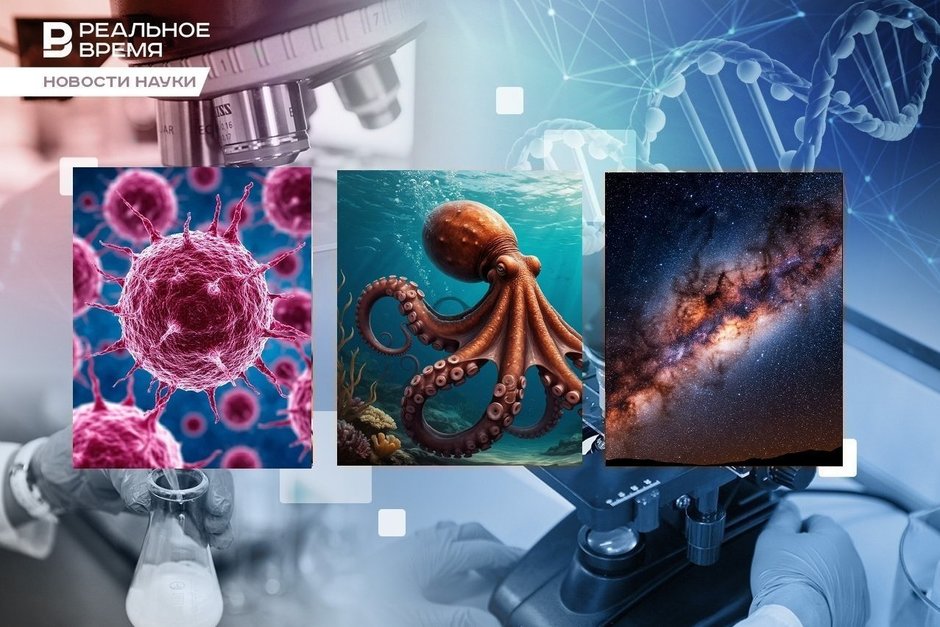
A gene has been found that influences the ability of cancer cells to “sprout” metastases. Stars in the Milky Way stop forming 38,000 light-years from the center of our galaxy. Russian scientists have developed a rapid test for heart attacks using a drop of blood, which is 45 times more sensitive than analogues. In the age of dinosaurs, giant octopuses the size of a modern six-story building hunted in the seas. Plant seeds “hear” the sound of rain and germinate a third faster under it.
A gene determining the “seeds” of cancer metastases found
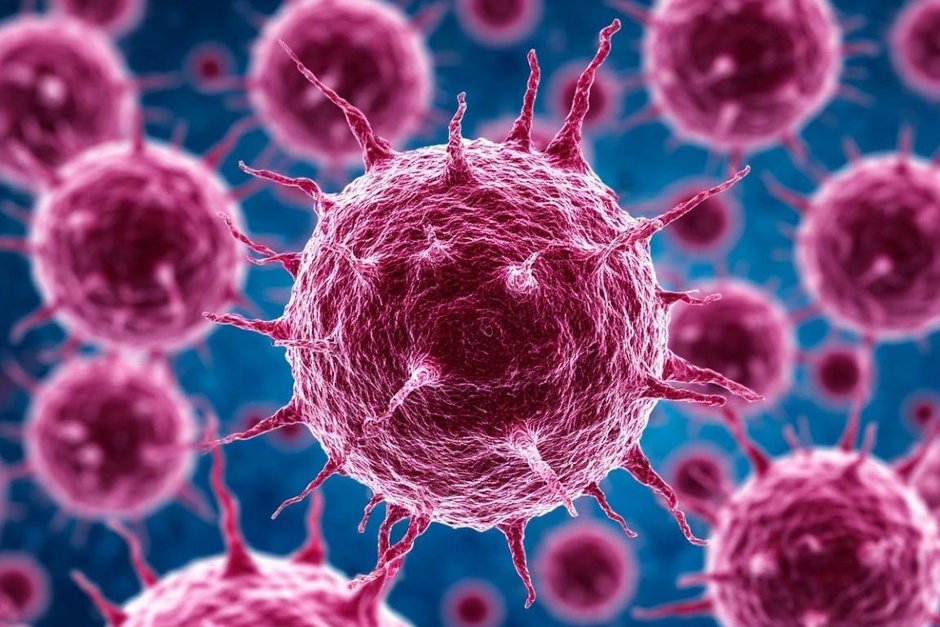
Modern medicine has almost learned to fight primary cancerous tumors. The issue of metastases has come to the forefront. It is still unknown how to predict whether a tumor will metastasize or not. And if it does, how aggressive it will be. Spanish scientists, who have been studying the migration process of cancer cells through the body for several decades, have published a paper claiming that “seed” cells for metastases can already be found in the primary tumor.
So, there are special cells in the primary tumor that can travel through the body and penetrate other tissues. Whether they will proliferate there (thus becoming the start of a metastasis) or whether they will remain dormant is the key question. It turns out that this behavior of cancer cells is not random. It does not depend on what their microenvironment will be.
The metastatic potential is embedded in these cells already at the primary tumor stage. Under the influence of the Prrx1 gene, cancer cells transition into a highly metastatic state; this gene is the commander-in-chief of the army of tumor cells. It not only forces them to detach from the primary tumor and be carried away by the bloodstream but also controls how they will behave further — whether they will lie dormant for years or immediately decide to proliferate.
However, tumors often present a paradoxical picture: cells with a high capacity for division do not spread well. Conversely, “light-footed” travelers do not always cause metastases. This is explained by the level of the Prrx1 gene. If its level is very high, the cells actively spread but lose their ability to sprout and proliferate. The most dangerous situation is when the gene's expression level is moderate. Then the cancer cells both travel and proliferate very actively.
The scientists reached these conclusions by studying genetic mouse models, conducting single-cell analysis, and studying the collective behavior of cells within tissues. They then moved on to humans: they analyzed tissue samples from breast cancer patients. The behavior rules of the Prrx1 gene turned out to be similar in mice and humans.
Further research promises to uncover more about the metastatic potential of cancerous tumors and ultimately protect patients from cancer metastasis by preventing tumor cells from transitioning into their most dangerous state. It is likely that if the harmful gene can be switched off, this might be achievable.
Where the stars of the Milky Way stop forming
The Milky Way is a disk galaxy. Stars form in it from the center outwards. But this “spread” is not infinite. Somewhere the galaxy must end — at the boundary beyond which stars no longer form. Scientists from the University of Malta have, for the first time, precisely calculated where this boundary lies.
There is a so-called “break” in the Milky Way — a clear edge beyond which the brightness of stars drops sharply. Astronomers believe this break is the boundary of star formation. Stars beyond this boundary migrated there from the inner region, meaning they are older. Therefore, they shine more faintly. Consequently, such a boundary can be found from within the galaxy, without visually observing the break line, by studying the distribution of stars of different ages.
The Maltese astronomers took data from the large astronomical surveys LAMOST, APOGEE, and Gaia, studied them, and classified stars by age. They found that stars in the Milky Way stop forming approximately 38,000 light-years from the center. At distances of 23,000–32,000 light-years, stars are generally younger because active star formation is occurring there. After that, the value reaches a plateau (32,000–38,000 light-years from the center). When star formation ceases, only old stars live beyond that point. The “break” occurs at 38,000 light-years.

The solar system is located approximately 26,000 light-years from the center — inside the star formation boundary.
Scientists at MIPT devise a way to diagnose heart attack from a drop of blood
The earlier a myocardial infarction is diagnosed, the more likely the patient is to survive — that's an axiom. Today, a heart attack is confirmed by laboratory tests, but they can be complex to perform, and waiting for results can take half an hour. Existing rapid tests have been insufficiently accurate: the sensitivity is too low, so they might miss early signs of heart muscle damage.
Russian scientists from MIPT and the General Physics Institute of the Russian Academy of Sciences have created a rapid test for diagnosing myocardial infarction. It is 45 times more sensitive than existing analogues. The marker of myocardial damage is detected within 6 minutes using a single drop of blood. The drop is applied to a test strip, and a rotating magnetic field is simultaneously activated.
The marker used is not the standard troponin found in conventional tests, but fatty acid-binding protein (FABP), which appears in the blood within the first hour after the onset of a heart attack and signals the problem first. However, detecting it requires a very sensitive tool.
To tag this protein, a new type of magnetic label was used: elongated threads of iron oxide hundreds of times thinner than a human hair. An antibody to the FABP protein is attached to their surface, turning the threads into traps for the marker.

In a rotating magnetic field, they stick to the marker protein and precipitate on the test line, producing a visual result. The magnetic mixing allows capturing the entire volume of the test material. Thanks to this, the test can detect the marker protein concentration in a very small range — 45 times lower than conventional tests.
Before introducing the test into clinical practice, it needs to be tested on large patient groups, a compact version of the analyzer must be created, and the necessary documentation obtained. However, in the future, using similar platforms and magnetic nanochains in a rotating magnetic field, other elusive biomarkers — from cancer markers to food toxins — could be investigated.
Octopuses the size of a six-story building hunted in the seas during the dinosaur era
During the Cretaceous period (145 million — 66 million years ago), the seas were inhabited not only by fish and reptiles. Giant octopuses up to 19 meters long roamed them. This corresponds to a modern 6— or 7-story building. Fortunately, no living creatures of this size remain on Earth, and the dimensions were reconstructed by Japanese paleontologists by studying fossilized beaks of ancient cephalopods.
Until now, scientists thought that sharks, plesiosaurs, and mosasaurs were the true masters of the Cretaceous seas. Invertebrates like octopuses and squids were considered small, modest animals unlikely to compete with large predators. But not so fast, researchers from Hokkaido University report. They studied octopus beaks from paleontological museum collections, added data from newly collected fossils, and concluded that dinosaurs-era octopuses were almost on a par with the dinosaurs themselves and occupied a central place in the ecosystems.
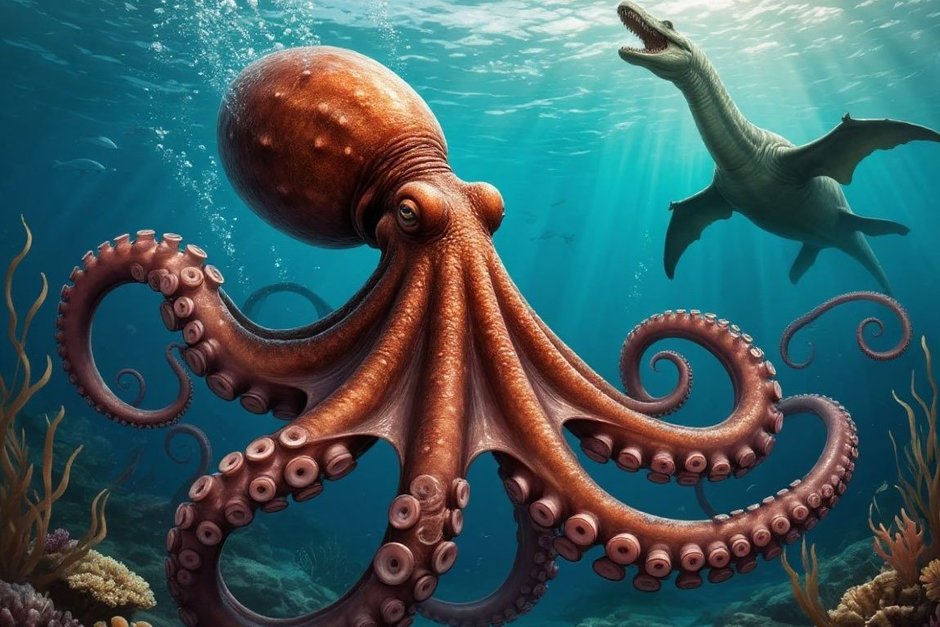
The problem is that octopuses have no skeleton or shell, and soft tissues do not preserve for 100 million years. Therefore, they are studied exclusively through their fossilized beaks. Twenty-seven beaks, dated from 72 to 100 million years old, were re-examined (including using digital reconstruction with AI).
It turned out that ancient octopuses of the species Nanaimoteuthis haggarti could reach lengths of 6.6 to 18.6 meters. This conclusion was drawn by comparing the beaks of modern octopuses with their body sizes. This means these charming mollusks were among the largest invertebrates in Earth's history.
Incidentally, modern octopuses are among the smartest invertebrates on the planet. So, perhaps their ancient counterparts were true masters of the seas.
Rice seeds germinate faster under the sound of rain
Plant seeds can not only perceive rainwater for germination but also react to the sound of rain. This discovery was made by American scientists. According to them, falling raindrops propagate acoustic waves. This causes vibration in the structures inside cells responsible for gravity perception. The plant embryo “thinks” that there is definitely water on the surface. And it germinates 30% faster!
These surprising data were obtained by American scientists from the Massachusetts Institute of Technology during experiments with rice seeds. The grains were placed at the bottom of water tanks — simulating the puddles in which rice grows naturally. Water was dripped from above, and underwater microphones recorded the acoustic pressure. The germination speed of seeds “under the rain” was compared with the speed of a control group growing in complete silence.

Rain noise accelerated germination by 24–37%. However, this mechanism only works at depths of up to 5 cm. Deeper than that, the sound waves dissipate and stop affecting cellular structures.