“It became clear to me that neither the sea nor the language dies, they only transform”
Daniya Zhansi presented her book on language and identity as a public talk
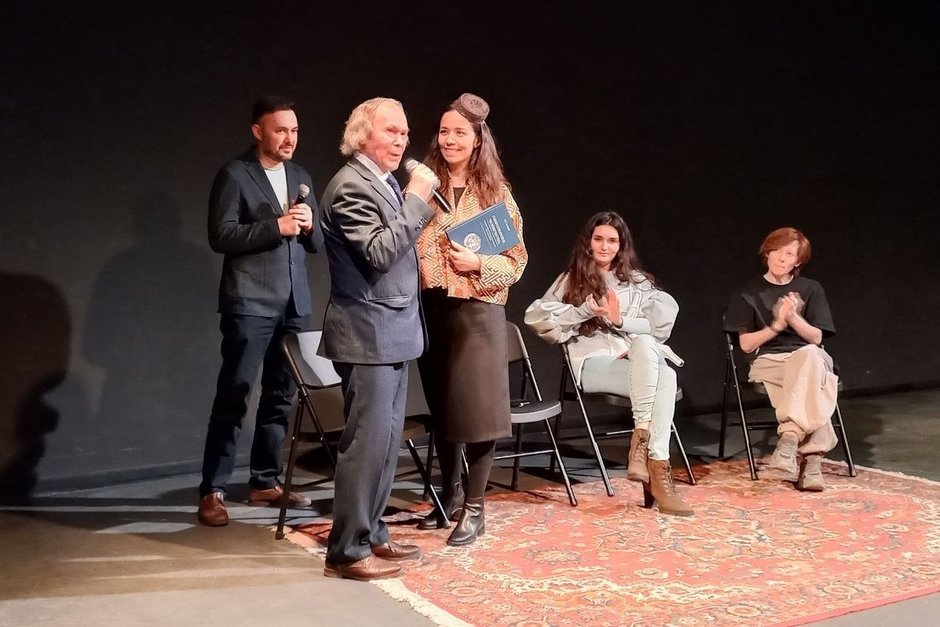
Daniya Zhansi presented her second novel, “DRUZHBA," in the format of a public talk on the theme “Language, City, and Loss” at the MOÑ theater platform. The discussion included director Tufan Imamutdinov, poet Yoldyz Minnullina, and orientalist and Iranologist Yultan Sadykova, while historian Engel Tagirov asked permission to call Zhansi his “spiritual daughter.”
Language and the sea
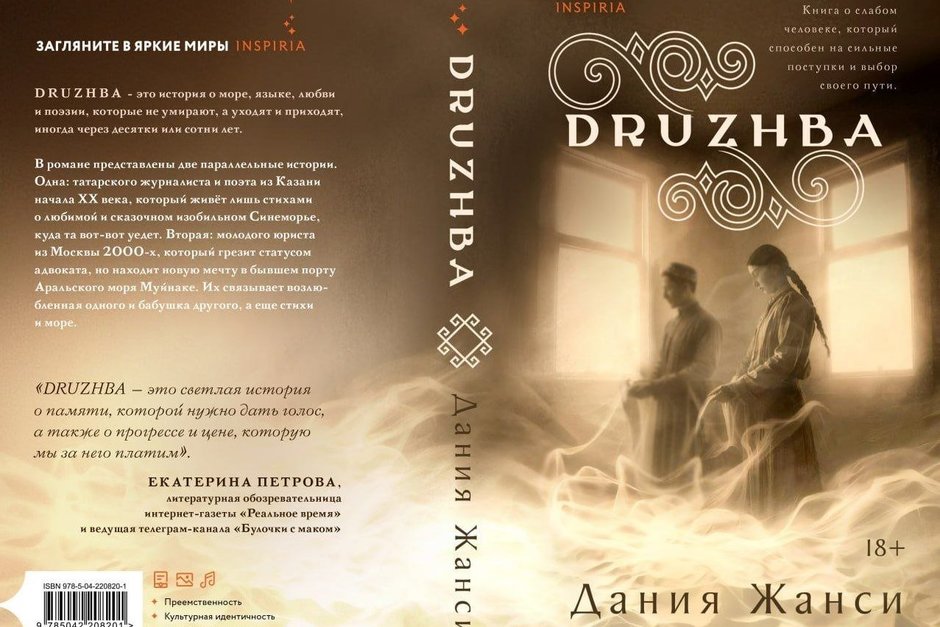
The novel “DRUZHBA” was published in the “Loft. Contemporary Novel” series. Two years ago, the same publisher, Inspiria (Eksmo), released Zhansi's first novel, “The Travels of Leila.” If the earlier Russian text was interspersed with English words, the second major work includes many inclusions of Tatar written in Latin script.
— Initially, I conceived the novel as a narrative about the dying of the Tatar language and the Aral Sea. However, during the writing process and immersion in the material, I came to a different conclusion, — said Daniya Zhansi. — It became clear to me that neither the sea nor the language dies; they only transform. They are capable of connecting people and events even across hundreds of years. This thought became central to my novel, changing its original message. I realized it was not about disappearance, but about eternal movement and renewal.
The author's idea for the novel began to form after watching the play “Alif” in St. Petersburg. In this play by Tufan Imamatdinov, Nurbek Batulla dances with his body, depicting the letters of Tukay's poem “Native Language.” Additionally, the text was influenced by research on the Aral Sea conducted by the writer's husband.
— I believe that language does not die but transforms; attempts to “bury” it are premature, — noted the director of “Alif," Tufan Imamatdinov. — The transition from one system to another leads to information loss, making it impossible to read many Tatar literary works in the original. A huge layer of Arabic calligraphy stored in museums becomes inaccessible for understanding. Although there are specialists in deciphering, the volume of literature is too great. For us, this was a transition from the standard understanding of Tatar theater to a non-standard one, opening new paths.
Sunchelyai and Bulat
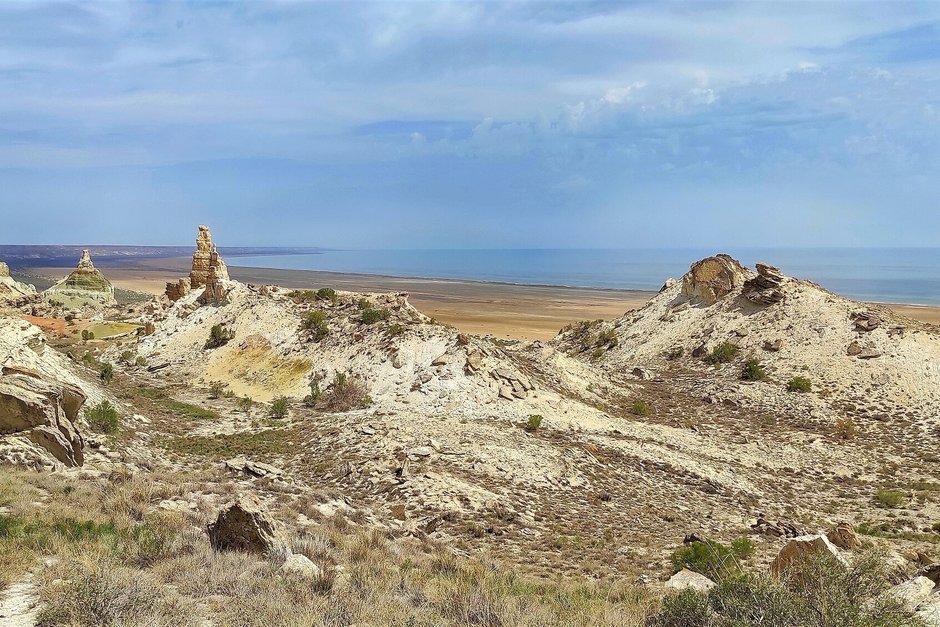
Indeed, one of the novel's heroes, a contemporary lawyer named Bulat, attends a certain performance — these events are mentioned at the beginning and end of the text. His storyline develops mainly in Muynak, a former port on the Aral Sea. Another hero lives in pre-revolutionary Kazan; he is a poet and journalist named Sunchelyai. The main question tormenting them, perhaps, is the question of identity. Who are they?
— I think my characters have a multiple identity that is not lost but transformed, — Zhansi said. — They face the search for themselves in different socio-cultural and linguistic environments. For example, the early 20th-century hero strives for roots and traditions but is also drawn to European culture and literature. I used my own experience of living between Russian and English to understand their inner contradictions. Bulat, my contemporary hero, also undergoes an identity transformation, finding new values and making non-obvious decisions. This is a process of continuous self-discovery and adaptation.
One of the first readers of the novel was Iranologist Yultan Sadykova:
— Language is something that existed long before societies, systems, regimes, politics, — she noted. — It is the background against which we all exist, against which states are born and die, wars are waged, reconciliations occur. Language remains. It is a boundless, endless river. We are a means for language's existence, not the other way around. It will remain after us, too.
— Language for me is an umbilical cord, not chosen like parents; it is a given. In adolescence, there is a desire to renounce what is imposed, to find one's own path and language — something I experienced, — Sadykova noted. — However, with age, this umbilical cord does not let go, causing a strong pull towards roots. My primary language now is Persian, then English, but the Tatar language evokes deep feelings in me.
Incidentally, poet Yoldyz Minnullina noted that “Alif” also began with Yultan Sadykova: Tufan Imamatdinov initially tried to make “Alif” about Persian poetry, but then realized that Tukay wrote with the same Arabic letters.

For languages to live — for Russia to be
The scientific editor of the novel was Bakhtiyar Izmailov, a senior researcher at the Marjani Institute of History. He asked the author: why is Sunchelyai so lucky to be surrounded by great people, while the contemporary Bulat seems to have no such titans nearby?
— From the late 2010s, it seems to me, and even now — is a time of revival of Tatar culture. Many grassroots initiatives have begun to appear, not imposed from above, but organically living and developing, seeking new forms. This is the living life of culture and language, — said Zhansi, noting, in particular, that she was fortunate to live in Kazan for a while during the writing process. Indeed, an attentive reader will notice much local toponymy and names in the text, something generally lacking in contemporary republican prose.
— The Tatar language is exactly 3,000 years old, — academician Engel Tagirov concluded the conversation in his own way. — Exactly as old as the nation itself, the people themselves. After all, the beginning of our source of the Tatar language and nation is the second millennium BC. That is China, the borders of the Sayan Mountains. That is where the beginning of our language, our culture, our nation originates. If in 3,000 years we have not lost the language, even though we have lost almost a third... The Chinese language is 10,000 years old; they have lost 0.1-0.3%. We have lost a third. For the nomadic Tatar people, it was probably too difficult to preserve the restlessness, the pure-bloodedness of the language. Our conversation, this presentation — will we be able to preserve it? We probably will. We have the right to say: we will.
— According to UNESCO, we lose one to one and a half languages every day. Russia is on the brink, facing the question “to be or not to be.” For the language to live — means the people to live. For the peoples to live — means Russia to be, — added Tagirov.
After that, the academician asked permission to call Daniya Zhansi his “spiritual daughter” and gave her a new book.