How the law on “russification” of business will work and how to mitigate risks
Change signage or register trademarks? Take on risks or wait for the first court cases? Experts explain

A roundtable titled “New Requirements for Foreign Names: What Businesses Should Do with Signage, Brands, and Trademarks” was held at the Tatarstan Entrepreneurship Support Fund. Experts met with business representatives to explain how to operate with the use of foreign words starting from March 1. Anna Kupriyanova, Executive Director of the Autonomous Non-profit Organization OZOIS and a Patent Attorney, and Gennady Zolotov, Head of the Innovation and Intellectual Property Commercialization Department at the Russian State Academy of Intellectual Property (RGIIP), detailed the essence of the changes and provided examples. Stanislav Fedorenkov, founder of a communications agency, gave examples of how to work with these changes from a marketing perspective.
In the beginning was the word. Russian word
On March 1, 2026, legislative amendments came into force in Russia establishing requirements for the use of foreign words and trade names in public spaces. The regulations cover store signage, cafe and restaurant names, names of retail outlets and service companies, advertising and informational signs, and essentially all business communication with end customers.
What does this mean for business? Is it necessary to change the name? How to design signage? Can English words be used in a brand? These questions were answered by Anna Kupriyanova, a Patent Attorney of the Russian Federation. She drew attention to the key requirements:
- All information presented to the end consumer must be in Russian. This applies to signage, websites, booklets, restaurant and cafe menus, any presentation and demonstration materials, and even navigation elements in a space. Example: a sign reading “Bouffet” at a conference venue must be in Russian (or in two languages, with Russian placed first).
- Information can be duplicated in English, Tatar, or any other language, but priority is given to the Russian inscription. First, it must appear first, and second, it must be in a font no smaller and written in a color as bright as the foreign language version. Example: the sign for the store “Koyash” must now read “Solnyshko. Koyash” (Sun. Koyash).
- Using transliteration (e.g., writing “neiche” for “nature”) is not a solution. An adequate, literal Russian translation of the word is required. So, not “enerdzhi bar” but “energetichesky batonchik” (energy bar).
- However, if the words are Anglicisms that have already entered the Russian language, they may not need translation. For example, the word “pr” (public relations) is considered such. To determine if a word can be left untranslated, it must be checked against the Russian Academy of Sciences' “Dictionary of Anglicisms.”

What's cheaper — change the sign or register a trademark?
There are two exceptions to the above rules. First, Latin script or English in a brand name is permitted if it is registered as a trademark. For example, Ozon. If an entrepreneur has done this, they may not need to change the English-language signage. However, the business must be registered as a legal entity — trademark registration is not applicable for individual entrepreneurs and self-employed individuals.
— Registered trademarks are those for which a certificate from Rospatent has been issued. Attention: a submitted application is not considered registered! — Anna Kupriyanova pointed out to the audience.
Participants briefly discussed that trademark registration is a paid procedure, costing an average of 100,000 rubles. For an enterprise with a turnover of, say, 600,000 rubles, this is a significant sum. Making a new sign might be cheaper, but what to do about customers' established habits regarding the old name — that's another matter.
The second exception is if the Latin script or borrowed word is specified in technical regulations for a particular type of product. For instance, B12 (vitamin name), Wi-Fi, or Bluetooth (in the sense of technical addressing means) do not need translation. However, experts recommend checking the existence of such technical regulations for each product.
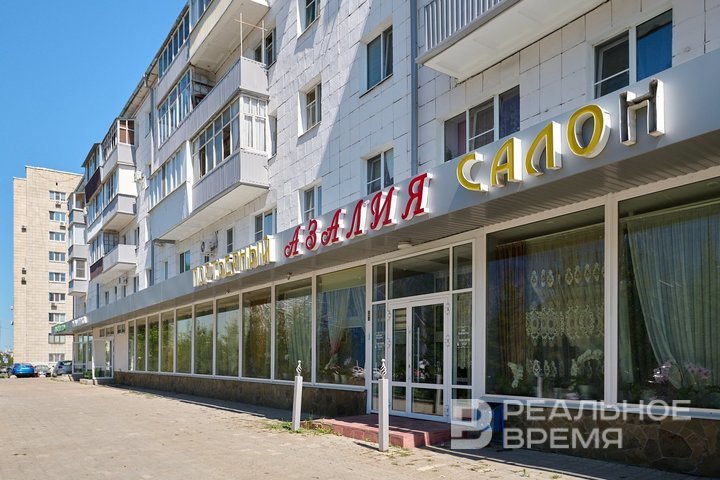
“One would like to believe we won't descend into absurdity”
— Many ask if there is a transition period. In fact, there was one, but it has already ended. The law was passed over six months ago, — Anna Kupriyanova explains. — And it has now come into force. But in practice, many only became concerned about this issue now that liability can already be imposed.
Contrary to alarming posts on social media, specific fines have not yet been levied — all three invited experts agreed on this. But this does not mean one can leave an English sign and hope for the best. The law provides for fines for violations ranging from 3,000 to 40,000 rubles. Experts suggest that initially, enforcement will start with warnings, with fines coming later.
Gennady Zolotov from RGIIP notes that the new law has indeed caused significant controversy. Enforcement practice will develop in the near future, so it is difficult to predict which direction it will take.
— One would like to believe we won't descend into absurdity and won't have to translate things that are already in common use and established in other regulations. A kind of “safety net” for entrepreneurs is trademark registration, which allows the use of foreign words. But there are no clarifications yet on whether foreign words included in a trademark but deemed unprotected by Rospatent — such as “bakery” or “coffee” — are permissible. How practice will evolve is still unknown, — the expert noted.
He reminded the audience that Russian was established as the state language of the Russian Federation not yesterday. Therefore, it is not at all surprising that legislation has arrived at its current norm.
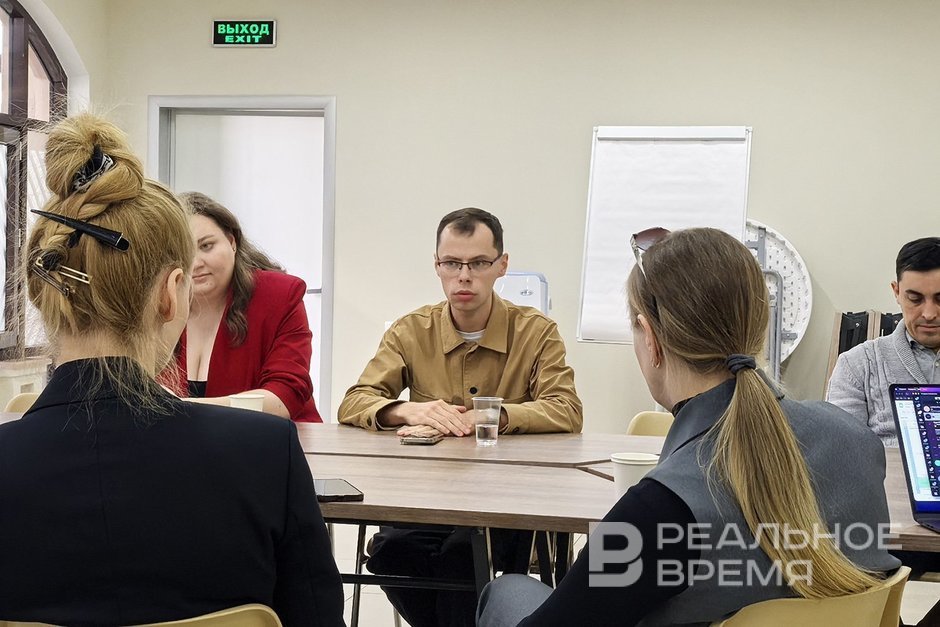
“Those who didn't sense this earlier are now facing certain problems”
Stanislav Fedorenkov, as a marketing specialist, gave recommendations to entrepreneurs on how to turn the changes brought by the new law to their advantage.
— It's important to understand that for marketing purposes, we as consumers have long been cultivated to believe that Anglicisms are beautiful, fashionable, and signify quality. We got used to it. But the initiative now being introduced was obvious. And I support it. Those who didn't sense this earlier are now facing certain problems, but they are absolutely solvable! — the expert said.
Stanislav Fedorenkov provided several hypothetical examples across different business sectors on how to turn the situation to one's advantage.
Restaurant business: Firstly, restaurateurs have started urgently registering brands, as establishment names often involve foreign words. Secondly, they are changing in-house navigation: changing signs (e.g., “reserved” to “stolik zabronirovan”). Thirdly, some restaurateurs are revising menus, writing Russian names for dishes — making them more understandable for visitors. This is a positive development.
Food production: Food industry players are putting understandable Russian names on products and introducing visual product representations. Thus, they are replacing and improving packaging.
Clothing sales: Several sellers are starting to use Russian words for clothing style descriptions. For example, “bootcut” is being replaced with “klesh ot kolena” (flare from the knee), etc. New collections are being released with new labeling. In Fedorenkov's view, this looks interesting, becomes clear, and attracts buyers.
For the construction sector, the expert advises simply naming new residential complexes with Russian words and phrases. What to do if an English name already exists and a registered trademark does not? Register it urgently.
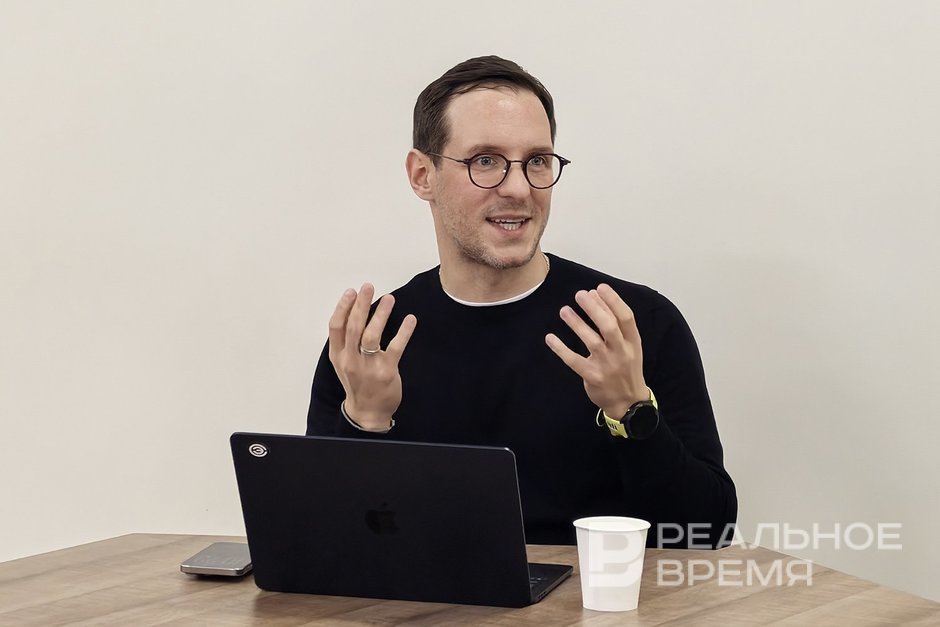
Don't delay submitting your trademark application
Entrepreneurs asked the experts specific, practical questions. For example, the owner of an English language school had not managed to register her trademark, and her school's name is in English. She asked: does she need to translate her sign? The experts replied: either order a new sign where the English name includes a Russian translation, or register the trademark (provided such a brand is not already registered).
The difficulty is that trademark registration can take a considerable amount of time: a year is not the limit. Meanwhile, the law is already in effect, and the English-language sign is still up. Gennady Zolotov reasoned:
— Perhaps you'll manage to register the trademark faster than the first claims reach you. But you should plan for at least six months. There is, of course, an expedited registration procedure, but it is quite expensive. Therefore, if you plan to register a trademark, it is best to file the application as early as possible. Then, if Rospotrebnadzor (consumer protection agency) comes with a claim, the fact that you are awaiting registration may serve as an argument. However, the risks remain with the old sign until registration is complete.
Gennady Zolotov emphasized this point: if you use a foreign-language trademark that is not yet registered, you are taking on the risks!
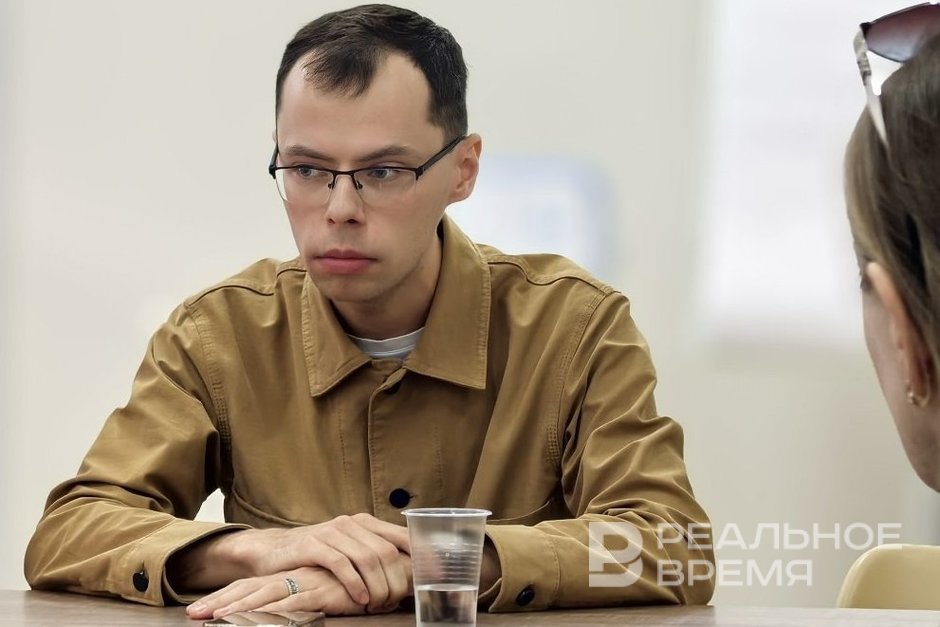
No man is an island: need to unite to overcome the limitations of the RAS anglicism dictionaries
Another contentious point that sparked discussion was dish names in public catering. Not all names of world cuisine dishes are included in academic dictionaries; the HoReCa sector is constantly seeking novelty. But what to do if the word “lamadjo” is not in official dictionaries? Write “Armenian flatbread with minced meat” in the menu of an Armenian restaurant?
— How public catering will handle this remains an open question. The law clearly defines the adaptation procedure: the Russian language must come first. But restaurants serving national cuisine strive to reflect dish names in their national language. I believe that in such cases, entrepreneurs in a given sector should unite and develop standards for their industry — adopt regulatory and technical acts that legitimize “unclear” terminology for that specific field. So, essentially, it's our task to provide the definitions we need or introduce the concepts we require. I understand this is an additional burden on business. But if we want to use certain terms, we need to unite and introduce specific standards, corresponding GOSTs (state standards), etc. This would be an excellent way around the dictionaries proposed by the Russian Academy of Sciences. Because there is fierce criticism directed at them — these dictionaries are very far from contemporary language. So, we'll have to do the work ourselves, — Gennady Zolotov offered a practical recommendation.
Ultimately, the experts warn: it is necessary to try to comply with the law as much as possible, anticipate all potential issues, and “prepare the ground.” If your English-language name is valuable to you, register the trademark. If you are ready to “Russify," change the sign promptly. Change the navigation, translate all English words on your website. Because, although court practice for such cases has not yet developed, you wouldn't want the first precedents to involve your business.

The day after the roundtable, Gennady Zolotov conducted a training seminar with entrepreneurs.
Anna Kupriyanova summarized the two days of productive work:
— In our view, organizing such events is a very important part of communication between the expert community and business when such significant laws, which adjust market behavior, are being adopted. During the roundtable, Gennady Zolotov, a federal-level specialist, provided clarifications on how to handle changes in branding and communication with end consumers. The next day, he conducted a training seminar dedicated to intellectual property protection. He explained how best to secure these rights, how to preserve them, and how to defend one's brand. Thanks to his visit for our events, entrepreneurs of Tatarstan received practical advice and undoubtedly learned a great deal of important and new information.