Sleep, protein, and stellar death: five scientific discoveries changing our understanding of the world
Interesting science news of the week
Artificial intelligence peered into our sleep and saw what doctors had been missing for decades. Physicists created a mathematical model where a wave moves faster than sound, but information does not. Biologists found a protein that heals the liver through the brain, not through diet. Chemists made particles dance, violating Newton's third law. Astronomers spotted dozens of previously invisible shock waves in the Helix Nebula. Realnoe Vremya has gathered five scientific discoveries that are changing our understanding of how the world works.
Sleep as a predictor: AI spotted in nocturnal recordings what doctors miss for decades
We are accustomed to diagnosing sleep apnea based on a single indicator — how many times a person stops breathing per night. This index (AHI) has been considered the gold standard for many years. But a study published in Nature Communications turns this practice on its head: it turns out that AHI says almost nothing about the risk of death or cardiovascular disease. However, if you let artificial intelligence analyze the entire night's recording — brain waves, heart rate, breathing, and oxygen — it finds hidden patterns that predict future diseases much more accurately.
Scientists trained a neural network on data from more than 10,000 overnight sleep studies, linking them to patients' medical records. The model identified five risk groups. In the most dangerous group, the risk of death was more than twice as high as in the safest group — even though the standard apnea indicators of these people could be completely different. Someone in the high-risk group had severe apnea, someone had mild apnea, or even none at all. The mere number of breathing pauses said nothing about the real danger.
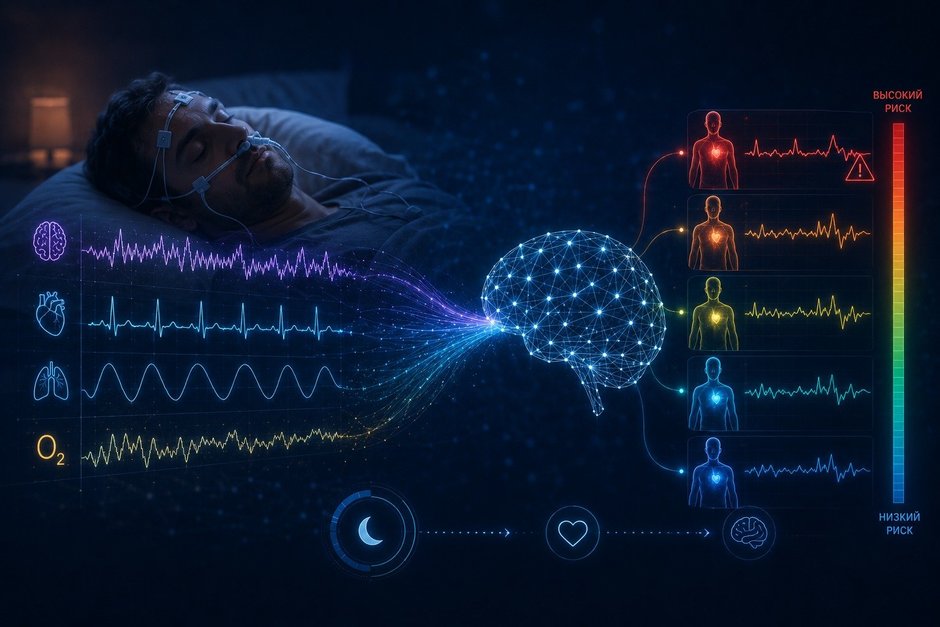
The conventional AHI index showed no correlation with mortality at all: people with “severe” apnea died no more often than those with normal breathing. Doctors relied on this indicator for decades, but it turned out to be almost useless for prognosis. However, the AI model detected subtle disturbances — how often a person wakes up, how their pulse changes, how the brain reacts to oxygen deficiency. These signals, invisible in a standard report, added up to a complete picture.
The scientists tested the model on independent data from another large study — and the result was confirmed. People whom the algorithm classified as high-risk did indeed die more often and more frequently suffered from heart disease, strokes, and dementia. At the same time, the model worked even on coarser sleep recordings made at home rather than in a laboratory.
What does this mean for the average person? Today, millions of people with apnea receive the same treatment: breathing masks, surgery, regardless of whether they are actually at risk. Some are treated unnecessarily, while others, on the contrary, remain unattended because their AHI “does not reach” the severe category. The new model allows pinpointing those who truly need help and not wasting resources on those who are safe. Doctors will be able to prescribe treatment not based on the number of breathing pauses, but on the real risk to health.
The study is another step toward personalized medicine, where a computer helps the doctor see what is hidden behind dry numbers. And perhaps soon we will not have to entrust our health to a single number — artificial intelligence will look into our sleep deeper than we ourselves can.
Almost supersonic: how two waves create the illusion of speed that violates physics
Imagine: you throw a stone into water and see the ripples from it reach the shore faster than they should. It sounds like science fiction, but physicists from the University of Pennsylvania and the Woods Hole Oceanographic Institution have theoretically predicted exactly this phenomenon for acoustic waves. It turns out that if the source and receiver are near a reflecting surface, the interference of the direct and reflected waves can create a wave packet whose peak moves faster than the speed of sound in that medium. But do not rush to conclusions — information is still transmitted slower than the speed of sound, and for light, slower than the speed of light.
When sound travels from the source to the receiver by two paths — directly and after reflection from a wall — these two waves overlap. Depending on the path difference, they can either amplify or cancel each other out. As a result, the signal shape at the receiver changes. Scientists found that the moment when the envelope of this complex signal reaches its maximum can occur earlier than if the sound traveled only along the straight path. In numerical experiments for water with a speed of sound of 1500 m/s, this “peak” appeared as if it were moving at a speed of 1694 or even 2782 m/s — almost twice the normal speed of sound. The effect occurs when the source and receiver are close to each other and at least one of them is within half the minimum time delay between the direct and reflected paths.
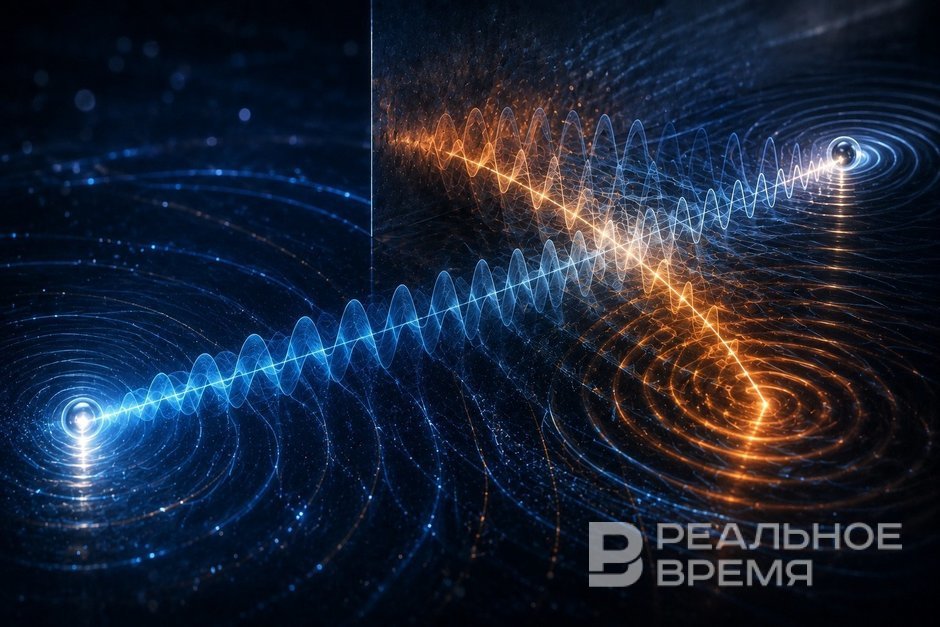
However, the physicists emphasize: this is only about the speed of the wave packet envelope, not the transmission of information. To understand this, they used a classical digital communication method: they transmitted two symbols (0 and 1) that differed only after the switching moment (the “non-analyticity point”). This point arrives along the straight path strictly at the speed of sound. A receiver with finite bandwidth and noise cannot distinguish symbols instantly; it needs time to accumulate enough energy. In simulations, the scientists calculated how long after switching the error rate drops to 10% (BER=0.1). For interfering paths, this time turned out to be shorter than for a single direct path, but in both cases, it occurred later than the arrival of the “non-analyticity point.” That is, information was transmitted at a speed less than the speed of sound, even though the energy peak arrived earlier.
These calculations echo the long-standing debate about superluminal group velocities in media with anomalous dispersion. However, here the medium is dispersionless, and the effect is purely interference-based. The authors suggest that a similar phenomenon should also be observed for electromagnetic waves in a vacuum near a reflecting boundary — then the peak of an electromagnetic packet could arrive faster than the speed of light. But even in this case, information cannot outrun light because the sharp front (symbol switching) travels along a straight line at the fundamental speed.
If this is confirmed experimentally, we will gain a new perspective on how waves interact with boundaries. This could affect the accuracy of location, communication systems, and even our understanding of speed limits. But for now, all this is theoretical calculations waiting for laboratory verification. And the most intriguing part: unlike a supersonic aircraft, such a “supersonic” wave packet does not create a shock wave — it simply appears as if it arrived faster, although the information still does not violate the main law of nature.
A life-saving protein: why weight loss is not the main thing in fighting a diseased liver
Two people are on a diet, lose the same weight, their livers clear of fat equally, but in one, inflammation recedes, while in the other, it does not. This is precisely what scientists from McMaster University discovered while studying the protein GDF15. It turns out that it fights liver inflammation not through weight loss, but through a completely different mechanism — and this changes the approach to treating the most common liver disease in the world.
Today, every third liver in the world is diseased with obesity — this is called MASH (metabolic dysfunction-associated steatohepatitis). The disease begins with fat but kills with inflammation and scarring. Doctors thought for decades that if a patient lost weight, the liver would recover. And they were right, but only partly. New research in the journal Cell Metabolism showed: you can lose weight, remove fat from the liver, but inflammation will remain — if the body lacks the protein GDF15.
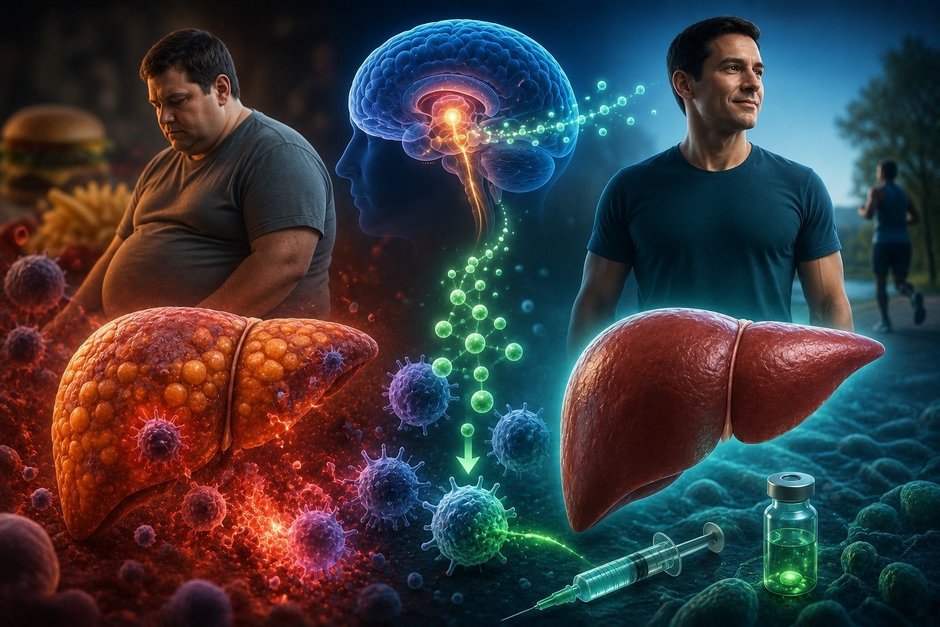
GDF15 is a signaling molecule that the body produces in response to stress. It is already known to suppress appetite. But the authors went further: they created mice with liver disease in which this gene was turned off. In such animals, inflammation and scarring were much more severe than in ordinary ones — with the same amount of fat in the liver. And when the mice were injected with artificial GDF15, the liver recovered more effectively than from simple fasting.
It turns out that GDF15 does not act directly on the liver but through the brain. It binds to a receptor in the hindbrain, which triggers an alarm signal — the hypothalamic-pituitary-adrenal axis. In mice, this led to a release of stress hormones (corticosterone), and these directly calmed inflammatory cells in the liver. “It is as if the brain sends a message to the liver: calm down, everything is under control," the authors explain.
What is the practical meaning? Today, the only way to cure severe liver disease is to lose a lot of weight, sometimes even with bariatric surgery. But not everyone can do this. GDF15 offers an alternative: a drug that calms inflammation and scarring even if the patient does not lose weight. This is especially important for people with obesity who find it difficult to lose kilograms, or for those whose disease has already progressed.
Scientists are already testing GDF15 analogues in clinical trials on humans. If the results are confirmed, it will be a breakthrough: a drug that heals the liver through the brain. One injection a day — and the liver stops inflaming, even if you are not on a diet.
Dancing clusters: how particles of different sizes break the laws of physics and do not let themselves freeze
In the world of colloidal particles, everything is usually predictable: throw a handful of microspheres into water, apply an electric field — and they will gather into a neat pile and freeze. This is how physics works for particles of the same size. But mix large and small balls — and chaos begins: instead of sticking together once and for all, they constantly gather into groups, fall apart, gather again — and so on endlessly. Scientists from Japan have discovered that this is not an accident, but a new state of active matter that could change our understanding of self-organization.
If you take polystyrene spheres of two sizes (1 and 1.5 microns) and apply an alternating electric field, the particles begin to attract each other. But this force is not equal in magnitude: a large particle attracts a small one more strongly than a small one attracts a large one. This violates Newton's third law — here action is not equal to reaction. For physics, this is exotic, but in the microscopic world, it is possible due to complex electrohydrodynamic flows that arise around charged particles in a field. It is this non-reciprocity that generates motion.
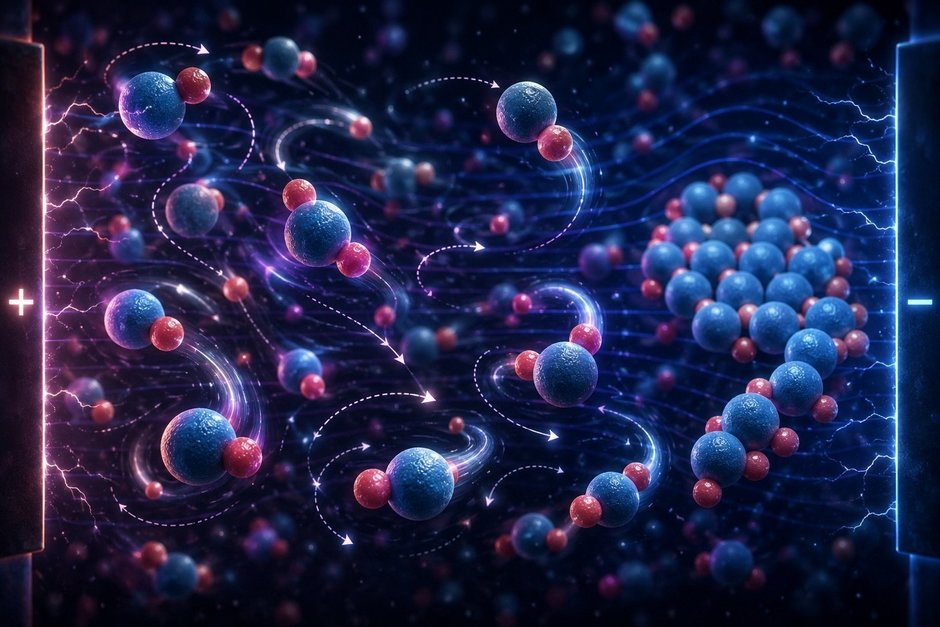
A “large-small” pair turns into a self-propelled dimer: they swim together like a tiny boat, because the forces acting on them are unbalanced. Such pairs accelerate to fractions of a micrometer per second, but their motion is chaotic: thermal fluctuations either break the pair or reconnect it. As a result, instead of a static aggregate, a constantly rearranging cluster forms, like a crowd on a dance floor — someone leaves, someone arrives, the overall picture never freezes.
In a conventional (monodisperse) system — only large spheres — the field forces them to gather into a dense crystal, and it no longer moves. It is as if people stood in a tight wall and froze. And in a mixture of large and small — a living, breathing structure that never stops. Experiments showed that such activity can last for hours while the field is on. Scientists built a computer model that confirmed: the main ingredient is precisely non-reciprocal attraction. And the key to the constant destruction of clusters is the geometry of the pair: if the “head” (large particle) faces outward and the “tail” (small) inward, the cluster disintegrates. Swap them — and everything freezes.
This discovery is not just a fun experiment. It shows a fundamentally new way of controlling colloidal systems. By changing particle size or field frequency, you can switch the system between states: “frozen” and “dancing.” And this is a direct path to creating “smart” materials — coatings that rearrange themselves, or microrobots that assemble and disassemble on command. At the fundamental level, the work demonstrates how breaking the symmetry of interactions can radically change collective behavior, opening the door to the world of non-static matter.
Cosmic kaleidoscope: the record-breaking telescope saw dozens of shock waves in the Helix Nebula
When stars die, they do not just fade away — they put on a grand fireworks display. When a Sun-like star exhausts its fuel, it sheds its outer layers, creating a planetary nebula — a glowing gas bubble. At the center of such a bubble remains a white dwarf. The Helix Nebula (NGC 7293) is one of the most famous and closest to Earth (only 650 light-years away). But recent observations with the new giant telescope MOTHRA delivered a surprise: at its edges, astronomers discovered a forest of at least 22 shock waves, resembling bow waves from fast-moving ships. And no one had properly seen them before.
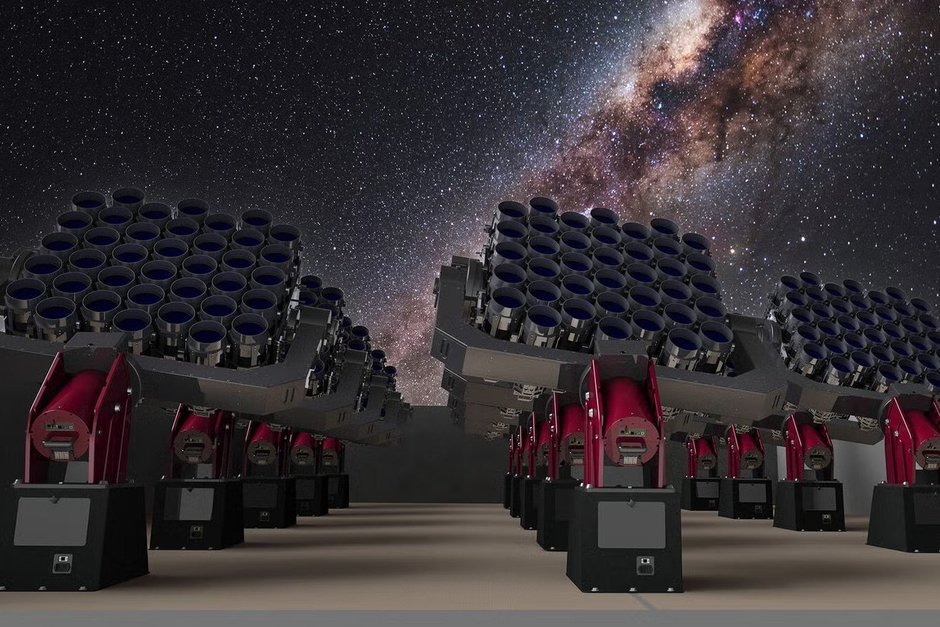
MOTHRA is not an ordinary telescope but an array of more than a thousand camera lenses with ultra-narrow filters. In test mode, it is already equivalent to a 4.8-meter refractor, and in the future, it will become even more powerful. With its help, scientists obtained an image of the Helix that shows structures previously hidden from view: many arc-shaped formations on the eastern side of the nebula. These arcs are shock waves that arise when fast clumps of matter ejected by the star in its late evolutionary stage crash into the surrounding interstellar gas at supersonic speeds.
The nebula itself moves through the interstellar medium at a speed of about 45 km/s. And its own ejections fly sideways at an additional speed — about 40 km/s. On the eastern side, these speeds add up, and the total shock reaches 80–90 km/s. It is there that bright arcs are visible. On the western side, the gas is already mixed with the turbulent “wake” behind the nebula, the speeds are lower — only about 35 km/s — and the waves there are barely distinguishable. Calculations confirm: a shock of 80 km/s should shine tens and hundreds of times brighter than one of 35 km/s, which is indeed observed in the images.
But the most interesting part is the objects themselves that create these waves. The foci of the parabolas used to approximate the arcs indicate the location of dense clumps of matter. But nothing is visible at these points! They are completely dark in the optical range. This means that these clumps consist mainly of neutral gas and dust, which do not shine themselves but reveal themselves only by their “wake” — the shock wave. It is as if you saw the waves from an invisible boat, but did not notice the boat itself.
Analysis of the shape and size of the arcs shows a clear pattern: the farther from the white dwarf, the smaller and more diffuse the waves become. The inner ones are large, thin, and clear. The outer ones are small, blurred, and ragged. This is direct evidence of the destruction of the clumps: at a distance of up to 0.4 parsecs (about 1.3 light-years), they are large and dense, but by 1.4 parsecs (4.5 light-years), they have managed to lose most of their mass, fragment, and mix with the surrounding medium. The lifetime of such structures is only about 10,000 years. This is an instant by cosmic standards, but this is precisely how heavy elements, dust, and gas born in the star's interior return to the interstellar medium to become raw material for the next generations of stars and planets.
The discovery is a crucial step in understanding how dying stars “recycle” themselves, enriching the galaxy. The next question: how common are such fragmented shock waves in other planetary nebulae? The new MOTHRA telescope, which is still under construction, will help find the answer. It is fast and sensitive enough to scan the sky for these elusive traces of stellar death. For now, the Helix Nebula shows us that even in an apparently well-studied object, the cosmos can surprise if you look at it in a new way.