Only 16 regions in Russia have average salaries exceeding 100 thousand rubles
Realnoe Vremya compiled a ranking of Russian regions by salaries, nominal and real incomes

The northern regions and Moscow turned out to be leaders in average salary levels. At the same time, in terms of nominal incomes, the capital slightly dropped in the rankings, and in terms of real income growth dynamics, the top changes significantly. Tatarstan did not make it into the top 15 by any of the three criteria, while Ingushetia is among the outsiders. For more details, see the material by Realnoe Vremya.
The leaders in average salary levels are the northern regions and Moscow
Based on the results of the first quarter of 2026, the leaders in average salary levels are the northern regions and Moscow. Thus, in first place is Chukotka (227.8 thousand rubles), in second place is Moscow (201.9 thousand rubles), in third place is the Magadan region (185.4 thousand rubles). The top 5 also includes the Yamalo-Nenets Autonomous Okrug (179.1 thousand rubles) and the Sakhalin region (156.1 thousand rubles), according to Rosstat data.
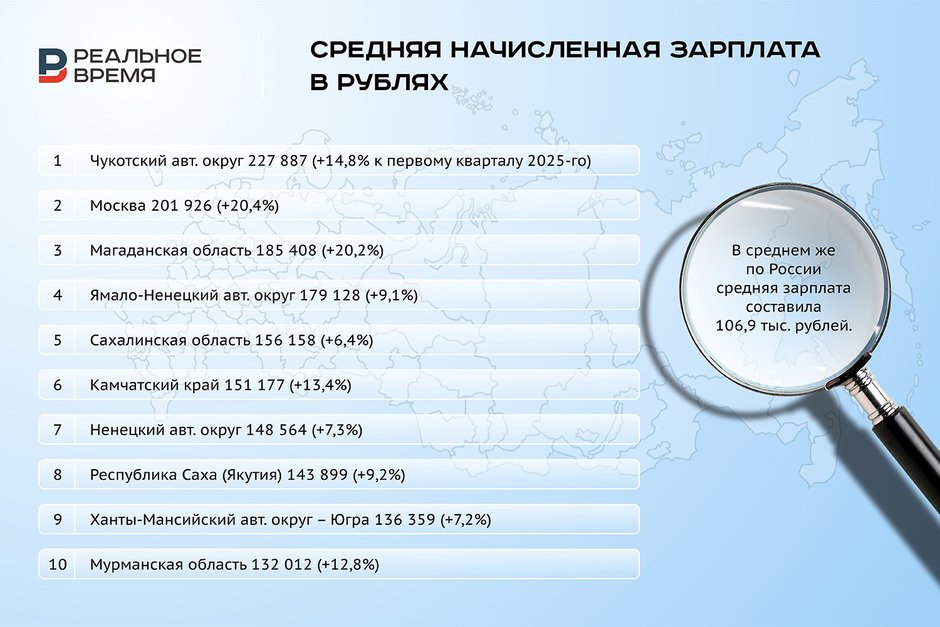
Other regions that made it into the top 10 include the Kamchatka Krai (151.1 thousand rubles), the Nenets Autonomous Okrug (148.5 thousand rubles), the Republic of Sakha (Yakutia) (143.8 thousand rubles), the Khanty-Mansi Autonomous Okrug — Yugra (136.3 thousand rubles), and the Murmansk region (132 thousand rubles). The average salary across Russia is 106.9 thousand rubles.
Note that when calculating average salaries, analysts sum up all accrued salaries in a group (for example, in a company, industry, or country) and divide by the number of employees. Moreover, taxes are not taken into account in the calculations.
Meanwhile, in terms of nominal income levels, Chukotka also retained first place (225.6 thousand rubles), while Moscow dropped to third place (166.7 thousand rubles). In second place, in turn, was the Yamalo-Nenets Autonomous Okrug (169.2 thousand rubles). The Nenets Autonomous Okrug retained fourth place (159.9 thousand rubles), and the Magadan region rounded out the top 5 (143.6 thousand rubles), while the Sakhalin region took only sixth place in the top (113.7 thousand rubles). In seventh place is Kamchatka (102 thousand rubles). St. Petersburg took eighth place (101.4 thousand rubles), and the top 10 was again closed by the Murmansk region (95.4 thousand rubles) and the Khanty-Mansi Autonomous Okrug (90.9 thousand rubles), swapping places relative to the first ranking. The average figure for the country is 69.1 thousand rubles.
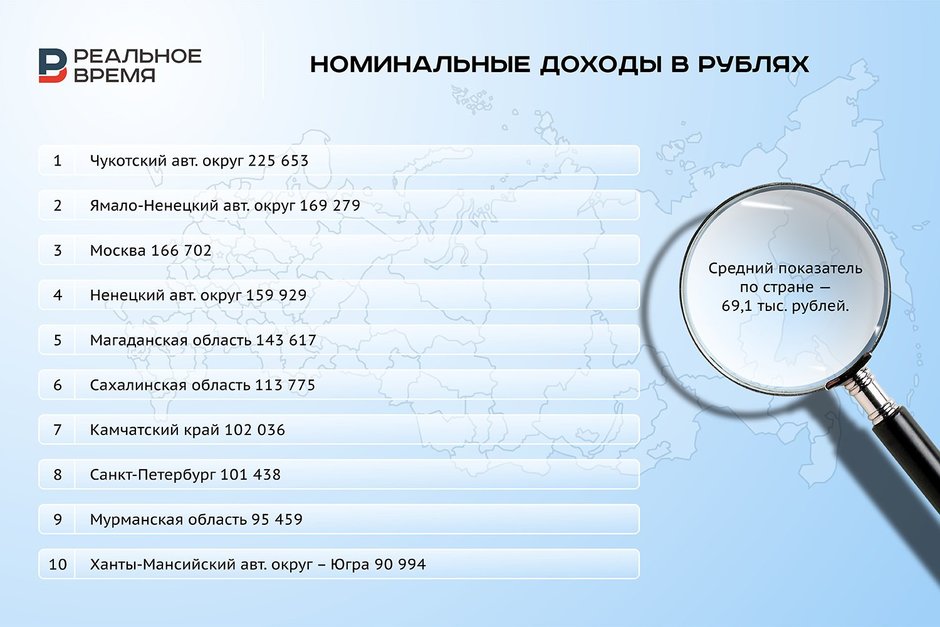
Recall that nominal income refers to all cash receipts of citizens for the reporting period. Unlike average salary calculations, this includes both money earned from hired labor and social benefits, income from business or investments, and so on.
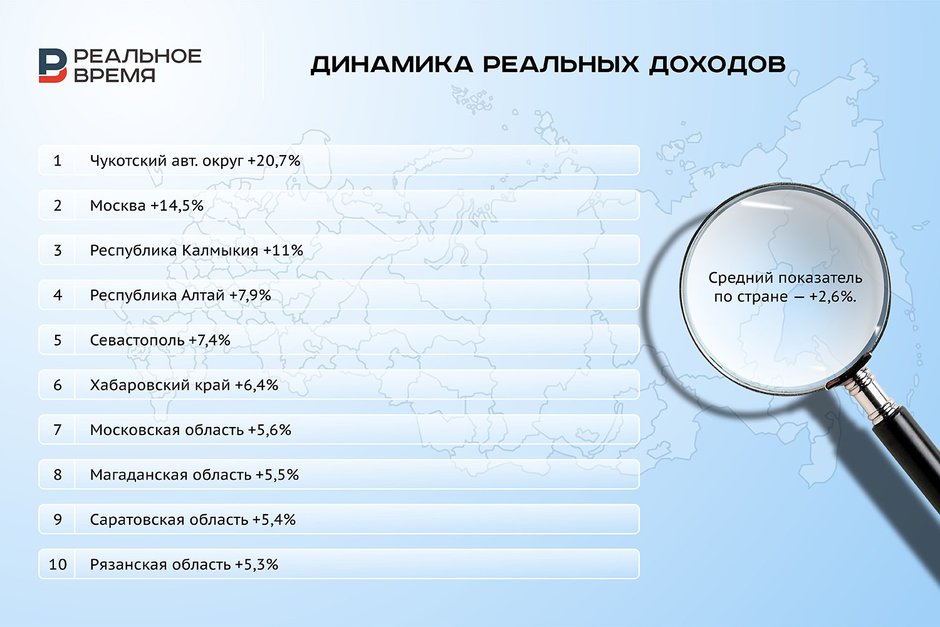
However, if we consider the regions by real income dynamics, that is, adjusted for inflation, the ranking visibly changes. Chukotka and Moscow, of course, are again among the leaders with indicators of +20.7% and +14.5%, respectively, but in third place is Kalmykia (+11%). Altai (+7.9%) and Sevastopol (+7.4%) made it into the top 5. In 6th to 10th places are the Khabarovsk Krai (+6.4%), the Moscow region (+5.6%), the Magadan region (+5.5%), the Saratov region (+5.4%), and the Ryazan region (+5.3%). The average figure for the country is +2.6%.
Tatarstan is at least in 16th place in the rankings
Meanwhile, Tatarstan ranked only 23rd in average salary levels with a figure of 94.1 thousand rubles. This is 53.3% less than in Moscow and 26.3% less than in St. Petersburg. In addition, the republican data is lower than the all-Russian data. The “salary indicator” in the republic is comparable to the Arkhangelsk region (94.3 thousand rubles) and the Jewish Autonomous Oblast (93.8 thousand rubles).
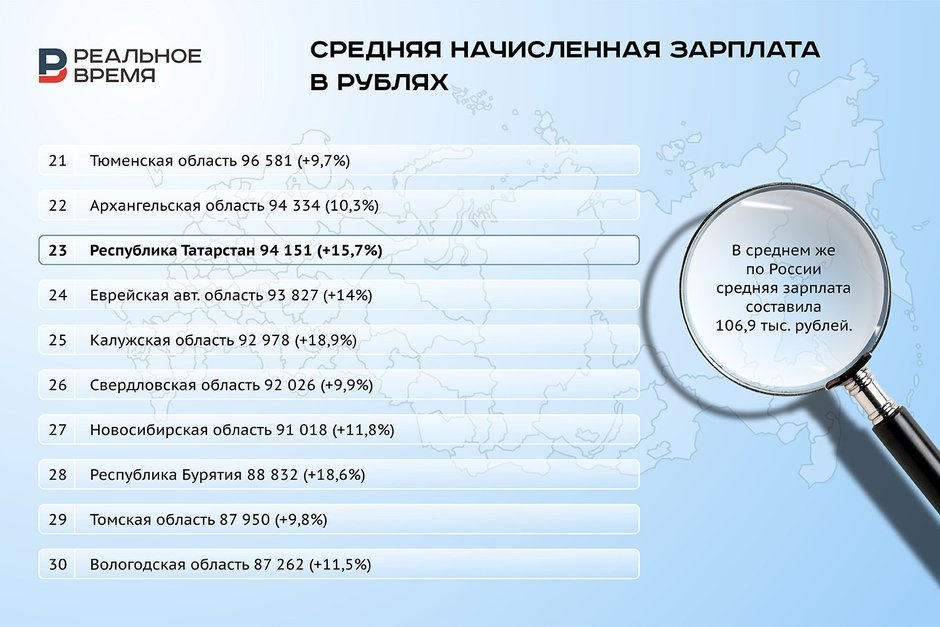
Also, salaries in Tatarstan are lower than in the Moscow region (125.8 thousand rubles), the Amur region (101.6 thousand rubles), the Irkutsk region (97.9 thousand rubles), the Leningrad region (96.8 thousand rubles), and the Tyumen region (96.5 thousand rubles), as well as in the Khabarovsk (112.1 thousand rubles), Krasnoyarsk (110.9 thousand rubles), Trans-Baikal (101.7 thousand rubles), and Primorsky (97.8 thousand rubles) krais, and the Komi Republic (98.9 thousand rubles).
At the same time, salaries in the republic increased by 15.7% over the year. This is much higher than the growth dynamics recorded in most northern regions that made it into the top 10, where this indicator varies from 7.2% to 14.8%, with the exception of the Magadan region (+20.2%). In terms of salary growth, Tatarstan also overtook St. Petersburg (+12.8%).
In the nominal income ranking, Tatarstan took 16th place with a result of 69.9 thousand rubles. Almost the same amount was recorded in the Sverdlovsk region (69.8 thousand rubles), the Krasnodar (69.5 thousand rubles), and Altai (69.4 thousand rubles) krais.
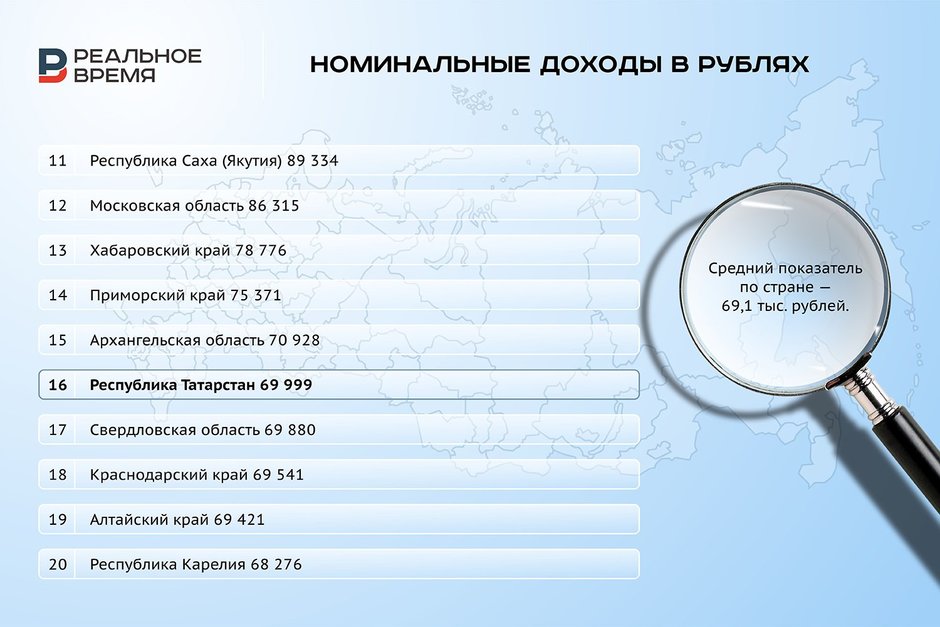
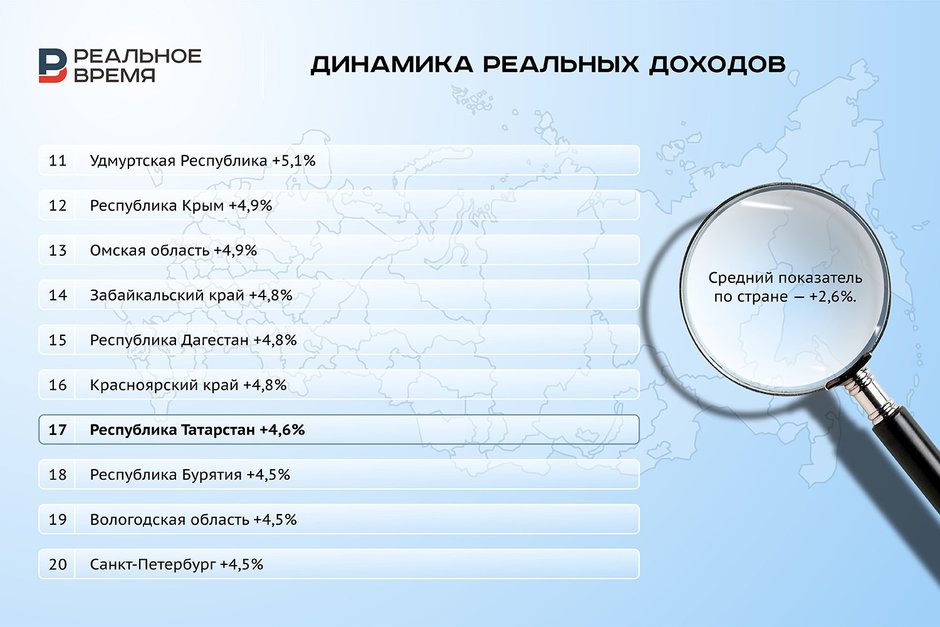
But the real incomes of Tatarstan residents increased by only 4.6% over the year. In terms of the dynamics of this indicator, the region took 17th place, losing not only to the top 10 but also to one of the Volga region entities — the Udmurt Republic (+5.1%), as well as Crimea (+4.9%), the Omsk region (+4.9%), the Trans-Baikal and Krasnoyarsk krais (+4.8%), and Dagestan (+4.8%).
Only 16 regions in Russia have average salaries above 100 thousand rubles
Average salaries exceeding 100 thousand rubles were recorded in only 16 regions. In addition to those mentioned in the top 10, St. Petersburg (127.7 thousand rubles), the Moscow region (125.8 thousand rubles), the Khabarovsk Krai (112.1 thousand rubles), the Krasnoyarsk Krai (110.9 thousand rubles), the Amur region (101.6 thousand rubles), and the Trans-Baikal Krai (101.7 thousand rubles) are included.
Three more regions are literally 2 thousand rubles short of a hundred thousand. Among them: the Komi Republic (98.9 thousand rubles), the Primorsky Krai (97.8 thousand rubles), and the Irkutsk region (97.8 thousand rubles).
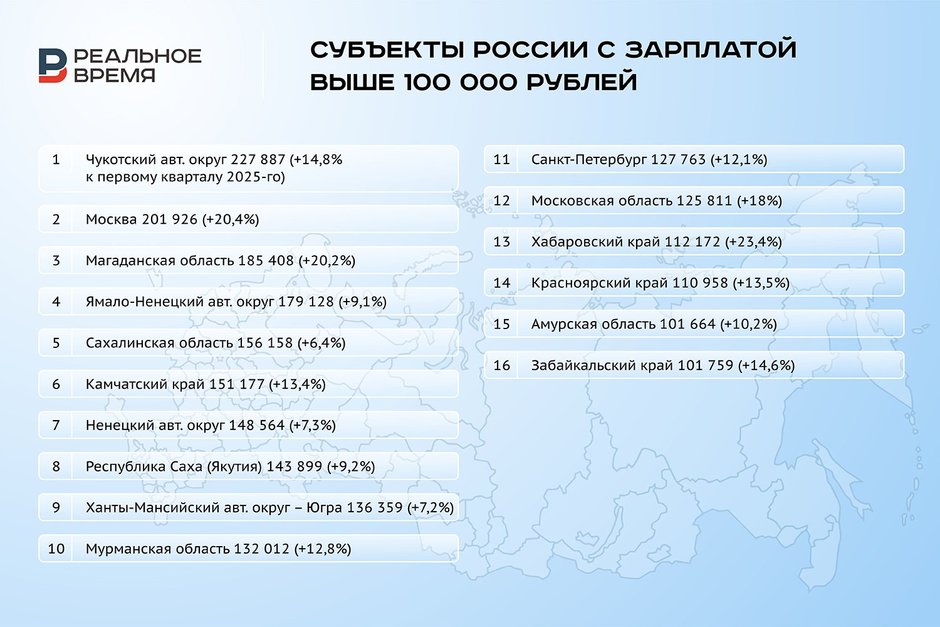
As mentioned earlier, the average salary in the country based on the results of the period from January to March of this year was 106.9 thousand rubles. Despite this, if we look at individual regions, only 14 of them had this indicator corresponding, while in the remaining 71, salary levels were below the national average.
If we consider the situation from the perspective of nominal incomes, only residents of 8 regions receive more than 100 thousand rubles: Chukotka (225.6 thousand rubles), the Yamalo-Nenets Autonomous Okrug (169.2 thousand rubles), Moscow (166.7 thousand rubles), the Nenets Autonomous Okrug (159.9 thousand rubles), the Magadan (143.6 thousand rubles) and Sakhalin (113.7 thousand rubles) regions, as well as the Kamchatka Krai (102 thousand rubles) and St. Petersburg (101.4 thousand rubles).
The outsiders in the rankings are Ingushetia and the Kurgan region
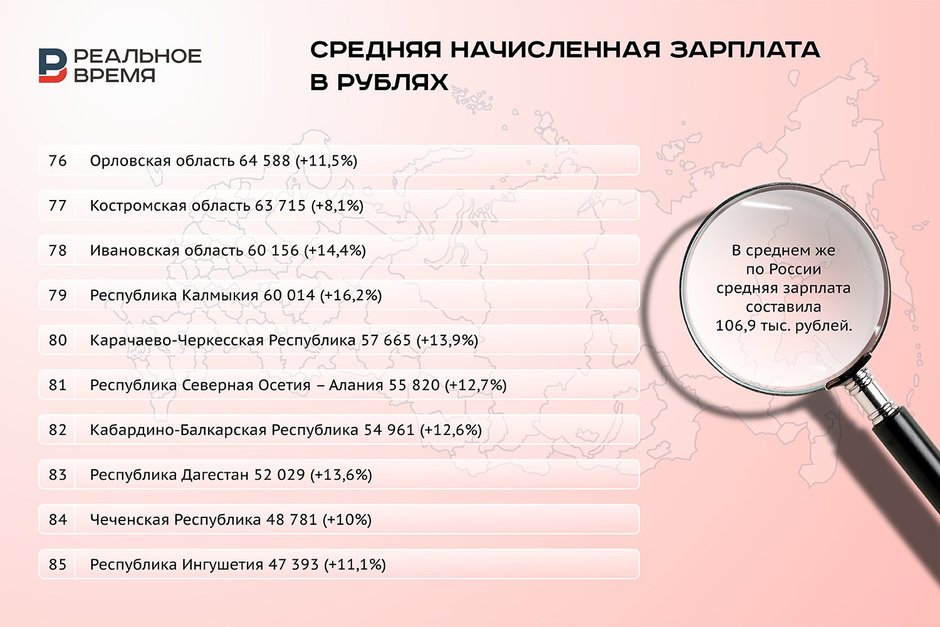
The very last places in the average salary ranking were taken by Ingushetia (85th place, 47.3 thousand rubles) and the Chechen Republic (84th place, 48.7 thousand rubles). Also not far behind are Dagestan (83rd place, 52 thousand rubles), the Kabardino-Balkarian Republic (82nd place, 54.9 thousand rubles), North Ossetia — Alania (81st place, 55.8 thousand rubles), and Karachay-Cherkessia (80th place, 57.6 thousand rubles).
In terms of nominal income levels, the most modest indicators are again in Ingushetia (24.1 thousand rubles). The Karachay-Cherkess Republic, on the contrary, dropped to 83rd place (33.9 thousand rubles), while Tyva was in 84th place (31.5 thousand rubles). Chechnya, however, rose to 79th place here (40.6 thousand rubles), as did Dagestan (81st place, 40.4 thousand rubles). By the way, the same indicators were recorded in the Stavropol Krai (80th place, 40.5 thousand rubles) and Crimea (82nd place, 40 thousand rubles).
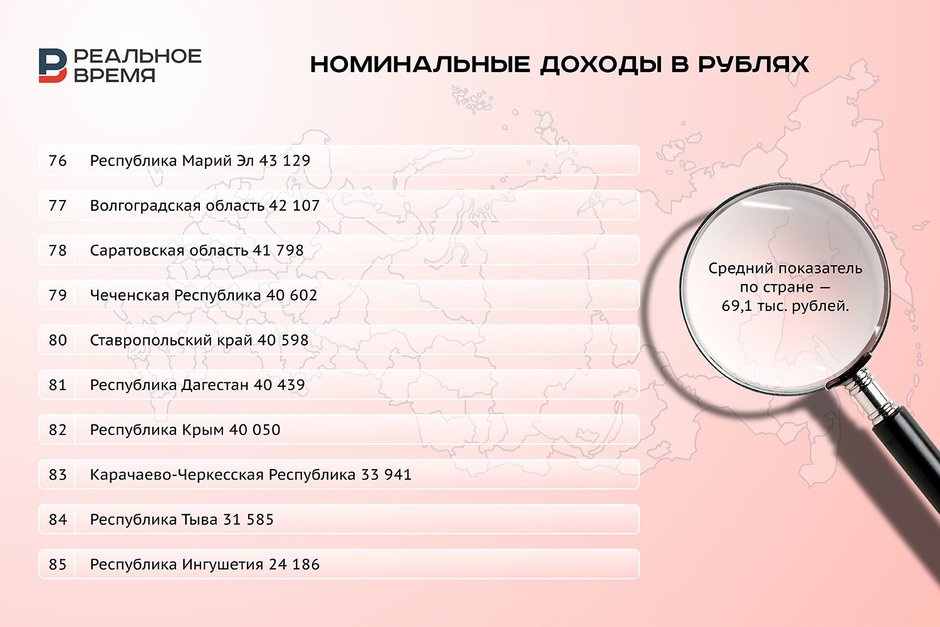
In terms of real income dynamics, the last places were taken by the Kurgan region and the Nenets Autonomous Okrug, where salaries adjusted for inflation remained at the same level (0%). And this despite the fact that the second region was in the top 10 in terms of accrued salary levels and nominal incomes.
Also, modest growth dynamics were in the Primorsky and Kamchatka krais (+0.2%). By the way, the latter was also in the top 10 in terms of salary levels and nominal incomes.
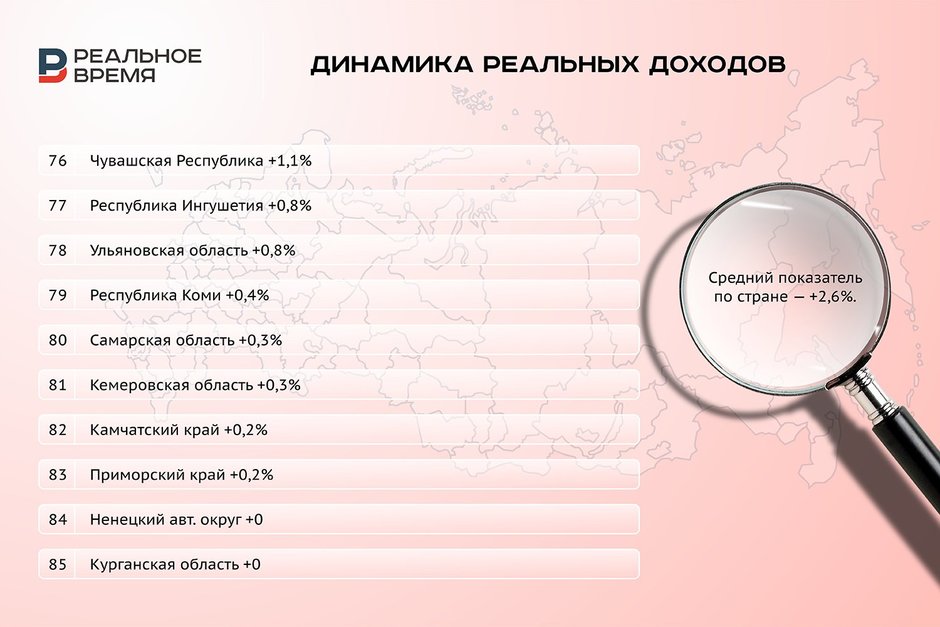
Also, low growth rates were recorded in the Kemerovo (+0.3%), Samara (+0.3%) regions, the Komi Republic (+0.4%), the Ulyanovsk region (+0.8%), and Ingushetia (+0.8%).