“Smena” shows how close Tashkent and Kazan are
Three new exhibitions open at the center of contemporary culture
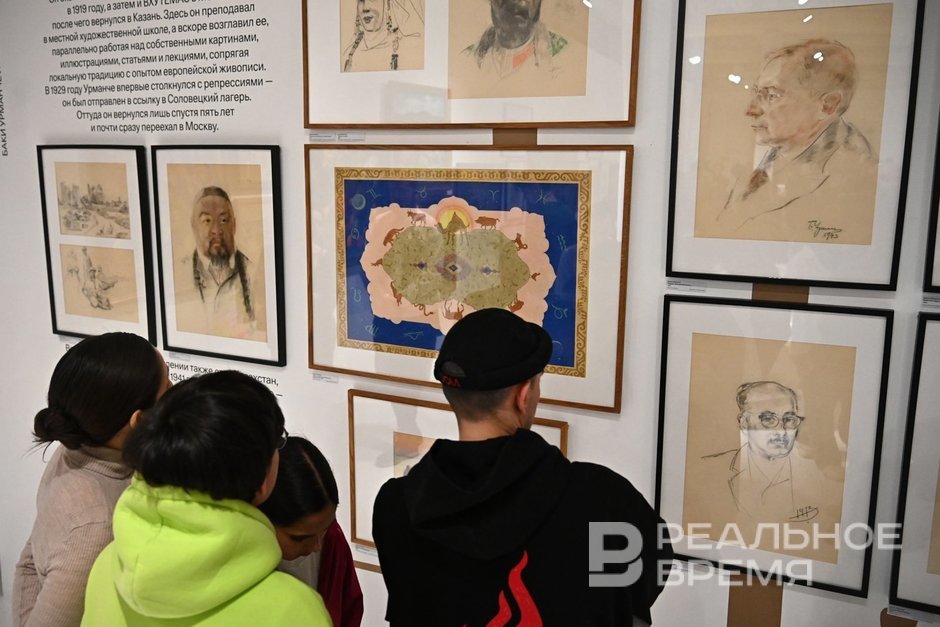
Three exhibitions opened simultaneously at the Smena Center of Contemporary Culture: on the connection between Kazan and Tashkent, on poly-screens from the Galeev-Prometheus Foundation, and a new exposition by artist Sasha Shardak. Curators and authors noted that such different themes unexpectedly intertwine. Never before has Smena featured so much painting — with the Central Asian period of Baki Urmanche's work taking center stage. More details in this report by Realnoe Vremya.
Benkov, Kovalevskaya, and the samarkand school
The main exhibition is undoubtedly “Kazan — Tashkent. Intersections in 20th Century Art," created jointly with the Marjani Foundation. Primarily, it highlights how Kazan, Tatarstan, and the Tatars form an important part of Uzbekistan's history and culture.
This is subtly but elegantly hinted at already in the photographs from early 20th-century photo studios depicting Tashkent residents — Tatars. During Soviet times, about half a million Tatars lived in Uzbekistan; currently, there are about 300,000. All our major imams, from Shigabutdin Marjani to Talgat Tadzhuddin, went to study in Bukhara.
However, the republic's representation is outlined not only by Tatar surnames. The list opens with the name Pavel Benkov. A graduate and teacher at the Kazan Art School, he first visited Bukhara in 1928, and in 1930 moved to Samarkand, where the so-called Benkovsky Impressionism emerged. The Republican Art College in Tashkent bears his name.
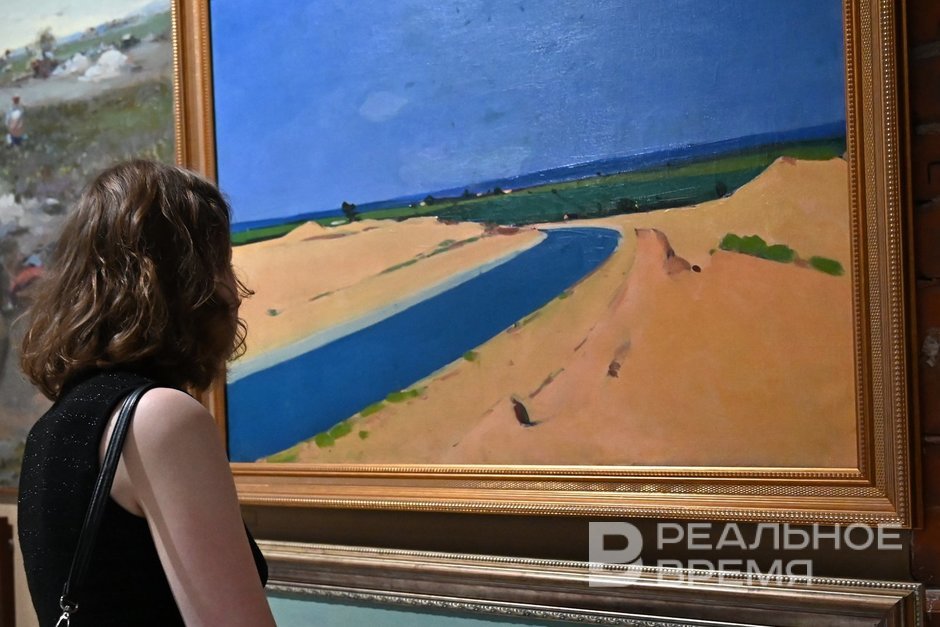
Following the teacher to Samarkand came Zinaida Kovalevskaya. Other Benkov students are also present in the exhibition — Rakhim Akhmedov, Yusuf Elizarov, Faim Madgazin, Rashid Temurov. Among those who graduated from the Kazan Art School is avant-garde artist Mikhail Kurzin.
Another notable artist in Uzbekistan is Chyngyz Akhmarov, a Tatar from Troitsk, whose panels are an integral part of Samarkand's visual code (Ulugbek Museum, “Yulduz” restaurant) and Tashkent's (Alisher Navoi metro station, Opera and Ballet Theater).
Urmanche and Taktash
A place of honor at the exhibition belongs to Baki Urmanche. His works are particularly interesting to view after the large-scale exposition at Khazine — here one can see, for example, more compact versions of “Grape Harvest," the portrait of Abai, as well as small sculptural works. It is worth recalling that Urmanche moved to Kazakhstan in 1941, then worked for several years in Samarkand and Tashkent, before returning to Kazan.
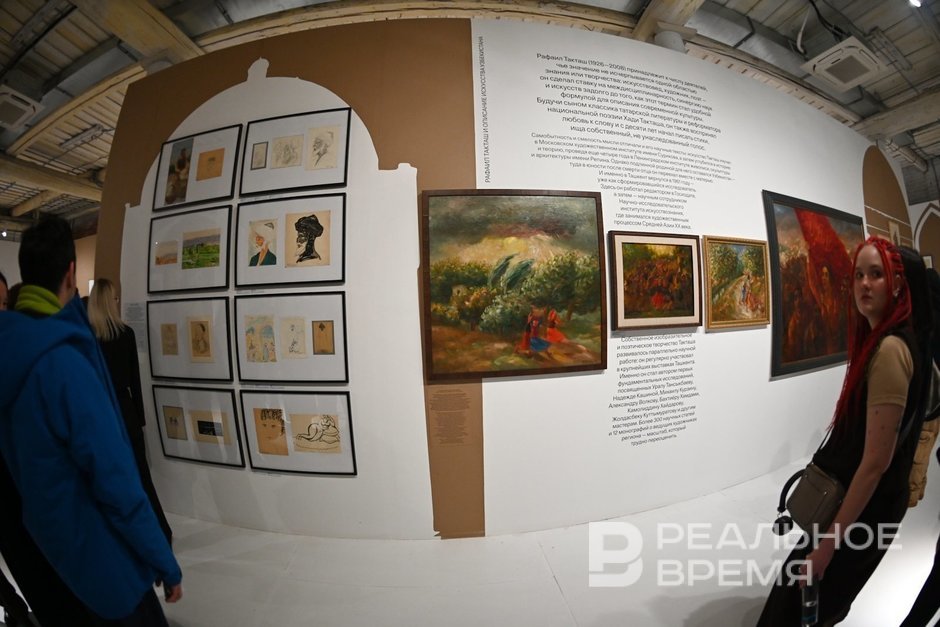
Rafail Taktash appears in the exhibition both as an artist (his graphic works) and as an art critic; under his wing are gathered the creators he dedicated his work to: Alexander Volkov, who inspired him, Ural Tansykbaev, Nadezhda Kashina, and others. The son of poet Hadi Taktash left Kazan with his mother in 1930, ended up in Uzbekistan in 1939, and after the Surikov and Repin institutes, moved to Tashkent, where he lived until his death. Gradually, painting gave way to art criticism.
Interestingly, Urmanche's diary entries about meetings with the younger Taktash have survived: “It seems to me he doesn't like my work, it doesn't stir any feelings in him. He doesn't understand them and seems to see nothing interesting. And although he wants to write about me, he tries, it's not because of some emotional shock, but merely due to demand. He's an art critic, so he needs to write about someone.”
The exhibition runs until June 14. It's impossible not to notice that this is something new for Smena; at least, we don't recall there ever being so much painting on the second floor.
A book about the exhibition, with texts and reproductions, is also planned, as well as a large educational program that will conclude in June at the Smena Summer Book Festival. “Global Perspective” is a series of projects by Smena and the Marjani Foundation dedicated to the cross-cultural dialogue of Kazan and Tatar history with the world.
Painting for a soapbox, or what Dziqa Vertov and Yuri Norstein have in common
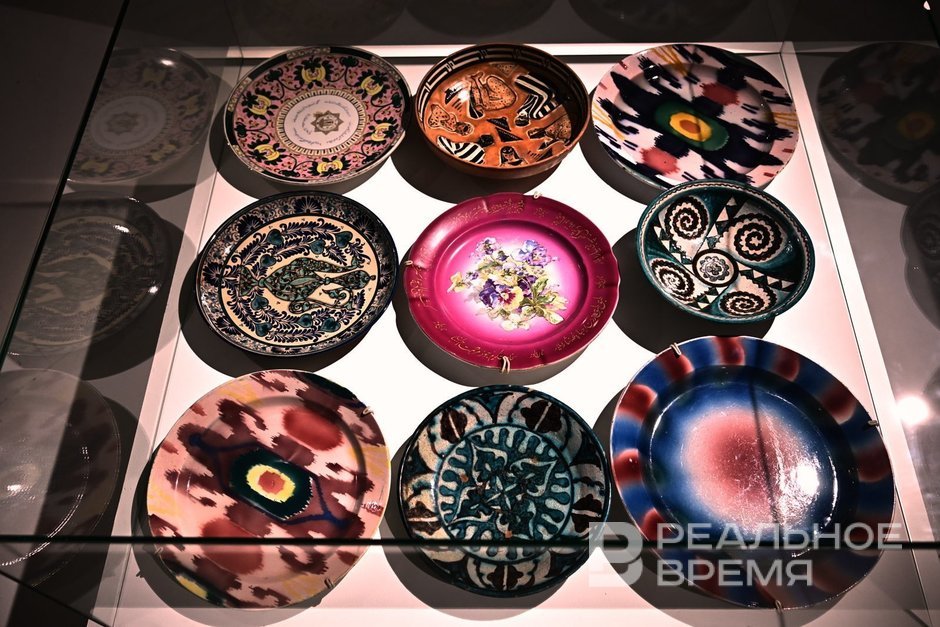
The exhibition's world consists of quiet courtyards, still lifes, portraits of bearded men and slender beauties, swift fairytale sketches, sunny mahallas, Cyrillic and Arabic script — there is even Soviet advertising.
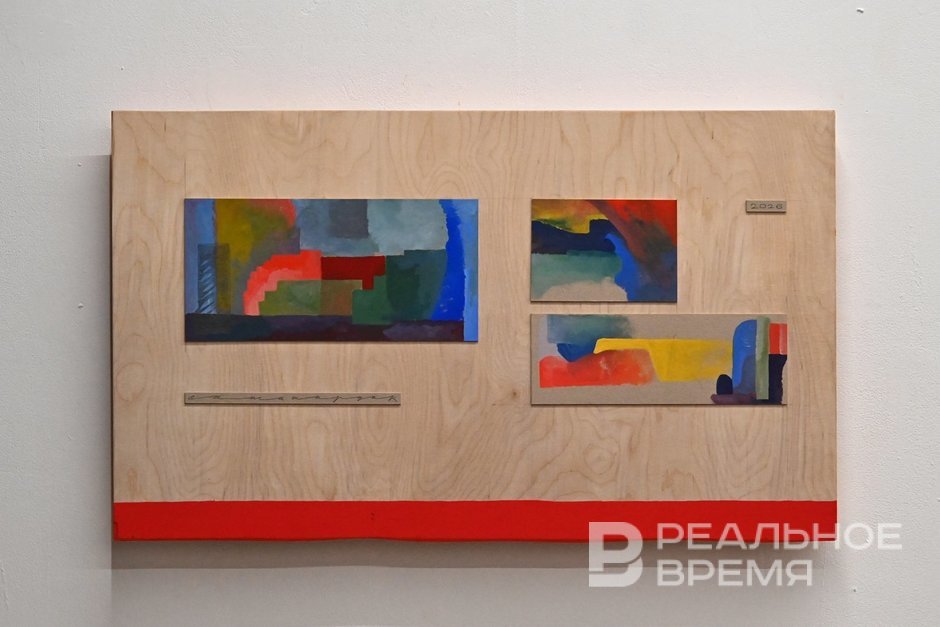
On the same floor, but in a different hall, is a smaller exhibition, not classical in appearance but rhyming with the “Uzbek” one in its sense of serenity and color palette — “Painting” by Sasha Shardak. He recalled that in 2018, at an airport exhibition, he had already found himself placed next to Baki Urmanche. The paintings are complemented by wooden sculptures that one is tempted to move along the “horizon line.”
The artist is primarily interested in changes in light, time, and perception. The project itself began with a series of poorly taken landscape photographs, which Shardak translated using tempera onto plywood and cardboard — in a conventionally academic manner.
On the third floor, in the space of the Galeev-Prometheus Foundation, reflections are offered on “Poly-Screens: Between Technology and Art” (“a study of segmented images as one of the methods of presenting visual material”). The foundation's director, Anastasia Maksimova, notes that the situation where visual information consists of several different parts (poly-screening) is characteristic of modernity. Meanwhile, the exhibition traces the origins back to quite old projects — from Alexander Rodchenko and Josef Svoboda, Bulat Galeev and Sergey Zorin.
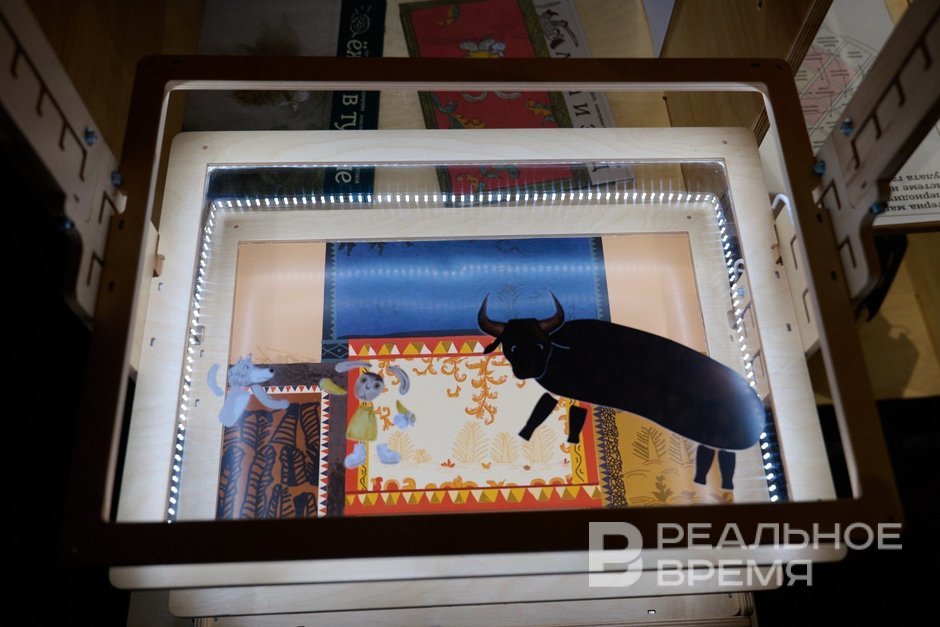
Moreover, archival materials here are combined with works by young designers from the Institute of Design and Spatial Arts at KFU. For example, with a model of a poly-screen shot from Dziqa Vertov's “Man with a Movie Camera” or a multi-station with transparencies and figures inspired by Yuri Norstein's cartoon “The Fox and the Hare.”
The central object of the exhibition is four “Proton” slide projectors, which can be controlled with a “Rassvet” control panel, adjusting the display of color slides.
The “Prometheus” project initially seems infinitely distant from “Kazan — Tashkent," but then one realizes that in both, information is fragmented and assembled from various sources, and media artists coexisted with painters and graphic artists in the same 20th century. And Bulat Galeev himself, an advocate of new art forms, was — of course — born in Tashkent.
Then he came to Kazan.