“Strela-Ak Bars” took a confident step toward the final of the Russian championship
The Kazan team won on its home field against “Yenisey-STM” 30:13

In the home match of the double confrontation of the final series of the Russian championship, the rugby players of “Strela-Ak Bars” outplayed Krasnoyarsk's “Yenisey-STM” 30:13. The second game will take place on October 11 in Krasnoyarsk. About the results of the first match of the semifinal series of the Russian rugby championship — in the report of “Real Time.”
With the light hand of an Olympic champion
The confrontation of two capitals — federal Moscow and sports Kazan — for the representatives of the rugby capital of Russia — Krasnoyarsk — threatens to end in a repetition of last year's final, when “Strela-Ak Bars” and “Dynamo” played out the gold medals in a head-to-head confrontation. Now “Dynamo” confidently won away against “Krasny Yar” — 32:21, and “Strela-Ak Bars” tested the new stadium in a match of far higher tension than earlier against Moscow's “Slava-MAR.” The team of Alexander Pervukhin does not bear the name “heavy machine” for nothing, adorning the name of the team “Yenisey-STM," because it is a kind of mark of quality, earned by years of victories.
Since “Strela-Ak Bars” took a place in the regular season lower than the Krasnoyarsk team, it began the semifinal series with a home match. It was started by the Olympic judo champion Tagir Khaibulaev. The winner of the bouts on the London tatami of 2012 is a frequent guest in Kazan; he performs here with master classes and represents “Dynamo RT” at internal competitions of this glorious sports society, and therefore his participation in the ceremony should not surprise anyone.
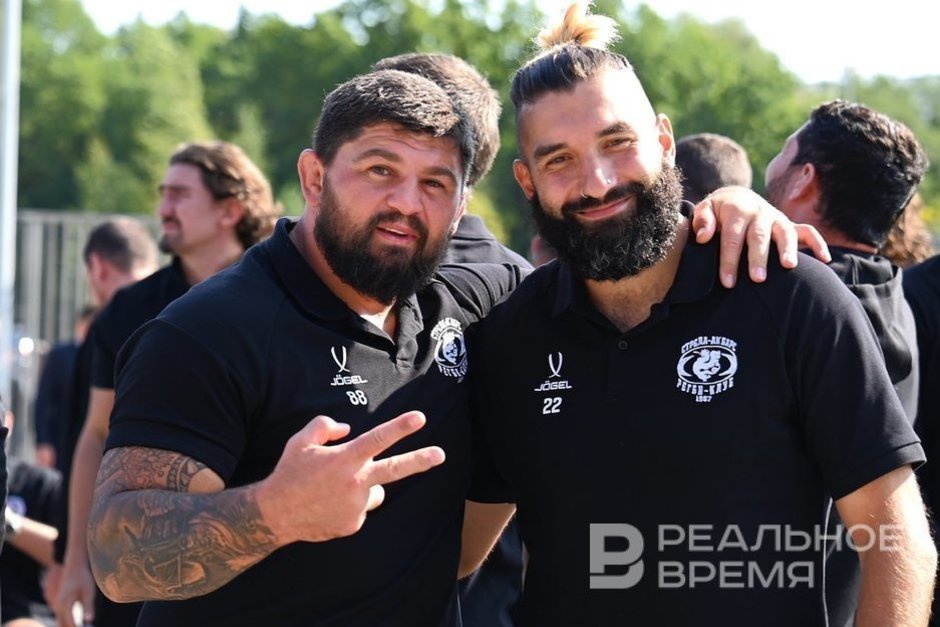
Before this game it became known that the match with “Yenisey-STM” would be the hundredth in the career for the Kazan player Eddie Ludik for “Strela-Ak Bars," where he began when it was still simply “Strela.” Here, of course, one thought that the previous confrontation with “Slava-MAR” could have been missed by Nikolai Kazalikashvili and Kobus Marais, and the Kazan team would have had a trio of “centurions.” But Edik, as his partners call the South African Edmund, now celebrated “single-handedly” before the game. Which began with the sending-off of the Krasnoyarsk player Azamat Bitiev.
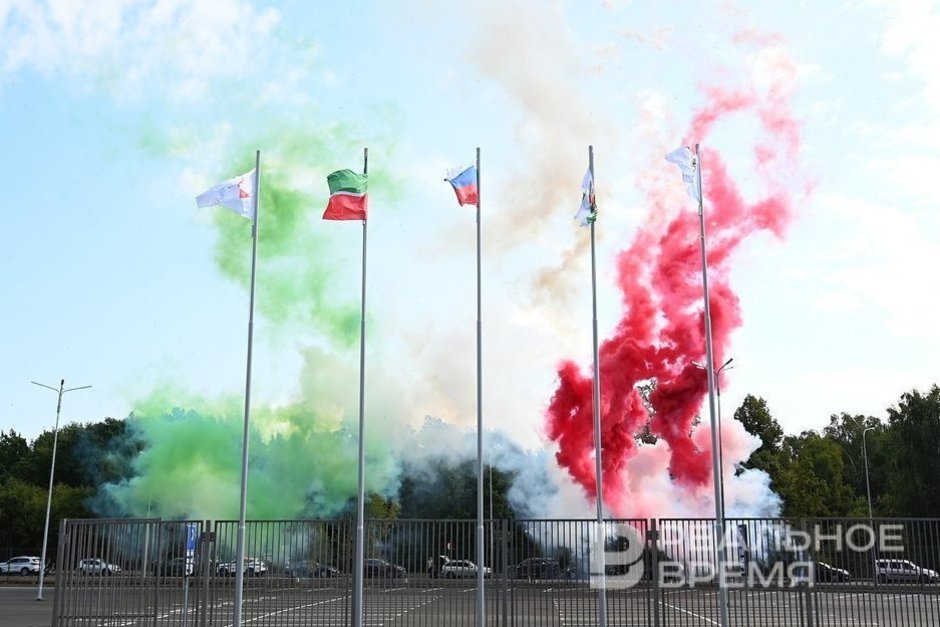
A beginning has been made
— “And how much this rear weighs, the neck will soon find out” — thus sounds in translation the verse of the French poet François Villon, written before his hanging. In this context it does not matter to us how much Bitiev weighed, settling on the substitutes' bench; far more important was to find out how much his sending-off would cost? It turned out that it was worth seven points, which the Kazan team scored in an attack begun by Johan Tromp, who gave a pass to German Davydov… The latter, starting the movement, deceived the Krasnoyarsk player Davit Meskhi, managed to give a pass to Deon Carstens before being tackled, he to Andrey Karzanov, and he scored a try in the center, maximally easing the task of conversion for Kobus Marais.
A bad beginning makes a good ending, but the continuation was ambiguous. At first we were upset, since Vitaly Zhivatov received an injury, because of which he was replaced by Evgeny Tkachenko, and the coaching staff of the Kazan team was forced to make corrections to the plan for the game, since the substitution was most likely planned, but much later. And soon Karzanov again became a participant in an episode that led to the second try of the “strelki” — the South African John Kotze violated the rules on him, replacing Bitiev on the sin bin, who had served his 10 minutes of penalty. But Bitiev's exit coincided with the moment of the second try of the Kazan team, when, without much cunning, the hosts passed the guests in a maul and scored a try with the hands of the Kazan Georgian Robert Sutidze. The try remained unconverted, but the score 12:0 looked simply like a name-day of the heart, delighting the numerous fans of “Strela-Ak Bars," including the club president Alexey Pesoshin.
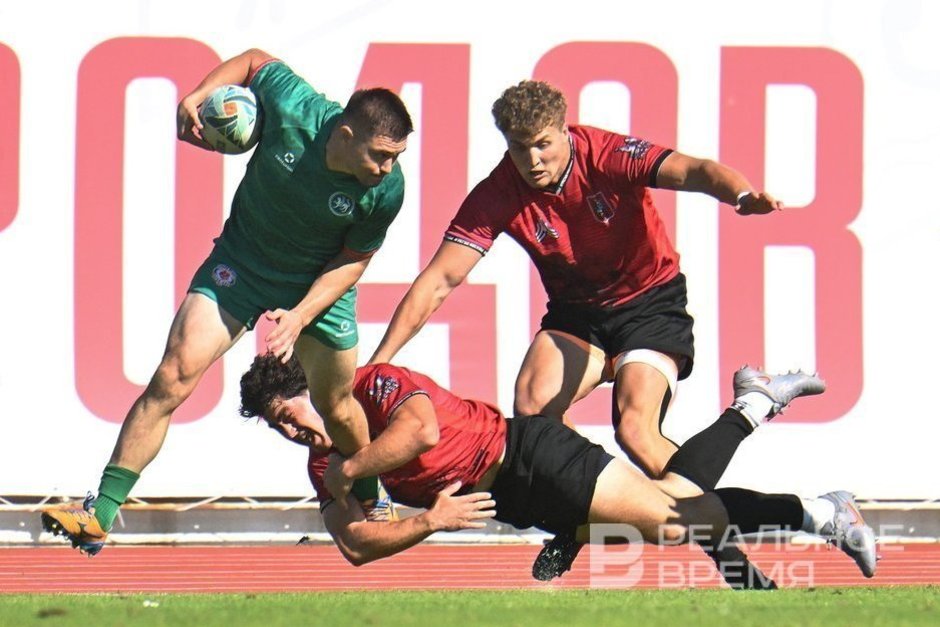
Only at the end of half an hour of the game did Timur Maslov break the ice, converting a penalty — 12:3. For those who know the specifics of Russian rugby, the fact that the Krasnoyarsk team decided on a penalty conversion rather than continuing the attack looked uncharacteristic, but in this match it was not the only episode that surprised the connoisseurs. Because in the remaining 10 minutes before the break “Strela-Ak Bars” pushed through the guests' defense in a scrum and Timur Gadzhiev scored with a conversion — 19:3. And at the end of the period they held out in defense, at the moment when they played shorthanded 13 against 14. Besides the sent-off Tkachenko, Davydov also went to the substitutes' bench, from whom the Krasnoyarsk South African François Oosterhuizen almost tore out a clump of hair. Fortunately, both German's hair and the Kazan team's score were not “damaged," and the score 19:3 looked like good compensation for the hosts for the efforts spent in the first half.
Pervukhin set up his gladiators
The beginning of the second half clearly demonstrated how the coach of the Krasnoyarsk team, Alexander Pervukhin, can set up his charges. They jumped out as if scalded, knocking down both Karzanov and Omari Grinyaev in the fight for the ball, but all within the framework of the rules. The rules of classical rugby, played 15 against 15, and we recall, we began the second half in the number 13 against 14. And this is already another variety of rugby, the so-called rugby league, a discipline into which the Kazan “Strela” went for a decade and a half after the collapse of the Soviet Union.
While Krasnoyarsk dominated in classical rugby, Kazan also led in rugby league, and the ability to play with 13 remained in their blood. At least, one could think so, characterizing the events that happened at the beginning of the second half of the game. First the Kazan team pushed the opponent in a maul, reaching practically their in-goal area, and the same Karzanov scored the ball there, whom Deon Carstens found with a pass on the edge of the field. The conversion from the edge of the field did not succeed for Kobus Marais, but then he accurately executed a penalty from the center of the field. Tromp held the tee with the ball, since the wind blew away everything in its path, but Marais was accurate — 27:3. By the way, Tromp is a Namibian by nationality, a representative of the country whose national football team Russia routed 6:0 in Yekaterinburg the day before, and the main thing in this news is to know that in Namibia, it turns out, there is also football besides rugby.
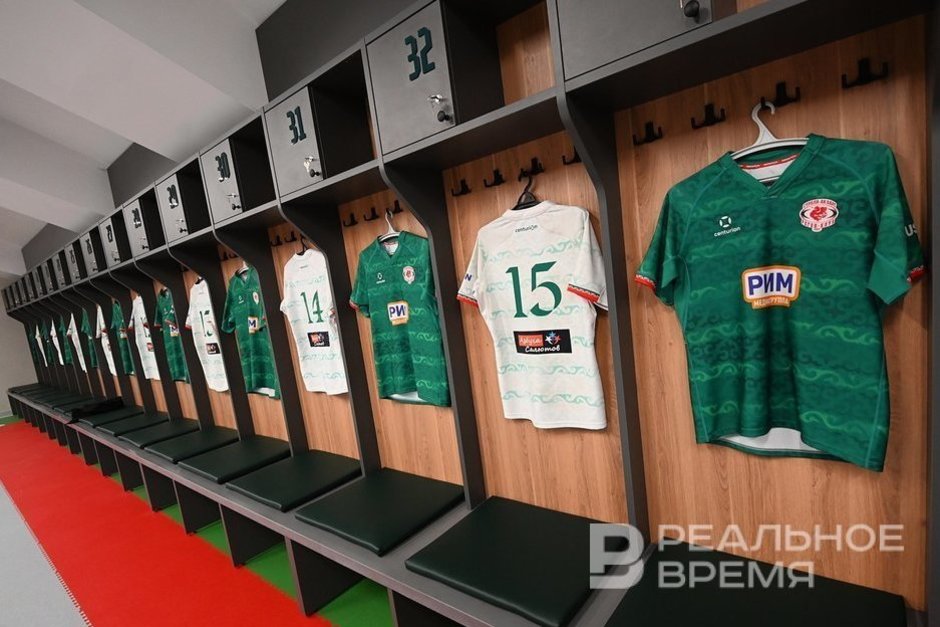
8:0 in the game, more reminiscent of rugby league, but the first principled one for the Kazan stadium (forgive us, Muscovites from “Slava-MAR”) confrontation. Just imagine: in Wales, the homeland of rugby, a stadium located on the territory of a park in Cardiff served as home for rugby players since 1970, but from 1989 it began to be shared with footballers. One for two sports. And this in the homeland of rugby. But with us there are two stadiums — for one team, and this in the homeland of echpochmak and chak-chak. In other words: whoever comes to us with a melon — and the rugby projectile is not called anything else — we will eat it with them.
A heavy ending
Alas, it was not possible to hold the rout gap of 24 points, since at the end of the game sendings-off rained down on us. First, in the confrontation with Meskhi, Karzanov earned an orange card. Orange is something in between yellow (sending off for 10 minutes) and red (until the end of the match), since in Karzanov's case the sending off forced him to sit on the sin bin for 20 minutes and return to the field only 2.5 minutes before the final whistle. Karzanov, by the way, apologized to Meskhi as he left, as the two offenders Davydov and Oosterhuizen, who had earlier divided German's hair, shook hands.
Krasnoyarsk would not be “Yenisey” if it had finished the game without at least one scored try. And the substitute Alexander Belosludtsev scored a melon in the in-goal area, but Timur Maslov pleased the Kazan spectators with a post when converting the try — 27:8. Then followed also the sending-off of the Kazan player Shamil Davudov, and Davit Meskhi on the flank flew into the Kazan in-goal area — 27:13.
Before the return game in Krasnoyarsk on October 11 (the match will begin at 12:00 Moscow time), a gap of 14 points would mean two converted tries, which looks dangerous. Fortunately for the Kazan team, again playing shorthanded, they earned a penalty. And when choosing between the crane in the sky (the possibility of scoring a try) and the tit in the hand (converting the penalty), they chose the fat tit. Pieter Steenkamp set the final score 30:13, after which the players of the opposing teams congratulated each other, embracing. By contrast: in hockey playoffs sometimes they do not even shake hands with each other, leaving this ceremony to the end of the series. But in rugby everything that happened on the field stays on the field.