“The Days of the Turbins” is one hundred years old: how a play permitted for one season lived a century
Bulgakov's play became the main hit of the season among the “non-party” public and Stalin's favorite performance. It was banned, taken off, and returned to the stage
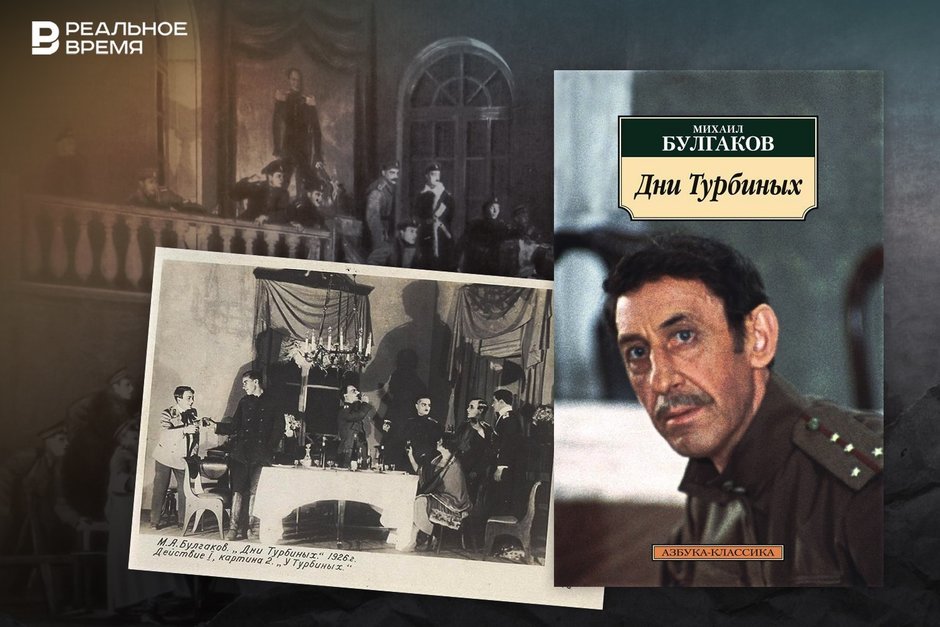
On October 5, 1926, the Moscow Art Theater first showed “The Days of the Turbins.” The premiere brought Mikhail Bulgakov wide fame. The theater staged his work for the first time, and the Main Repertoire Committee permitted the performance only ten days before the premiere — on September 25. At the same time the department gave the Moscow Art Theater the right to play the play for only one season. The limitation did not hinder its success. At evening showings even an ambulance carriage was on duty: some spectators felt unwell, there were hysterics and fainting. Thus began the stage history of one of Bulgakov's most famous plays. In 2026 “The Days of the Turbins” marks its centenary. For the anniversary the literary reviewer of “Real Time” Ekaterina Petrova tells about the history of the creation of the play and its path to the spectator.
How “The White Guard” became a play
At first Mikhail Bulgakov wrote a novel about a family caught by the Civil War. He finished work on “The White Guard” in 1924, and the journal “Rossiya” began printing the first chapters at the end of that same year. In 1925 the journal continued publication, but closed, so the novel did not reach readers in full. The first thirteen chapters came out in “Rossiya," and “The White Guard” appeared in full only in Paris in 1927—1929. In the USSR the novel was printed in full considerably later.
Bulgakov came to the theater even before working on “The White Guard.” In 1920 in Vladikavkaz he wrote the play “The Turbin Brothers.” Then he moved the action to the era of the 1905 revolution. A few years later the idea received a continuation. In the spring of 1925 the Moscow Art Theater proposed that Bulgakov make a play based on “The White Guard.” Bulgakov himself began the first edition in the summer of that same year and presented it to the theater on August 15. He called the five-act play “The White Guard.”
But the theater demanded reworking, and Bulgakov shortened the play to four acts. Along with the volume the plot also changed. Alexei Turbin ceased to be a doctor and became a colonel. In the new version he died already in the third act. At the end of January 1926 the Moscow Art Theater held a reading of the second edition. It still bore the title “The White Guard.”
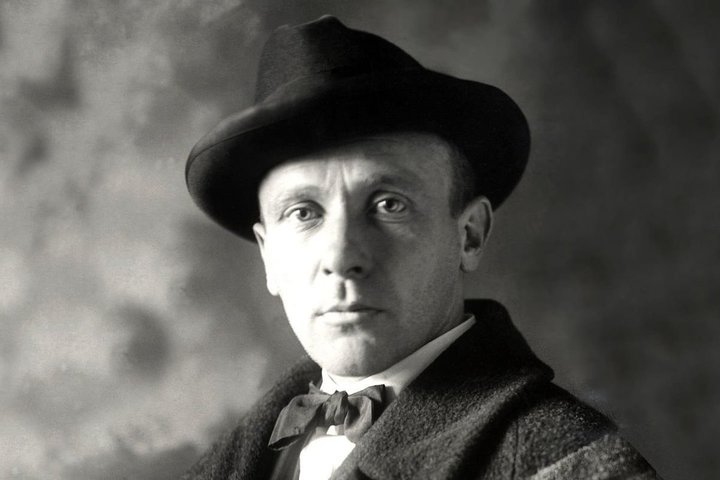
Bulgakov continued to rework the text already together with the theater. The Moscow Art Theater introduced its own edits into the production, and the Main Repertoire Committee later demanded new changes. Thus the third, “Soviet," edition arose. In the finale the sounds of the “Internationale” and a eulogy to the Red Army appeared, and the scene of the beating of a Jew by the Petliurists was removed from the performance. Only after these changes did the Main Repertoire Committee on September 25, 1926 permit the production — exclusively to the Moscow Art Theater and only for one season.
Rehearsals under the supervision of the Main Repertoire Committee
The word “white” did not survive censorship. The Main Repertoire Committee demanded changing the title “The White Guard.” Stanislavsky proposed “Before the End," Bulgakov refused categorically. In August 1926 the parties agreed on “The Days of the Turbins.” The general rehearsal for members of the Main Repertoire Committee took place on June 24, 1926.
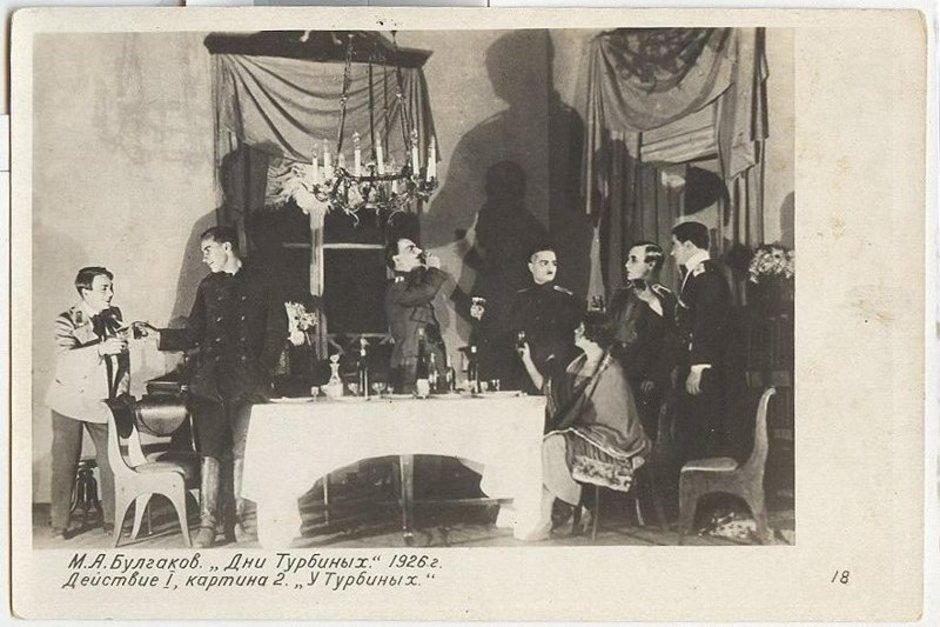
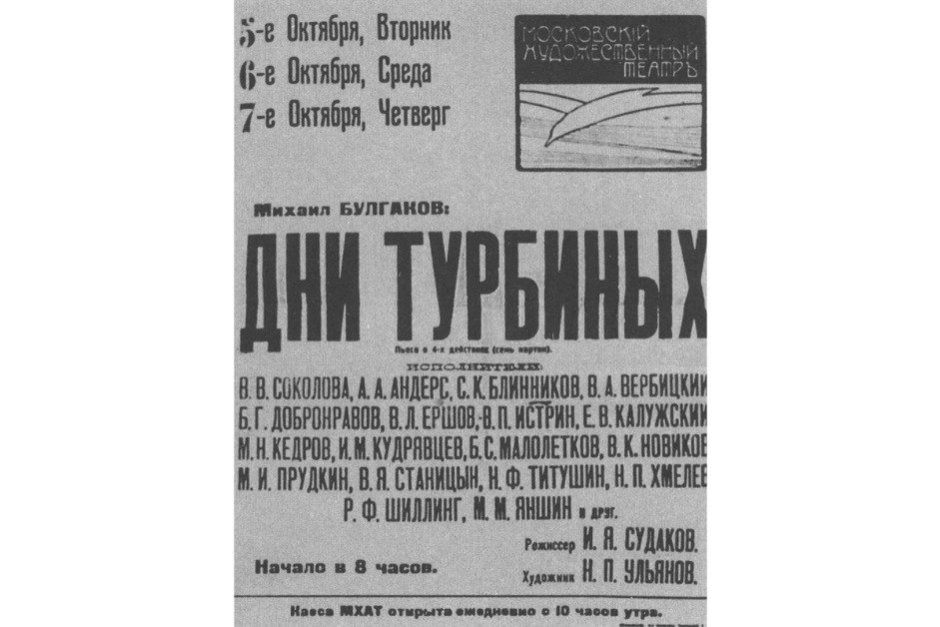
The performance of October 5, 1926 was staged by Ilya Sudakov with the participation of Konstantin Stanislavsky. Alexei was played by Nikolai Khmelev, Lariosik — by Mikhail Yanshin, Myshlaevsky — by Boris Dobronravov, Shervinsky — by Mark Prudkin. Bulgakov's stenographer Irina Raaben recalled:
— The performance was stunning, because everything was alive in people's memory.
Spectators had hysterics, they fainted, seven were taken away by ambulance. The publicist Ivan Solonevich described the scene where the officers sing “God Save the Tsar”: the hall stood up, people wept silently. Over the season the theater played the performance 108 times, more than any other in Moscow theaters.
Bulgakov counted hostile reviews and put them in an album. By March 28, 1930 there lay 298 “hostilely abusive” reviews and 3 positive ones. The People's Commissar of Education Anatoly Lunacharsky in “Izvestia” on October 8, 1926 called the play a “semi-apology of the White Guard.”
The theater critic Alexander Orlinsky reproached the playwright that his officers live and fight without a single batman. Bulgakov answered on February 7, 1927 at a dispute in Meyerhold's theater: batmen in Kiev “could not be obtained for their weight in gold.” He cut out Orlinsky's article “Quo Vadis?” of January 4, 1927 and pasted it into the first theater album. In it he underlined the phrase "…an excellent answer to 'The Days of the Turbins!'"
The leader's favorite performance
“On a fishless day even 'The Days of the Turbins' is a fish," wrote Joseph Stalin on February 2, 1929 to the playwright Vladimir Bill-Belotserkovsky. He had asked why theaters so often staged Bulgakov. The play, according to Stalin, was “not so bad," because it “gives more benefit than harm.” The spectator leaves with an impression “favorable for the Bolsheviks”: if even the Turbins laid down their arms, the Bolsheviks cannot be beaten. The author, Stalin added, was “in no measure guilty” of this demonstration.
Ten days later Stalin repeated this to Ukrainian writers. Bulgakov, he said, is “not ours," but with his “Turbins” he brought “much benefit.” The guests took offense. The writer Oleksa Desnyak answered that Bolshevism defeats the heroes of the play not as Bolshevism, but because it preserves “a single and indivisible Russia.” As a result the repertoire committee banned the play, and in April 1929 it was taken off the repertoire.
Bulgakov wrote a letter “to the top.” In April 1930 Stalin called him. To the complaint that the Moscow Art Theater would not take the writer on staff, he answered:
— Well, submit an application. It seems to me that they will agree.
Mikhail Afanasyevich became an assistant director, and the performance returned to the stage in 1932. Bulgakov wrote to his closest friend — the Soviet philosopher Pavel Popov — that the government had given a “remarkable order” to revive the play, and this meant that a “part of his life” had been returned to the author. According to the version of the Soviet film scholar and translator Marianna Shaternikova, Stalin watched Afinogenov's “Fear” at the Moscow Art Theater, remained dissatisfied and demanded the restoration of a “good play.” She also writes that the leader sat in a box behind a curtain and went to “The Turbins” “15 or 20 times, if not more.” To Khmelev Stalin said:
— You play Alexei well. I even dream of your black mustache.
In 1934 the theater congratulated Bulgakov on the five hundredth performance and wrote that “The Turbins” had become “a second 'The Seagull' for the new generation. At the same time Elena Bulgakova wrote in her diary of 1937:
— Today in “Pravda” there is an article by Pavel Markov about the Moscow Art Theater. Not a word about “The Turbins.” In the list of playwrights of the Moscow Art Theater there is Olesha, Kataev, Leonov (authors of plays that have left the Moscow Art Theater stage), but Bulgakov is not there.
Bulgakov also recalled Nemirovich-Danchenko's congratulation on the five hundredth performance. According to him, in it there was not a single letter that related to the author. The performance ran on the Moscow Art Theater stage until June 1941 and gave 987 showings.
The fate of the play abroad and after the writer's death
Abroad the play lived its own life. On August 26, 1927 the Riga newspaper “Segodnya” printed the note "'The White Guard' Broke Out of the USSR.” The newspaper told that a stenographer had recorded the play at several performances and forwarded it to Berlin. And the Riga Russian Drama played the play under the title “The White Guard.” By the way, when Alexei Turbin asked to stop the singing of “God Save the Tsar," one spectator demanded to continue the anthem.
In December 1929 “Segodnya” published another note, “The Trial of the Play 'The Days of the Turbins'," this time a letter from Belgrade. The Union of Journalists and Writers organized a public reading and a literary trial at the university. The accusers called the play non-artistic and unacceptable for White Guard souls. The defender, Colonel of the General Staff Evgeny Messner, argued that the play was truthful and conveyed the voice of under-Soviet Rus. No verdict was delivered, but, according to the author of the letter, for many the play ceased to be odious.
After Bulgakov's death in 1940 the play again returned to the stage. In the 1950s the performance ran at the Stanislavsky Theater. In 1953 the Department for the Distribution of Dramatic Works under the VUOAP released the text on a hectograph. In 1955 the publishing house “Iskusstvo” printed a collection with a print run of 10 thousand copies. The text was prepared by Elena Bulgakova; she checked it against the prompter's copy of 1926 from the Moscow Art Theater museum. The philologist Vyacheslav Kuritsyn in his book “Russian Literary Postmodernism” (2001) writes that in 1955 Elena Sergeevna complained:
— About two hundred theaters took “The Turbins," but they are afraid to stage it.
The fears were justified in Kiev. The journalist Andrey Kolesnikov* describes the situation when writers and the presidium of the Union of Writers of Ukraine wrote letters against the production at the Lesya Ukrainka Theater. They called Bulgakov an author “simultaneously anti-Ukrainian and anti-Soviet” and demanded stopping the performance. At the same time the Moscow Art Theater played “The Turbins” in Kiev in 1936 without problems.
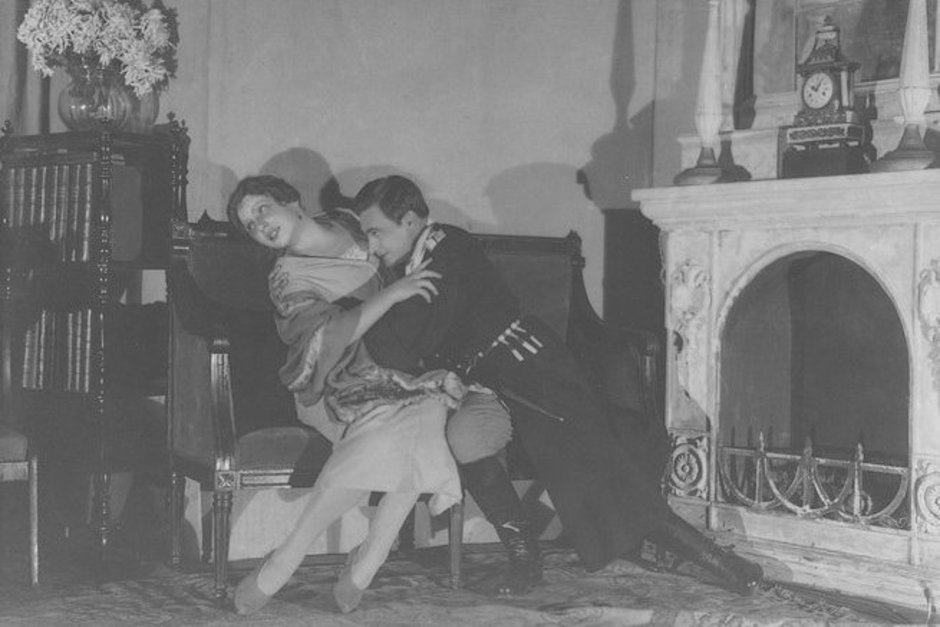
Today the play is staged again. In 2010 the London National Theatre showed a version by the Australian playwright Andrew Upton under the title “The White Guard.” The director was Howard Davies, Nikolka was played by Richard Henders, Lena — by Justine Mitchell. The Moscow theater “MOST” staged “The Days of the Turbins” with the director Georgy Dolmazyan. He returned several lines from the first edition to the performance. The finale of the play remained the same. The clock plays Boccherini's minuet, Lariosik mutters about cream curtains and repeats: “We will rest! We will rest!” Studzinsky speaks the last line: “For some — a prologue, for others — an epilogue.” Censorship once permitted this play in a single theater, and a hundred years later it is staged all over the world.
Ekaterina Petrova — literary reviewer of the online newspaper “Real Time," host of the Telegram channel «Булочки с маком».