“Sakhi(ya)": instead of a dress — a cap, a shirt, and pants
Director Alexander Dalmatov stages a play for the second time, this time in Menzelinsk
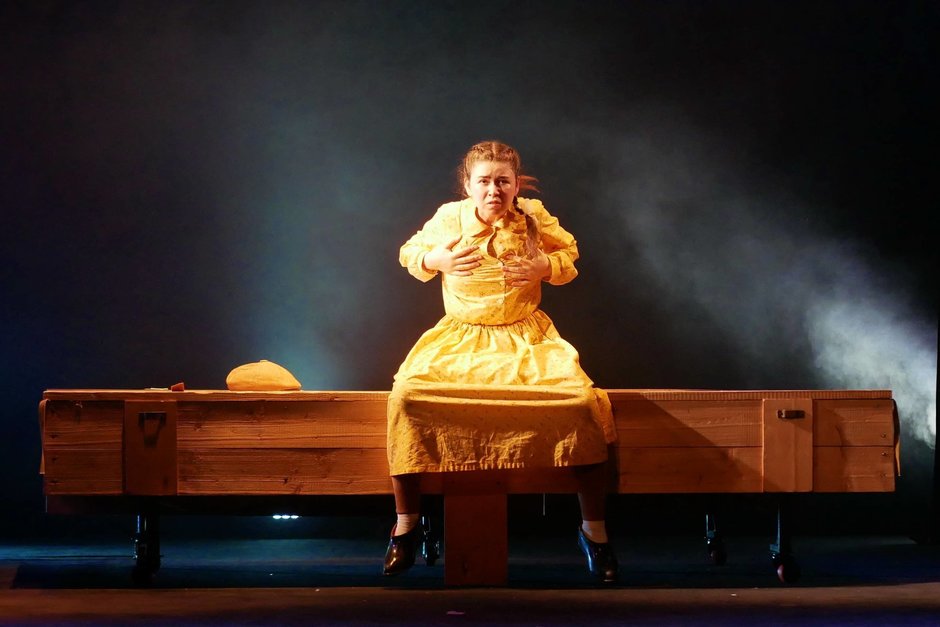
Film director Alexander Dalmatov, known to audiences for the TNC series “Keshe kitä, jyry kala” (“A Man Leaves — His Song Remains”) and “Ay bulmasa, yoldyz bar” (“Without the Moon, a Star Shines for Us”), is once again trying his hand at theatre. After his experience at the Almetyevsk Theatre, where he staged an adaptation of Ravil Sabir's novel “Fäxrine üterep tashladylar” (“The Hour of Judgment”), the director presented at the Menzelinsk Theatre the play “Sakhi(ya)" (12+), based on Fanis Yarullin's story “Kyygak-kyygak kaz kychkyra” (“The Goose Cries Loudly”): about a girl who decided to live like a man. For more details, see the material by Realnoe Vremya.
All because of those rags!
“Fäxrine üterep tashladylar” was first shown in Almetyevsk in April 2024. It was positioned as a film-play because part of the action took place on screen. After this, Alexander Dalmatov, for whom it was his theatre debut, together with his creative team, presented two major works in the serial format — “Keshe kitä, jyry kala” based on Mukhammet Magdeev and “Ay bulmasa, yoldyz bar” based on Tufan Minnullin, solidifying his status as the most sought-after film director in Tatarstan. And now — his second appearance in theatre as a director.
The People's Poet of Tatarstan, Fanis Yarullin, also did not limit himself to genres, becoming known in poetry, drama, and prose. Dalmatov explains his choice of material simply — it is a work understandable to the people. Therefore, when he was offered to do something in Menzelinsk, he settled on this story, which was almost entirely transferred to the stage.
The main character, Sakhiya (Milyausha Shayakhmetova), lives in a village with her carpenter father Lukman (Ilnaz Khismatullin), her handicraft mother Magdaniya (Zulfira Garaeva), and her fashionista sister Sakina (Dilyara Zinnurova). Soon she loses her mother, who went to wash yarn on the ice (that is, she fell victim to her profession), her father goes to the front forever, and her pregnant sister, unable to bear the deception of the local lame womanizer Ramzi (Nafis Gayfullin), leaves for another village.
That is, the mother died, in essence, “because of rags," and the sister suffered because of female weakness. All this, as well as the company of boys and the war, influence Sakhiya to begin calling herself Sakhi, to refuse dresses, put on pants, a shirt, a cap, and ride a horse named Akkosh. In harsh times, she essentially turns from a girl into a boy. In Tatar, there is a word for this — “irdäwkä," meaning a masculine woman.
From “Almagachlarym” to “Ant Hill”
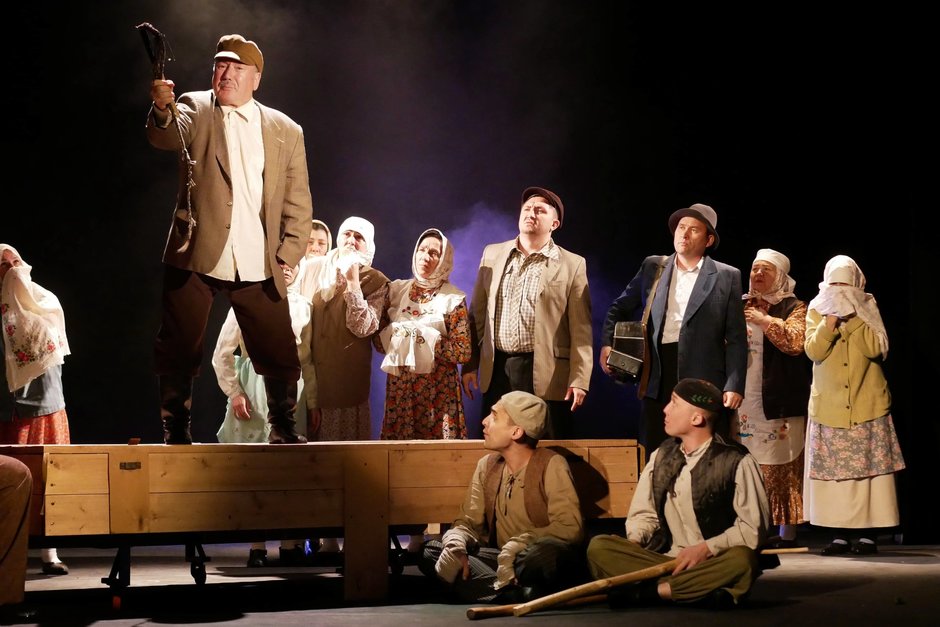
Next to young Sakhiya, her elderly version (Elvira Khairutdinova) constantly appears, often taking on the role of narrator, and as a character, she is revealed closer to the finale. Fanis Yarullin, and following him, the author of the adaptation Alsu Khabibullina (who worked with Dalmatov on the series “Ay bulmasa, yoldyz bar”), show the story of a woman from the 1940s right up to the 1980s, as indicated by the changing portraits of leaders and the songs, where from “Almagachlarym” to Tsoi's “Ant Hill” — it's two hours.
— I was familiar with the work, so, of course, I agreed, — says Khabibullina. — The work went quickly and easily. I liked that the main character is complex, with a strong internal conflict.
The main stage structure (artist Salima Askarova) is a large bench-säke, which transforms into a tribune, a screen (yes, here too Dalmatov manages to shoot a few film fragments, which, however, provide more mood than information), a truck, and a dance floor. The characters also love to look out the window, which appears both as a symbol of hope, of expectation, and as a kind of boundary between the home and the rest of the world. A lyrical piano riff appears from time to time — Milyausha Khairullina is responsible for the music, and Ildar Shakirov illuminates the scene. Let us add that the choreography is handled by the theatre's resident director, Ilnur Garifullin.
— I wrote according to the tasks set by the director, — says Khairullina. — I wanted to convey both the web of time, and the threads of her fate, and the symbol of weaving, and boyish daring, and a fragile maiden soul.
How to put on a dress again?
Before the intermission, the playwright and director move the plot of the story inventively and swiftly. Dynamics are added by children's games, dances to the accordion, as well as the frightened chairman Nasibullin (a characteristic role by Hafiz Khamatullin). There are so many events that not all fit on the tiny stage: the actors sometimes interact with invisible actions beyond its boundaries.
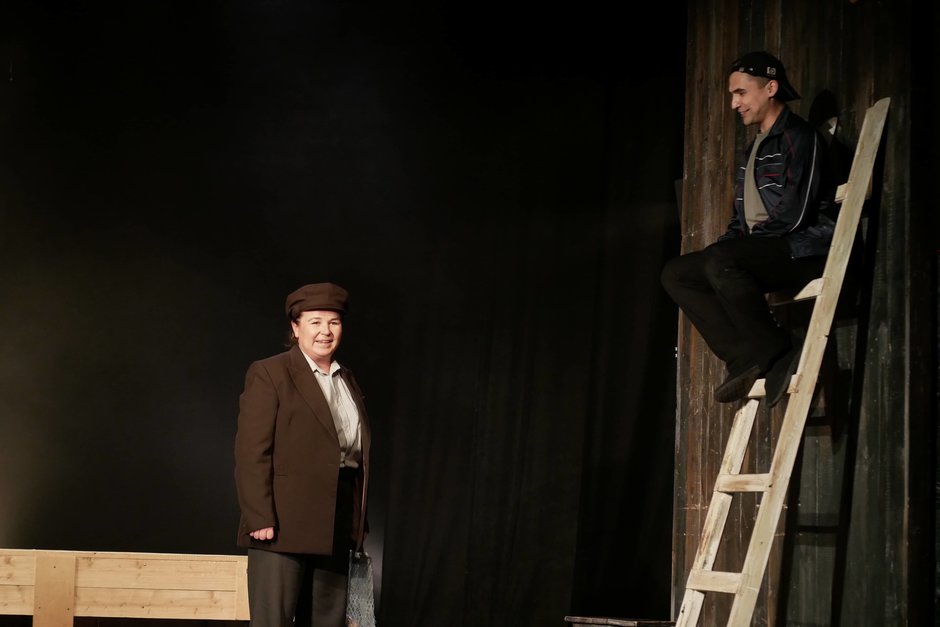
Since this is a story spanning several decades, many actors have to play multiple roles, turning from village boys, for example, into colleagues at a Siberian construction site. Rustem Zinnurov is especially active — here he is galloping on a stick-horse through the village, and here he is already a curly-haired urban handsome man Adonis, who impresses Sakhiya so much that she begins to reach for the feminine again. But not everything is so simple — nothing is forgotten in the village. And so Sakhiya runs away from the village.
In the cascade of events in the second part, where, for example, Sakhiya's failed wedding appears, the very briskness of the action seems to drown — and where is it all leading? In the hall, relatives and fellow villagers note that the story has been transferred to the stage almost verbatim, with respect for the author, but it could have done without some minor, beautiful, and fussy episodes. Sometimes the drama turns into a domestic comedy: the actors, for example, play Ramzi's love triangles with great pleasure, while the level of tension and tragedy weakens.
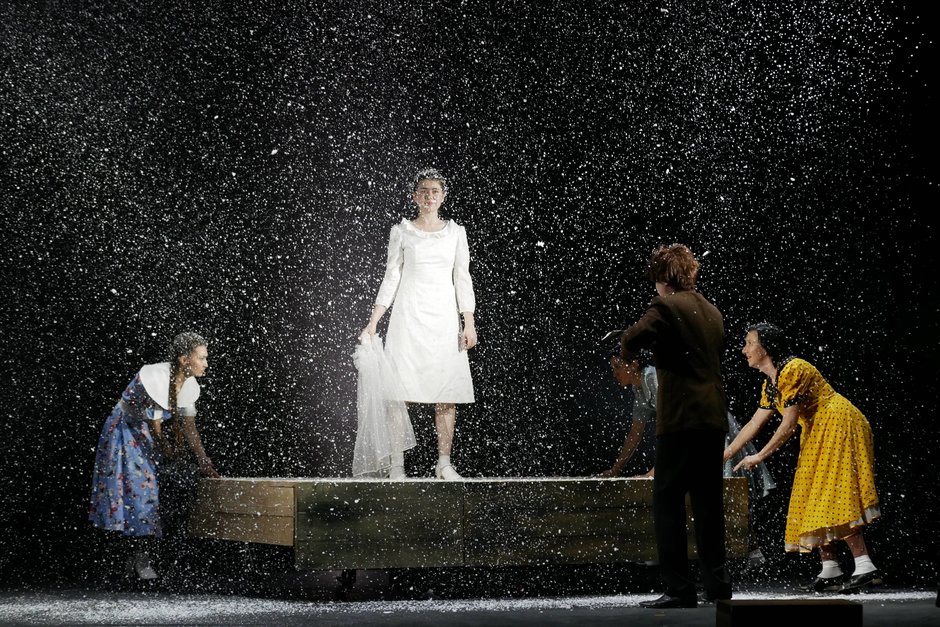
On the other hand, the theme of the play itself is complex, and therefore requires several attempts at comprehension, departure, and return. What does it mean to be a girl, a young woman, a woman according to the authors' version? To be a beloved daughter? A faithful wife? To wear beautiful dresses and shoes? Having somewhat confused the audience and themselves a little, the authors arrange a meeting at an orphanage between the son (!) of Sakhiya (Zinnurov's third role in the play) and the considerably aged heroine. And so they are already rolling in a motorized wheelchair towards a bright future. So there is another answer to the main question: to be a woman is to raise mischievous sons.