Telegram blocked in India, age limits on social media, quantum computers development, and new images of Earth
Top tech news from around the world over the past week

The world of technology found itself at a crossroads this past week: while some companies promise quantum breakthroughs and buy up AI startups for tens of billions of dollars, governments around the world are tightening the screws — blocking messengers and introducing age restrictions on social networks. A small Russian satellite is taking its first images of Earth, while British teenagers are preparing to say goodbye to endless feeds of funny pictures. The main events shaping our digital future — in Realnoe Vremya's roundup.
Telegram is getting in the way of future doctors
The Delhi High Court has recognized the temporary blocking of Telegram in India as legal. The messenger was blocked in the country from June 16 to 22 at the request of the National Testing Agency to conduct a repeat entrance exam for medical schools. In May, more than 2.2 million people took it, and when the results were checked, it turned out that the questions had been leaked in advance through Telegram channels.
According to Indian authorities, the blocking turned out to be an extreme measure: other attempts to prevent repeat leaks and fraud did not yield positive results. Negotiations with Telegram's administration lasted about two weeks — as a result, Indian authorities decided on the blocking and the introduction of additional measures: the messenger was required to block the ability to edit messages in India by June 30. With its help, fraudsters could fabricate evidence in the leak case.

Telegram tried to challenge the decision in court, arguing that the blocking “punishes” 150 million users of the messenger in India. According to its founder, the blocking only caused inconvenience to ordinary users, while fraudsters simply moved to other platforms.
In response, the Indian government stated that Telegram's architecture does not allow for effective tracking of violators, and one user can create dozens of bots for mailings and hiding their tracks. The court sided with the government, confirming that the law allows blocking entire social platforms in the public interest.
The parade of social media bans continues
Two countries at once announced the introduction of strict age restrictions for social networks last week. On June 15, British Prime Minister Keir Starmer announced that from the summer of 2027, a ban on the use of social networks and account creation will be introduced for children under 16. On the UK government's website, this was called a measure designed to “give children back their childhood.” The law is planned to be passed by the end of 2026, and it will come into force in the spring of 2027. Social media platforms themselves will have to verify users' ages under threat of multi-million dollar fines.
The United Arab Emirates turned out to be slightly softer in terms of age but stricter in terms of requirements: on June 16, the Cabinet of Ministers banned children under 15 from using social networks. Within the next 12 months, platforms must develop an age verification system using digital identification and biometrics. For violations, social networks face fines or a complete ban on the country's territory. The UAE became the first Arab country to adopt such a measure. Teenagers aged 15–16 will be allowed access but with serious protective measures: age filtering, restrictions on contacts with strangers, and parental controls.

Such decisions fit into a global trend started by Australia in December 2025. The country was the first to introduce a ban on social networks for children under 16. Since then, at least 14 countries have announced or planned to introduce restrictions. These include Greece: here, the ban for children under 15 will come into effect on January 1, 2027. Indonesia banned social networks for children under 16, and Malaysia introduced a similar rule. Denmark, Norway, and Spain have announced plans to introduce similar restrictions.
A new turn in quantum computers
The past week was marked by two landmark events in the world of quantum computing, bringing the era of fault-tolerant systems closer. Quantum computing company QuEra announced that by 2028, it plans to create the world's first practically universal and error-resistant quantum computer called Libra. As the company explained, the main problem with modern quantum systems is the high error rate, which limits the complexity of solvable problems. A fully functional fault-tolerant computer does not yet exist, so QuEra representatives compared its possible appearance to breaking the sound barrier.
Libra is based on qubits created from supercooled neutral atoms controlled by lasers. The device should contain from 10 to 15 thousand physical qubits, combined into 256 logical groups. According to developers' estimates, this will allow one error per million operations. The expected performance will open the way to solving problems inaccessible to modern computers: from modeling new molecules and drugs to discovering new materials.
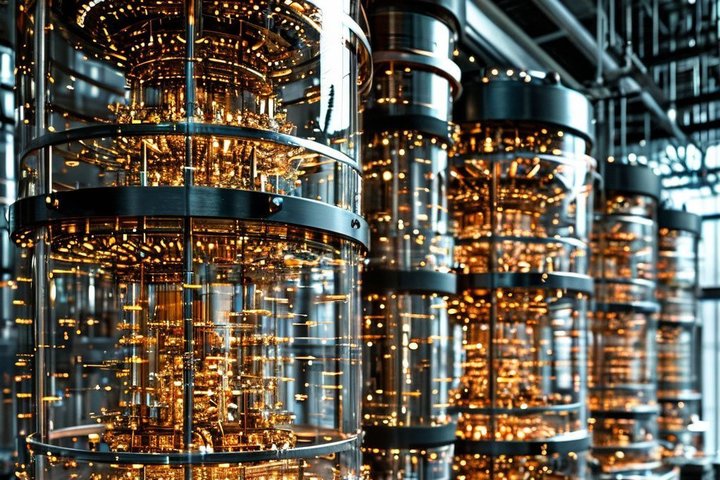
While QuEra is working on an ambitious future project, Quaninuum has already demonstrated a serious breakthrough in the fault tolerance of quantum systems. Its 98-qubit quantum computer Helios, created in collaboration with Sandia National Laboratories (under the US Department of Energy), set a record for accuracy among all such devices. During independent verification, the computer achieved accuracy of 99.9975% for single-qubit operations and 99.921% for two-qubit operations. The computer's architecture contains 50 logical qubits responsible for error correction, and the achieved accuracy, according to scientists, paves a direct path to creating full-fledged fault-tolerant quantum systems.
Access to the Libra system will be provided through the Amazon Web Services (AWS) cloud platform, allowing researchers around the world to gain access to fault-tolerant quantum computing. However, some experts call QuEra's idea too ambitious: the largest atomic qubit matrix to date has 6,100 elements, and they have not yet been used for real tasks. Giants like IBM predict the emergence of fault-tolerant machines no earlier than 2029 and with less capacity than QuEra is currently claiming. Nevertheless, the Helios results show that the industry is moving in this direction at a very rapid pace.
New photographs of Earth
The Russian small spacecraft AIST-ST has successfully confirmed the functionality and characteristics of its target equipment and transmitted the first radar images of the Earth's surface. The satellite, created by scientists and engineers of Samara University named after Korolev together with specialists from the St. Petersburg Special Technology Center, became the world's first radar Earth monitoring satellite in the CubeSat format. The spacecraft was launched on December 28, 2025, from the Vostochny Cosmodrome by a Soyuz-2.1b launch vehicle.
The uniqueness of the AIST-ST spacecraft lies in its record-small size. The satellite is designed in a 16U format — 16 connected cubes measuring 10x10x10 cm each. The mass of the device is only about 30 kg. At the same time, it carries a full-fledged radar operating in the range from 8 to 12 GHz, capable of “seeing” through the densest clouds and conducting surveys at any time of day. Usually, equipment with such capabilities is installed on significantly larger spacecraft.
During tests, the satellite conducted surveys in route mode, transmitting images of the territory of Japan, the Panama and Suez Canals, as well as the USA. The resolution of the resulting images was no less than 5 meters per pixel. Samara University stated that the device fully confirmed the functionality of its target equipment and the stated characteristics.
SpaceX's new acquisitions for $60 billion
Just a few days after its record IPO on Nasdaq, SpaceX announced the acquisition of the developer of the popular AI programming tool Cursor. The deal, concluded on June 16, is a share agreement worth $60 billion. It is expected to close in the third quarter of 2026. Back in April, SpaceX received an option to buy the startup, which included an alternative payment of $10 billion in case of refusal.
Cursor is one of the fastest-growing AI startups, helping programmers write and debug code using text queries. More than a million people use the product daily, and 64% of Fortune 500 companies have expressed trust in it. Among Cursor's clients are Adobe and Nvidia, whose head Jensen Huang called the service his “favorite corporate AI product.” At the same time, access to computing power has long constrained the company's growth, and the partnership with SpaceX opens up access to xAI infrastructure for Cursor.
Earlier, Elon Musk publicly admitted that his AI division xAI lags behind direct competitors like OpenAI and Anthropic, especially in the field of developer tools. The purchase of Cursor will allow SpaceX to instantly obtain a ready-made, mass-demand product and a development team. Against the backdrop of the deal announcement, SpaceX shares rose by more than 10%, increasing the market capitalization by almost $247 billion.