Fantastic horizons
Winners of “Novye Gorizonty” (New Horizons) were awarded at the House of Writers' Creativity in Peredelkino, and they discussed how Russian science fiction has begun to turn its face towards the reader.
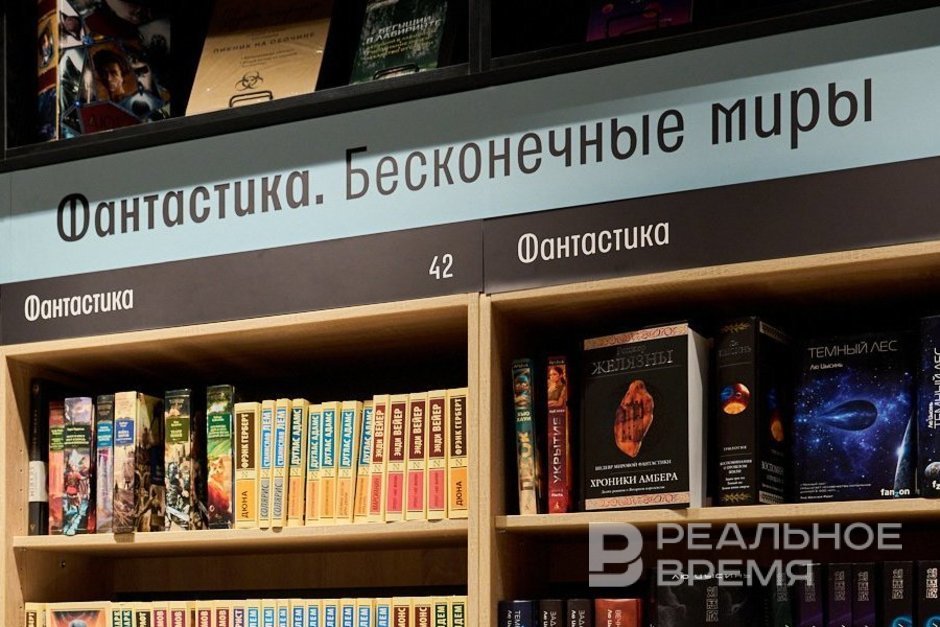
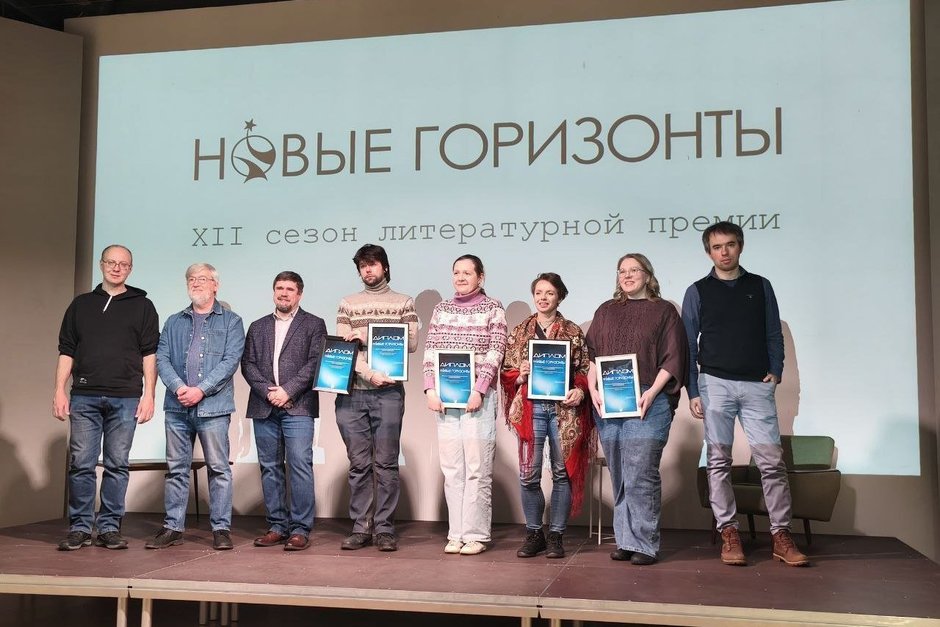
At the end of January, the award ceremony for the winners of the 12th season of the literary prize “Novye Gorizonty” (New Horizons) was held at the House of Writers' Creativity in Peredelkino. As part of the event, a public discussion was organized titled “Scientific, Social, Psychological... Where to Expect the Next Breakthrough in Science Fiction?”. Participants talked about the transformation of the genre over the last decade, the role of commercial platforms and self-publishing, and whether a breakthrough is possible under the dominance of the market. Details are in the report by “Realnoe Vremya” literary critic Ekaterina Petrova.
You Are Here
Three books made it to the final of the domestic nomination of “Novye Gorizonty”: “Atomic Pie” by Marzipana Konfityur, “Tabiia Thirty-Two” by Alexei Konakov, and “The Black Hut” by Anna Luneva and Natalia Kolmakova. The jury, chaired by Andrei Vasilevsky, editor-in-chief of “Novy Mir," awarded the prize to Konakov's novel “Tabiia Thirty-Two.” Honorary diplomas from the founders of the prize, Vasily Vladimirovsky and Sergei Shikarev, were awarded to Eduard Verkin for the novel “Magpie on the Gallows” and achievements in the field of synchronous physics and quantum realism, as well as science fiction historian Alexei Karavaev for the book “A Brief History of Soviet Science Fiction.”
The ceremony itself was the final event after lectures and a public talk, where they discussed science fiction and its future. The discussion began with changes that have occurred in Russian science fiction since the prize's founding in 2013. Journalist and critic Roman Fainitsky spoke about a shift from an inward-looking genre focused on the domestic market to literature aimed at a universal reader.
“In recent years, a trend has emerged to look broadly and address not only the domestic audience but also people in principle. These books try to speak to a reader who is unfamiliar with our [Russian] context, and this ability became the main criterion for me," Fainitsky formulated. According to him, over the past ten years, Russian science fiction has noticeably moved away from directly imitating Western plots towards searching for its own images and meanings, and such texts have become significantly more numerous in the prize field.
Writer and co-founder of the “Novye Gorizonty” prize Sergei Shikarev linked key changes primarily with a change in the status of the genre. “Science fiction was long perceived as marginal literature, then as a guilty pleasure, and today it is a respectable genre present in prestigious prizes, thick literary journals, and non-fiction series," he noted, recalling the “Bolshaya Kniga” award being given to Eduard Verkin.
At the same time, Shikarev pointed out a paradoxical aspect of the process: despite the expansion of institutional opportunities, some authors still preferred to remain in the genre “ghetto.” He also noted a decrease in the share of science fiction based on strict hypotheses and an increase in entertainment forms, which he suggested treating without drama.
Science fiction researcher and co-founder of the “Novye Gorizonty” prize Vasily Vladimirovsky complemented this view with specific institutional shifts. According to him, the turning point in the attitude of publishers and qualified readers towards science fiction became especially noticeable from 2017, when major publishers not only began publishing but also stopped disguising and started directly defining the genre in the book description as a science fiction novel. “This is not a merger of mainstream literature and science fiction, but a long, cyclical process: genres go side by side, periodically intertwining. We have already been in a similar situation — for example, in the 1920s, when boundaries between science fiction and 'serious' prose practically did not exist," he said, insisting on the historical repetitiveness of what is happening.
Writer Shamil Idiatullin noted the transformation of the genre on several levels at once. He said that the scientific component of science fiction still reacts weakly to topics of bioengineering, immortality, and other actively discussed scientific directions, and socio-political changes directly influence the set of permissible and in-demand plots.
In the literary dimension, according to Idiatullin, the fragmentation of the field has been completed over the past decade: “Today it is impossible to speak of a unified process of creating and consuming science fiction. There are print and audiobooks, prestigious publishing houses, self-publishing with tens of thousands of texts, and an audience comparable in volume to the official market.” This plurality of forms and channels, the writer emphasized, has become one of the key outcomes of recent years.
Science Fiction from the Internet Expanse
“Romantic vampires, 'pregnant by a dragon', boyar-anime, time travelers — these are not vanished phenomena; they occupy a noticeable share of commercial platforms. The question is whether we need to account for this part of literature and this, albeit not very large but tangible, reader demand," Vasily Vladimirovsky posed the question to his colleagues.
Sergei Shikarev's answer was extremely harsh and concise: “We must account for it, but read it — by no means.” For him, commercial platforms represent a closed ecosystem not aimed at entering other literary institutions. He questioned the very thesis about possible “growth” of authors within such an environment: “The self-publishing platform Author.Today is a commercial platform that allows an author oriented towards commerce to satisfy all their demands. If an author is interested in print publication and commerce is not a priority for them, their appearance there is unlikely.”
Roman Fainitsky, on the contrary, insisted on the need to consider not only the texts but also the audience of such platforms. He noted that a simplified idea about readers of commercial science fiction does not correspond to reality: “We tend to think that there is some audience that reads only Author.Today and nothing else. I think this is deeply wrong. A modern author competes for attention not with another author, but with YouTube, Netflix, games, and forums.” According to his observation, a generation of authors and readers is forming who freely navigate between mass platforms and canonical science fiction, not perceiving them as fundamentally different worlds.
Vladimirovsky objected to this optimistic scenario, drawing on the experience of previous decades. He argued that the idea of “cultivating” a reader from mass literature to more complex literature is not confirmed by practice: “We have observed this for thirty years. Readers do not transition to more intellectual literature; they move to other media. Readers of ethnogenesis read only ethnogenesis and do not grow.” Shikarev added that a similar effect is visible at the author level: few have managed to overcome the framework of the commercial format, and it took decades.
Fainitsky, meanwhile, shifted the emphasis to the cultural scale of the phenomenon. He spoke not of guaranteed growth of specific authors but of the accumulation of plot codes and settings: commercial science fiction over time turns into cultural material, which is then reinterpreted and deconstructed by other writers. According to him, ignoring this layer threatens losing an understanding of where new literary strategies come from.
Professor Maria Shteiman from the Institute of Media at HSE University broadened the conversation by suggesting viewing science fiction not only as a literary genre but as a meta-genre and transmedia phenomenon. She pointed out that the fear of readers moving to games or series is related to an excessive narrowing of frameworks: science fiction has long existed in different media. At the same time, Shteiman separately emphasized the risks of commercialization at the corporate level, when control over fictional worlds shifts from the reader and author community to the rights holder, forming a “canonical” reading.
Where Are We Going
The main question — about the future of science fiction — boiled down not to genre forecasts but to discussing the conditions under which a breakthrough is possible at all. Writer Alexei Andreev proposed viewing the future of science fiction primarily through the source of demand. According to him, with market dominance, the genre inevitably reduces to stable forms: “If the demand is set by the market, literature will always have three pillars: crime, erotica, and the mystical. All diversity in the market converges to this.”
He emphasized that science fiction arose in situations of non-commercial pressure, when literature responded to large external stimuli: “Real science fiction appeared because there was the Cold War, there were Baikonur and BAM. If there are no such non-commercial stimuli, only psychiatric horror in different genres will remain.” The future of the genre, according to Andreev, is possible only by abandoning purely economic schemes.
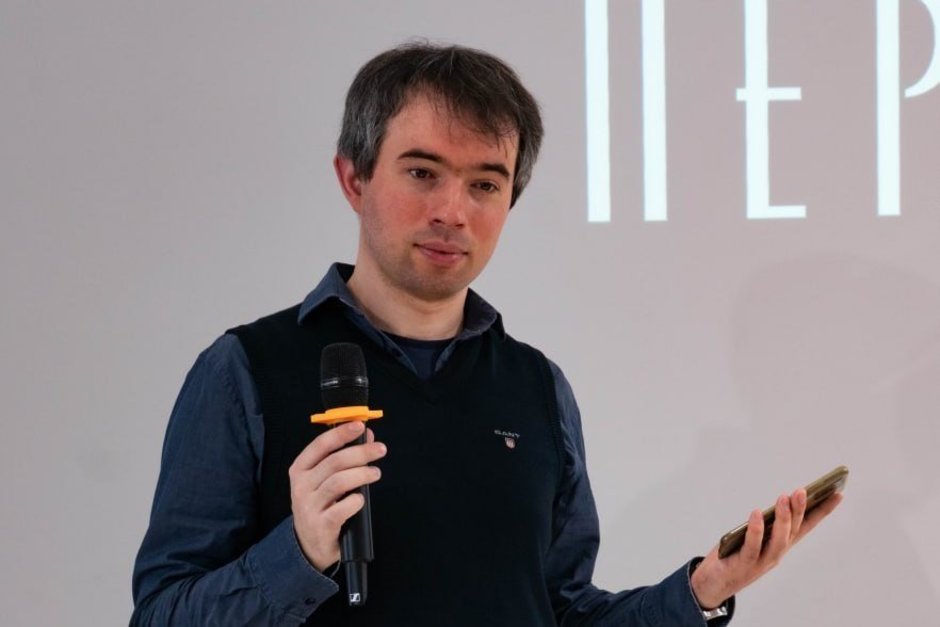
Sergei Shikarev objected to directly reducing the development of science fiction to ideological directives. He reminded that the impulses of the genre have always been associated with large projects and technological shifts but were not exhausted by the Cold War. As an example, Shikarev cited Isaac Asimov's position, who explained interest in Soviet science fiction by the fact that ideas about the future best show the structure of society. Shikarev emphasized: “Each time the emergence of new genres and movements was associated with social and scientific changes. Cyberpunk appeared with the spread of computer technology, the new wave — with the anthropological turn.”
Vladimirovsky, in turn, clarified that even in early American science fiction, the decisive factor was not ideology but the technological environment. He reminded that inventor and science fiction writer Hugo Gernsback created science fiction as a form of enlightenment during the radio revolution. Moving from discussing impulses, Vasily Vladimirovsky turned to the institutional question: what structures allow science fiction to develop today. He summarized his position to three necessary elements: “For living science fiction, networking, journals as central platforms for discussion, and prizes with authority are needed. Without this, the community doesn't work.”
Shamil Idiatullin linked the future of science fiction to the general state of scientific thinking. He noted that expecting a surge in the genre is difficult in a situation where science — including humanities disciplines — is losing its public status. At the same time, he reminded that science fiction is not limited to physics and space: “Linguistics, sociology, psychology have developed very expressively over the last fifty years and have already become the basis for good books.”
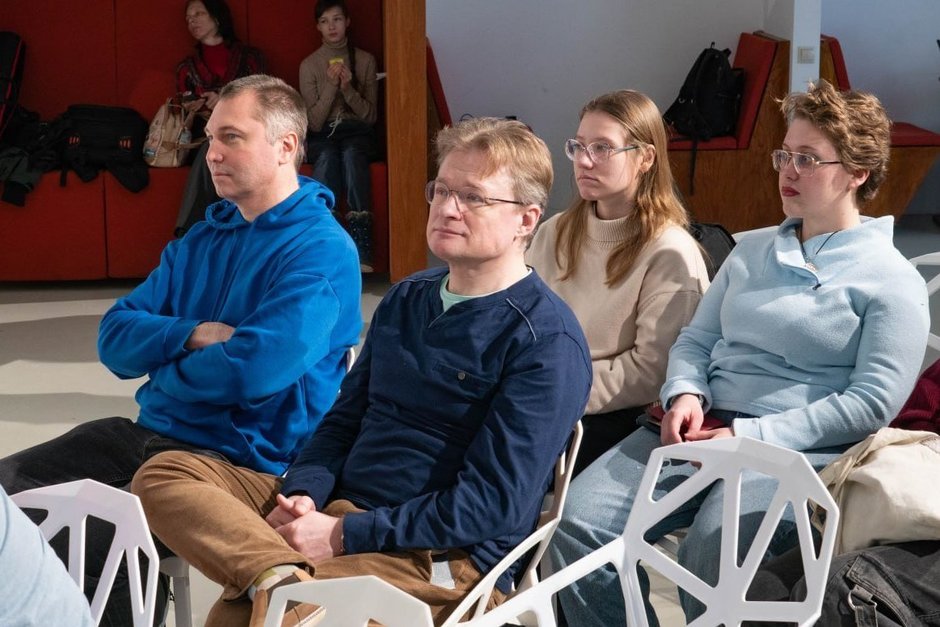
Roman Fainitsky spoke about the future of science fiction as a problem of the environment, not themes. He proposed abandoning rigid genre boundaries and building a horizontal professional community open to different forms of the fantastic. According to him, breakthroughs have always been born from conflict and rebellion, not from fulfilling demands: “A talented author is not a person who writes slogans. Good authors are born from troubled times and resistance.” Fainitsky also emphasized that modern writers increasingly exist as “digital nomads," for whom national and institutional frameworks cease to be defining.
In the discussion about “hard” science fiction, participants agreed that many images of the future were already described by 20th-century science fiction writers. Shikarev noted that drones, smart homes, and orbital hotels have long been present in the works of Isaac Asimov and Clifford D. Simak, and the problem of today's science fiction is a deficit of authors capable of working with modern scientific concepts. At the same time, Idiatullin insisted that the potential of science is broader than the usual technological forecasts, and Vladimirovsky concluded that even exhausted plots do not cancel the possibility of writing about the same technologies differently, “combining and arranging them differently.”
Ekaterina Petrova is the literary critic of the online newspaper “Realnoe Vremya," host of the Telegram channel “Poppy Seed Buns.”