Life begins only after 60: late love, friendship, approaching illnesses and new meanings
For Grandparents' Day “Real Time” selected five fiction books where the main characters are people of the “silver” age

Today Russia celebrates the unofficial Grandparents' Day. By tradition it is customary to arrange tea parties and look through family albums together with the older generation. The idea of the holiday originated in the Netherlands in 2009; there relatives give each other houseplants, where the roots symbolize the ancestors and the leaves — the grandchildren. In Russia this day coincided with the ancient Slavic holiday of Autumn Grandfathers. And especially for those who have not yet joined the ranks of grandmothers and grandfathers but are already close to it, the literary reviewer of “Real Time” Ekaterina Petrova selected five fiction books that tell about the life of people of the “silver” age.
From chivalric romances to Simone de Beauvoir
In literature elderly people did not immediately become full-fledged characters. Often they were symbols of wisdom, and even more often — of decrepitude and the withering of life. In works of the Middle Ages the elder was associated with experience and authority. He performed the role of counselor, as, for example, Gornemant — a character of Chrétien de Troyes's chivalric romance “Perceval, or the Story of the Grail” (1180—1181). Gornemant taught the young main hero the basics of chivalric mastery and the rules of etiquette. The other side of the coin of the image of the elderly person — the depiction of infirmity and greed, and sometimes even inappropriate lust. That is exactly how Greed appears in the famous French allegorical poem of the 13th century “The Romance of the Rose," written by Guillaume de Lorris (the first part) and Jean de Meun (the second).
With the flourishing of realism in the 19th century the elderly person for the first time becomes the object of close artistic investigation, where old age was considered as a social and psychological phenomenon. Balzac creates a whole gallery of such “types.” The passions and tragedies of Gobseck (1830) or Father Goriot (1835) determine the plots of the books. Old age became visible, but had not yet taken the central place on the literary stage.
In classical Russian realism the main heroes still remained young people rebelling against society. And the elderly appeared as secondary figures symbolizing conservative forces or family ties. Such is Kabanikha from Alexander Ostrovsky's play “The Storm” (1859). Marfa Ignatyevna Kabanova — the concentrated embodiment of the old patriarchal world with its prejudices and ignorance; she is the main conservative force. Here too one can refer the old-type bureaucrat Pavel Afanasyevich Famusov from Alexander Griboyedov's comedy “Woe from Wit” (1825) and the old prince Nikolai Andreyevich Bolkonsky from Leo Tolstoy's epic novel “War and Peace” (1865—1869). Although the figure of the prince is much more complex.
The real turning point occurred only in the second half of the 20th century. The scientific revolution in gerontology, the change in the demographic structure of society and the appearance of pension systems made old age a mass and socially significant experience. In the cultural sphere the fundamental work of Simone de Beauvoir “Old Age” (1970) played the key role. She spoke out against old age as a biological sentence and proposed to consider it as a socially and culturally constructed phenomenon, full of contradictions and suppressed desires.
Gradually elderly heroes in literature cease to be a background and become protagonists whose problems and anxieties are in the focus of the narrative. And the literature of the 21st century investigates already what was earlier tabooed: the late love and sexuality of elderly people, their loneliness and existential crises, illnesses and attempts to preserve dignity in the face of the inevitable.
Fredrik Backman. “A Man Called Ove," “Sindbad” (18+)

Once a colleague of Fredrik Backman wrote in a blog about a man named Ove who exploded with anger while buying tickets at a museum. Backman recognized himself in this character and began to write notes about what irritated him himself. Thus the literary Ove was born — a sullen and grumpy pedant who lives by his strict rules and demands their fulfillment from others. But for all his unsociability this is a man with a big heart. He is a widower who has also lost his job. And in order to preserve at least some support in life, Ove scheduled his day by the minute: he wakes up, goes around the territory of the district, checks the parking, grumbles at the negligent neighbors. The man decides to settle scores with life, but the carefully planned attempts fail. And then a noisy young family with two little ones moves into the settlement, which accidentally, parking next door, demolishes Ove's mailbox. This comic incident becomes the beginning of a touching story about lost love, unexpected friendship, a homeless cat and the ancient art of reversing a car with a trailer.
In Sweden the novel came out in 2012 and almost immediately became a bestseller. Backman's realistic prose with elements of tragicomedy and family-domestic drama conquered the hearts of millions of readers around the world. Sometimes this work is called a “book-antidepressant.” Even greater popularity came to the author and the novel after the Swedish film adaptation in 2015 with Rolf Lassgård in the main role. By the way, the film received an “Oscar” for the best foreign language film. And in 2022 Ove was played by Tom Hanks in the American remake “A Man Called Otto.”
Irina Leyk. “The Day Between Friday and Sunday," “Dom Istoriy” (16+)

Leonid is already over seventy; behind him is a successful career and loyal friends. But with his family it did not work out. His whole life is subordinated to one goal — waiting. But Lydia Andreyevna has a big and strong family with caring children and wonderful grandchildren. Only her well-being was destroyed by a terrible diagnosis; she suffers from Alzheimer's disease: she confuses her relatives, does not recognize her daughters and often does not understand where she is. Every Saturday, regardless of the weather, Leonid goes to the airport. There he waits for the woman whom he loved more than 50 years ago and who promised to come but never appeared. Half a century later Leonid does not lose hope. Lydia Andreyevna has her own ritual on Saturdays. She packs her suitcases, because in her fading consciousness lives the same promise — Leonid is waiting for her at the airport.
“The Day Between Friday and Sunday” is a story about a love that is longer than memory and stronger than illness. The writer and translator from Dutch Irina Leyk made a gender inversion of “Juno and Avos.” If in the classical story fidelity is kept by the man and the woman waits, then in Leyk both heroes “wait” in their own way. Leonid is in chronic waiting in real life, and Lydia waits at the walls of her crumbling memory. By the way, Leonid is that rare image of a man not only in literature but in life in general, capable of fidelity over the course of half a century. His Saturday trips to the airport are an act of love that neither time nor common sense can shake. The book is very heartfelt and emotional, with the subtle sense of humor inherent to the writer. An ocean of tears, both from the sentimentality of the story and from laughter, is guaranteed.
Maria Aksenova. “The Book House on the Amur," MIF (16+)
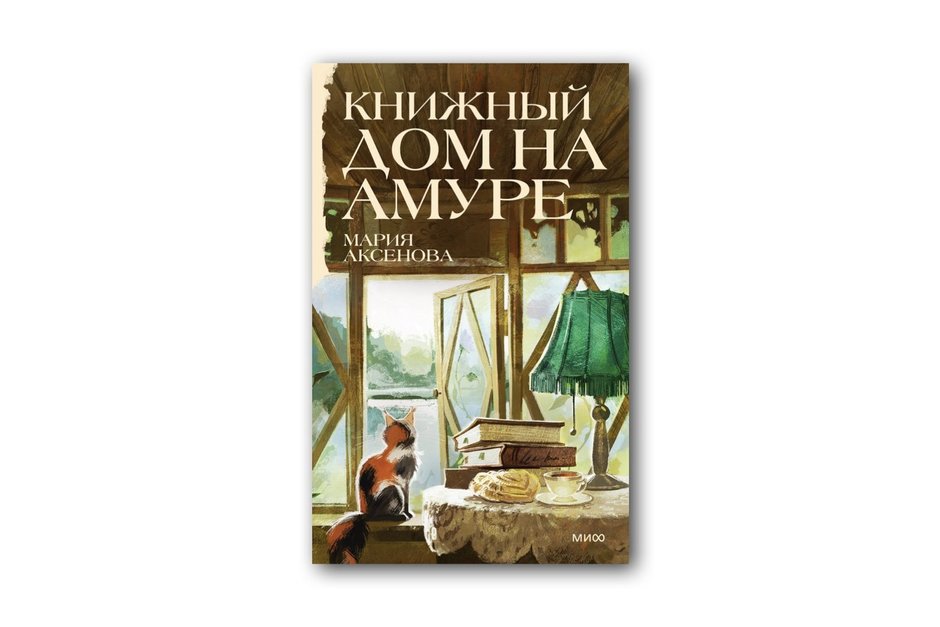
The story of Leonid Markovich from Maria Aksenova's novel is in some ways similar to “A Man Called Ove.” Unfortunately, comparisons with Backman's book are inevitable in all cases when the main hero is a sullen widower. Leonid Markovich is 68 years old; he recently lost his wife Zoya and now does not know how to live without her. The apartment has become empty, and the emptiness from the space in the house has moved into the inner life of the hero. Everything in the apartment reminds of Zoya, which makes it altogether dreary. Therefore Leonid decides to exchange his big apartment for a house in the provinces, which turns out to be not as good as the son's friend, of a semi-swindler type, promised. On the territory adjacent to Leonid Markovich's “new” house there immediately appears the wayward cat of the former owner Francesco, as well as the local residents, who, of course, have business with the newly appeared neighbor.
“The Book House on the Amur” is Maria Aksenova's second book. She debuted with the touching story about the growing up of a girl in the Far Eastern provinces, “Child of the Forest.” In the new novel the writer remains true to herself, continuing to raise complex themes but telling about them brightly and with hope. Here there is the experience of loss and the sense of guilt accompanying it, voluntary seclusion and a gradual return to people, the acquisition of a new meaning where it would seem impossible to find it, as well as the saving power of books. All the inhabitants of the provinces are united by the love of reading. There is no bookstore here, but there is a library and a book club. It is precisely the books that Leonid Markovich discovered in huge quantities in the new house and wanted to get rid of, that become a support in difficult moments and return the taste for life.
Bernhard Schlink. “The Late Life," “Azbuka” (18+)

“The Late Life” is a novel by the well-known German writer, the author of the famous “The Reader.” The book came out in 2023, and in 2025 a translation into Russian appeared. Bernhard Schlink himself is a lawyer and historian of law; his professional experience, as well as his age (the writer was born in 1944), give the novel a special depth and authenticity in depicting the feelings and thoughts of an elderly intellectual. The life of the 76-year-old Martin Brehm is outwardly prosperous. He is a professor of the history of law, the author of a popular textbook, a specialist respected in the professional environment, who has already been retired for several years and leads a calm and measured life. He is happy in his second marriage with his young wife Ulla (she is 43) and is raising his six-year-old son David. However the idyll ends when Martin is informed of a fatal diagnosis — cancer of the pancreas with metastases in the bones. The doctors say that he has several months left to live.
How to dispose of the remaining time? Martin begins a “countdown," planning his every step. He wants to prepare his wife and son for this sad event, and at the same time to think about what to leave them in terms of memories. The special tragedy of the story is built on the very image of Martin. Family and fatherhood appeared for him rather late, and now he must leave his close ones, barely having had time to truly know the joy of love. At the same time Schlink avoids melodrama; he shows dying as a process full of everyday affairs and domestic problems, denial and attempts to preserve dignity and care for the relatives.
Jo Siple. “The Five Wishes of Mr. McBride," “Bombora” (16+)
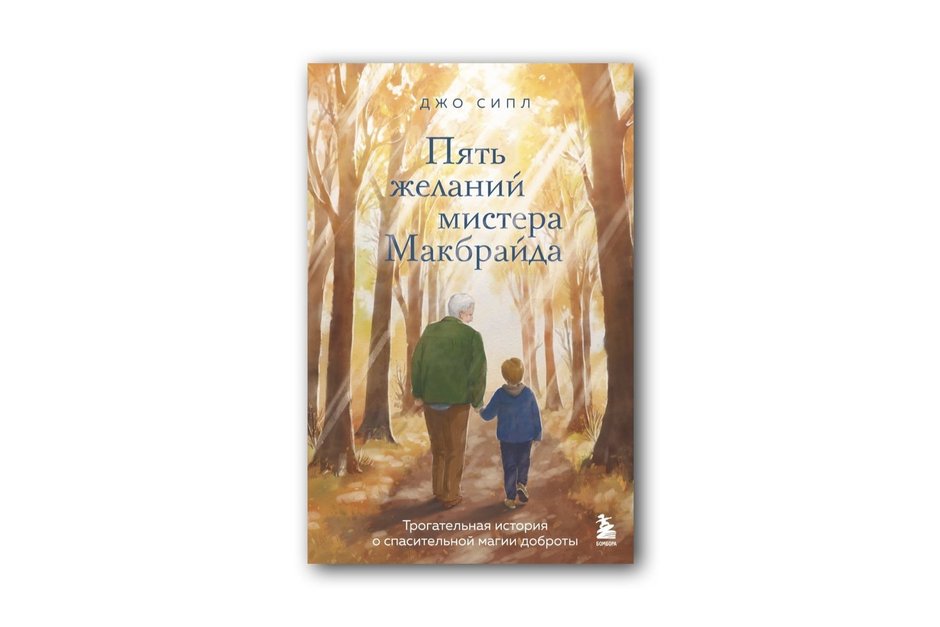
Jo Siple's debut novel is also often compared with “A Man Called Ove," only already by the emotional state of the work. The author wrote his “book-hug” for seventeen years before it saw the light in 2018. This is a sentimental story about the friendship between a hundred-year-old old man and a terminally ill boy. Murray McBride has lived a very long life; he has outlived practically everyone he loved. Tired of loneliness, Murray decided that the time had come to leave life and stopped taking his medications. On the day of his hundredth birthday he meets in the hospital the ten-year-old Jason Cashman, who is awaiting a heart transplant. The boy shows his new friend a list of five wishes that he wants to manage to fulfill before his heart stops: to kiss a girl, to hit a home run at a Major League stadium, to become a superhero, to find his mom a good boyfriend and to work real magic.
These five wishes become the beginning of a joint journey in which Murray decides to help the boy fulfill his dreams, and along the way to regain the taste for life himself. Murray teaches Jason to value moments, and Jason, who fights for every day, forces Murray to remember what it is like to be young and to dream. Despite the serious themes, there are many touching and sometimes even comic scenes in the novel, especially in the dialogues between the old man and the boy.
Ekaterina Petrova — literary reviewer of the online newspaper “Real Time," host of the Telegram channel «Булочки с маком».