Particles from the depths of the Universe, the mirror nature of life, the “switch” of neurons
We explain what the Nobel Prize in scientific disciplines was awarded for in 2026
“Real Time” explains how, and most importantly why, the discoveries were made for which the 2026 Nobel Prize was awarded. In today's review there are only three parts: we deliberately focused only on the scientific disciplines of the prize, since only they can be explained from an objective and factual point of view. The prize in physics was awarded for a way to detect high-energy neutrinos — only they can bring humanity information about infinitely distant worlds, from which not a single type of radiation can break through to us. The prize in physiology and medicine — for the discovery of the method of optogenetics, which, in essence, represents a button for switching nerve cells on and off. The prize in chemistry — for the discovery of a way to synthesize in the laboratory only one mirror version of organic molecules, as nature does. A detailed explanation — in our review.
How they learned to “catch” neutrinos and what Soviet physicists with a radio receiver have to do with it
The 2026 Nobel Prize in physics was awarded to Francis Halzen of the University of Wisconsin (USA) for the decisive contribution to the creation of the IceCube neutrino observatory and the discovery of high-energy neutrinos of astrophysical origin. The neutrino is the most secretive particle in the Universe. It has no electric charge and almost no mass. It passes through matter unnoticed, only occasionally colliding with an atomic nucleus — at that a micro— or, rather, nanoflash of light is formed. Every second 65 billion solar neutrinos pass through the nail of your little finger! But neutrinos also come from other regions of space. And if one captures them (and distinguishes them from “ordinary” ones — formed during the decay of radioactive substances or born by the Sun), one can learn something about those extreme conditions in which they arose.
Francis Halzen back in 1986 understood that on Earth the ideal medium for “catching” such neutrinos would be the ice of Antarctica. By the way, it was Soviet physicists who prompted him to this idea; they planned to capture neutrino signals in Antarctica using radio receivers. They supposed that when a neutrino collides with an atomic nucleus in the ice, an electric spark would arise that would generate a radio wave. Halzen understood that one could act “directly” and look for flashes of blue light during such collisions. It is convenient to do this at great depth, where darkness is constantly preserved. Unlike warm ocean waters, here there is no interference from living beings. The ice is stable, and there are no earthquakes in the region. An ideal medium!
In 1989 Halzen presented a report with the project of an “ice” neutrino observatory. Already in 1992 the first attempts were made to lower light sensors into the glacier at the South Pole — this was the first neutrino observatory, AMANDA. In 2011 the neutrino telescope IceCube was built. This gigantic observatory really represents a cubic kilometer of ice at a depth of 1.45 to 2.45 km, pierced by 5160 light sensors. Halzen all this time acted as the “locomotive” of his project. It was he who brought the project of the neutrino observatory at the pole from the stage of an idea to the completion of measurements and the obtaining of scientific results.
In 2013 IceCube for the first time registered a neutrino with monstrous energy. Its parameters allowed no doubt that it was precisely particles from deep space that had been “caught.”
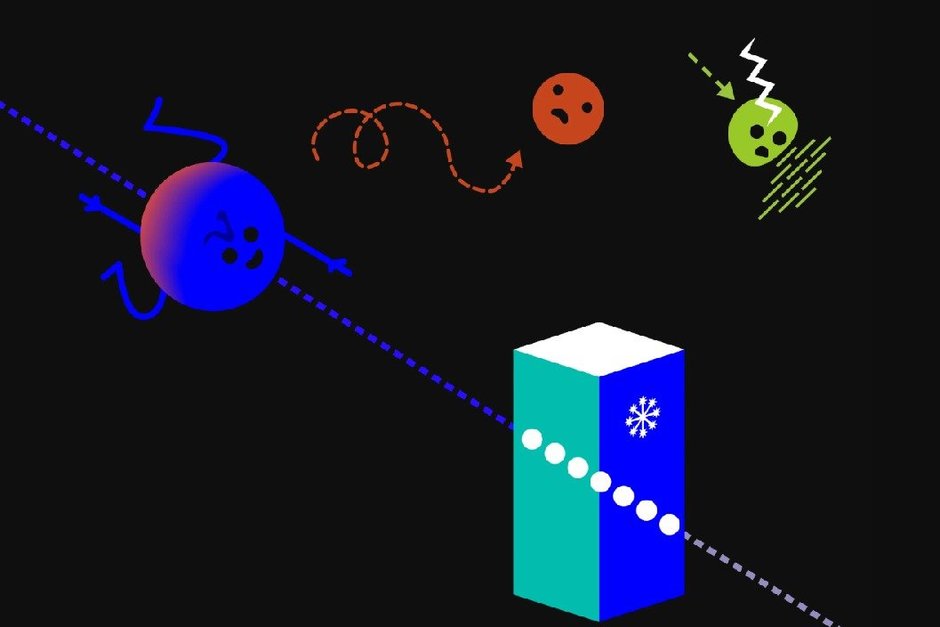
The question remains: why is this needed? To study the high-energy phenomena of the Universe. The main advantage of neutrinos is that they have no electric charge. And that means their trajectory is not curved in space by anything at all, and one can trace where the particle came from. By the way, for the possibility of using neutrinos to study cosmic phenomena the Nobel Prize was awarded back in 2002 — it was received by Raymond Davis and Masatoshi Koshiba, who were the first to learn to determine the trajectory of neutrinos and trace their origin. Neutrinos helped physicists confirm their models of the processes inside the Sun and inside a supernova.
Physicists hope that IceCube will bring neutrino astronomy to a new level and give information about mysterious phenomena hidden behind dust clouds. Especially when it is expanded to a volume of 8 cubes of ice (this is in the immediate plans). Another interesting goal is objects that are at such monstrous distances from Earth that other forms of radiation simply do not reach us. That is, neutrino astronomy can give physicists knowledge that cannot be obtained in any other way.
How two scientists repeated the chemistry of life
In some chemical reactions not one but two types of molecule are formed, which mirror each other. Their atomic composition is the same, but their structure is different. Like the right and left hands. In honor of the hands this phenomenon is named — chirality. The molecules from which life is built can often have a chiral version. But nature for some reason always synthesizes only one “hand.” Life is homochiral (from the Greek words “same” and “hand”). Such, for example, are amino acids: all of them exist in two mirror variants, but in cellular proteins only one of them is found.
But in the laboratory the very same reaction for some reason always gave an equal distribution of both mirror versions. And this was bad. After all, in pharmaceuticals one needs to obtain one specific form. Its “mirror” can cause harmful side effects. In history there was a tragedy connected with the fact that the “wrong” chiral form of the active substance got into a medicine. The sadly infamous thalidomide in the mid-20th century relieved pain syndrome and eased the life of pregnant women, but caused an epidemic of congenital anomalies in children. Subsequently it turned out that the second chiral version of the thalidomide molecule was to blame, which was synthesized in the same volume as the first, harmless one. No one knew that this could be dangerous. In the release of the Nobel Committee such a danger is explained thus:
— Imagine that you are a locksmith making keys to order. When making them, two mirror variants are always obtained, but only one of them fits the lock. If one tries to open it with the other key, the lock will break. And it is very hard to distinguish the keys, therefore the client receives both.
The 2026 Nobel Prize in chemistry is received by Henri B. Kagan of the University of Paris-South and Kenzo Soai of the University of Tokyo — precisely for managing to cope with this problem and unravel the mystery of homochirality.
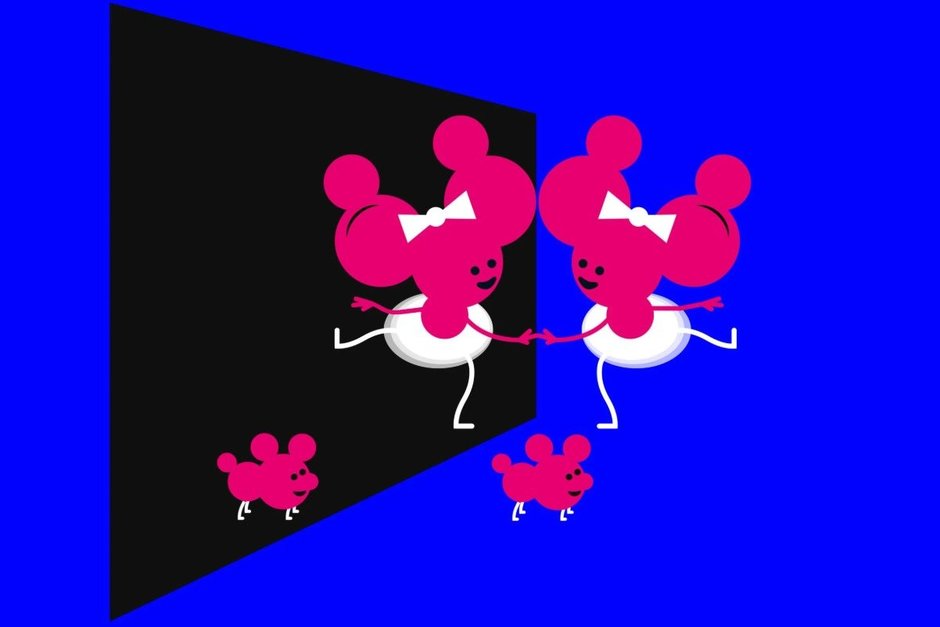
Of course, the works of these two Nobel laureates did not appear out of nowhere. At the beginning of the last century the German Marckwald thought up using a catalyst — also chiral — in an organic reaction. And this helped: slightly more of one of the two mirror versions of the substance was formed. Such reactions are called asymmetric. In 1953 an article came out by the physicist Charles Frank, who proposed a model of a chemical reaction where three conditions would be fulfilled: an asymmetric reaction with a catalyst, the further amplification of the formation of one mirror version and the formation of a chiral catalyst directly as a result of this same reaction. Such a scheme, when the reaction reinforces itself, is called autocatalysis.
Then chemists thought up how to translate this theory into chemical practice. In 2001 and 2021 the Nobel Prize in chemistry was awarded to researchers who developed the first truly asymmetric chemical reactions. The two remaining conditions were fulfilled by Henri Kagan and Kenzo Soai. In 1986 Kagan found how to amplify the formation of one mirror version and described a series of asymmetric reactions. And Kenzo Soai in 2003 thought up an elegant reaction in which only one product was formed, having the needed mirror orientation. He became the first scientist who, for the first time since the origin of life on Earth, successfully reproduced the condition of chirality.
The discoveries of Kagan and Soai affect every company whose production interacts with living organisms. These are pharmaceutical preparations and flavorings, fragrances and agricultural chemicals. It is important for the production of certain materials. Chemists have received fundamentally new tools for use, and world global science — the solution to a great mystery of chemistry: how the homochirality of life appeared.
How an algal protein activated all of neuroscience
The work of the brain has been a mystery to man since ancient times. In the 20th century physiologists determined which areas of the brain control physiological functions. But how memories, feelings and behavior are formed could not be understood. Research methods did not allow seeing the direct work of the living brain. Francis Crick, the 1962 Nobel laureate, after discovering the secrets of DNA tried to think up a way to activate individual neurons in the living brain. He wrote that the one who could make them react to light would be able to control them.
Karl Deisseroth, Peter Hegemann and Georg Nagel were awarded the 2026 Nobel Prize in physiology and medicine for managing to do this. These three scientists discovered the foundations of optogenetics. It allows “switching on” and “switching off” the activity of individual neurons in the living brain.
And it all began with Peter Hegemann of the Max Planck Institute of Biochemistry (Germany) becoming curious: how does the alga Chlamydomonas manage to react to light instantly — twenty times faster than the human eye? He studied the “eyespot” of the alga — he wanted to isolate the light-sensitive protein that forms an ion channel conducting an electric impulse. At the turn of the millennium the complete DNA map of Chlamydomonas became known — and Hegemann together with Georg Nagel of the Max Planck Institute of Biophysics (Germany) suspected that they had found the genes of this protein.
Nagel introduced copies of the “suspicious” proteins into frog egg cells, and the egg cells began to produce them en masse. And these proteins worked exactly as Hegemann had supposed — they represented ion channels that opened under the influence of light. They were named channelrhodopsins. The channelrhodopsin in the frog egg cell worked no worse than in the alga: the channel opened on the cell surface in 0.2 milliseconds, positively charged ions passed through it, and an electric signal was generated. Hegemann and Nagel understood that they had made a revolution: they had discovered the possibility of making any cell light-sensitive. After they published the results in 2003, Karl Deisseroth of Stanford became interested in them.
Deisseroth had received a doctorate in neuroscience. He had already been searching for several years for a protein that could be used to generate impulses in neurons when the article of Nagel and Hegemann was published. He requested the DNA of the channelrhodopsin from Nagel, introduced it into rat neurons in Petri dishes — and the neurons became light-sensitive, instantly reacting to blue light. This light caused a nerve signal that could be transmitted to other neurons.
Deisseroth together with Nagel and Hegemann worked for several more years — and in 2006 the new method received the name optogenetics. In 2007 Deisseroth successfully activated neurons in the brain of living mice — acting on the neurons with a thin optical fiber introduced into the brain through a small opening in the skull, he “intercepted” control of the mouse's whiskers. Then optogenetics was used for the controlled awakening of sleeping mice — and again it worked! In 2012 Deisseroth activated the memory zone in mice and evoked in them a specific memory of lived events.
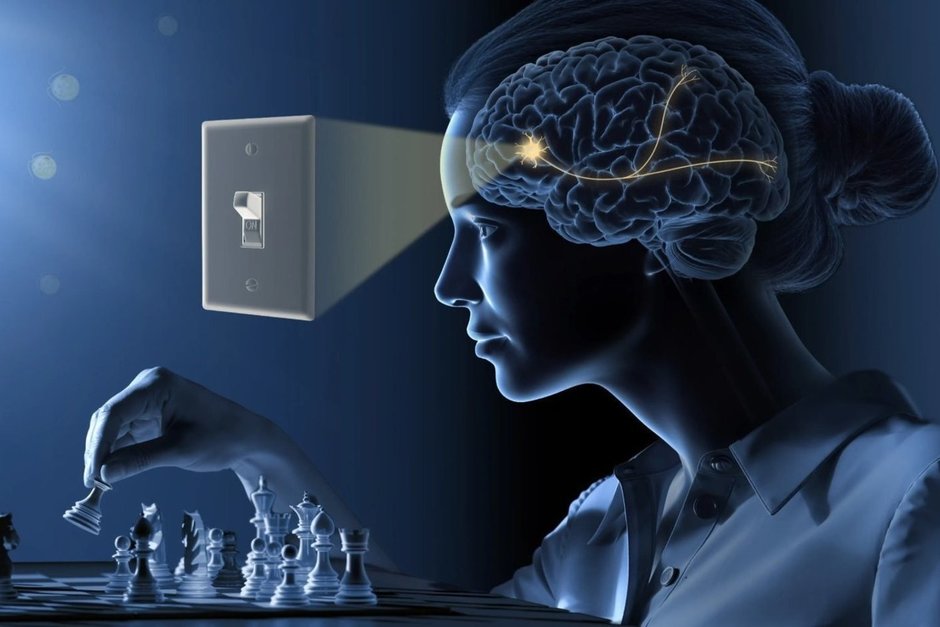
All this opened a new era in neuroscience. Now, thanks to optogenetics, scientists will be able to determine which exactly neurons from a complex bundle control different functions of the brain. For example, neural chains controlling the sensation of pain and thirst, social behavior and food consumption, the reward system and attention have already been identified. With the help of optogenetics neurons have been found that are responsible for the circadian rhythm and for fever upon activation of the immune system. And optogenetics can also be used for mapping the nervous system and its connection with cellular functions outside the brain.
So why is all this needed? Optogenetics, as scientists hope, will allow finding new methods of treating neurodegenerative and mental diseases. This methodology has already given valuable knowledge in the field of mental and neurological disorders: depression, anxiety, schizophrenia, Alzheimer's and Parkinson's diseases. And knowing how a disease forms, one can effectively search for ways to cure it. Moreover, optogenetics can itself serve as a method of treatment. In particular, clinical trials are now underway in which medics try to restore vision in people blinded because of pigmentary retinitis. A protein similar to channelrhodopsin was introduced into the retina of a blind person — and vision was partially restored! There is also hope that optogenetics will help improve cochlear implantation — with its help it will be possible to activate the auditory nerve with greater precision.