Yulia Kleiman: “Of course, we are far from ready to cooperate with everyone”
Program director of the theatre venue “Uzel” — on how independent art works in the Northern capital
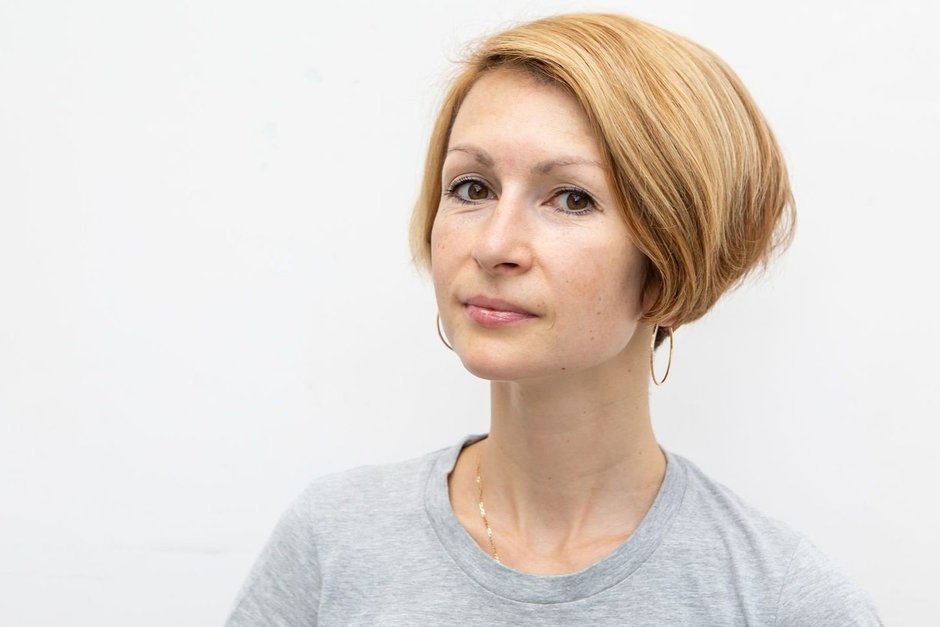
The St. Petersburg theatre venue “Uzel” went on tour at the MOÑ theatre space. Its program director, Yulia Kleiman, is well acquainted with the cultural life of Tatarstan — for example, she created the audio play “Lonely City” in Almetyevsk and has visited Kazan multiple times as a critic and moderator. In an interview with Realnoe Vremya, she spoke about how “Uzel” came to be, what format it exists in, and whether she has to turn down directors.
“We are self-sustaining”
— Yulia, how did you agree to become the program director of “Uzel”?
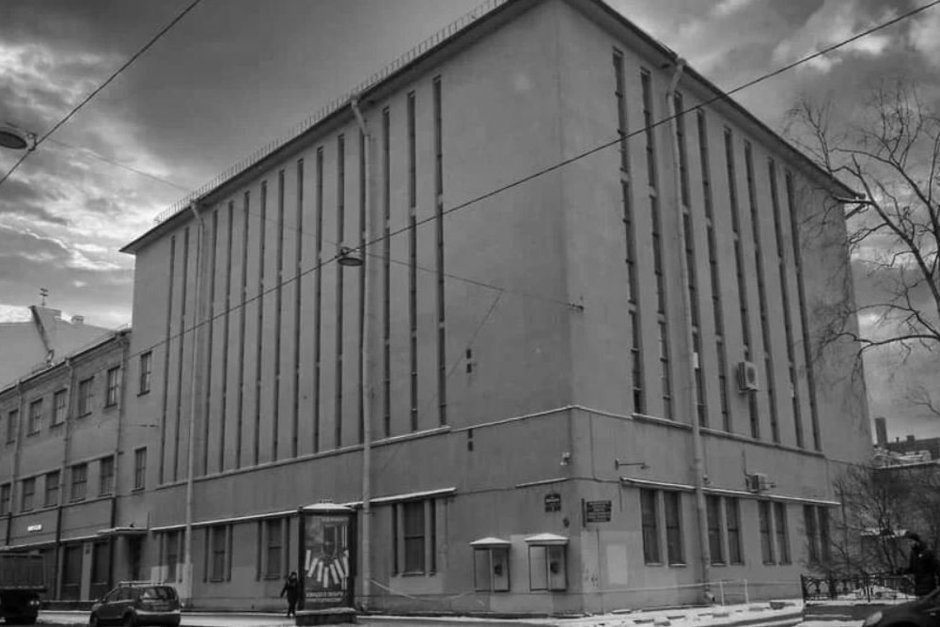
— The story began in autumn 2024, when Andrey Yurchenko, director of the independent venue “Zal#3," was looking for a new space for his theatre. He found a then completely ruined place in the “ATS” cluster, which the cluster's owner planned to renovate and turn into a theatre. Then Andrey came up with the idea not to make a second venue, but to organize a completely new, separate location. He invited me to be the program director.
Strictly speaking, we have absolutely equal leadership. Andrey is the executive producer, responsible for all financial matters, contracts, and so on, but we also jointly discuss the artistic policy. We opened in March 2025. The first thing we showed was a performance by Dmitry Volkostrelov. This unites us with MOÑ: “Gorky / Tolstoy. Memories” was first shown in Kazan. Then Dima performed it in Moscow and brought it to us on tour. For the official opening, we invited young directors, artists, actors, critics — everyone we would like to collaborate with in the future. We have no state funding, and we have not applied for government grants. We are self-sustaining. We give 20% of ticket sales to the owner of the “ATS” cluster; that is our rental condition. The remaining 80% is split equally: 40% for “Uzel” and 40% for the production team.
— I read that some performances were created with institutional support.
— For example, we collaborated with the Goethe-Institut, which supported the laboratory “Days of Spiritual Anguish / Nostalgia” and the production of the performances “Hypnotheatre by Branko Dušić" and “Family Album.” In fact, these are very small subsidies; they only concern the production of the performance, not further runs. We collaborated with the French Institute in St. Petersburg, which supported our Laboratory of French Absurdism and the performance “Parade by Erik Satie.” Additionally, “The Tin Drum” has a sponsor: at the creation stage, a philanthropist appeared who invested personal funds in the production and continues to support it. Unfortunately, there are no more such cases so far. Therefore, we rely on ticket sales and do everything to have full houses. Gradually, we have developed our own audience, including proactive viewers who bring their friends, and they bring theirs. Audiences love discussions, so sometimes we hold them. In addition to performances, our venue hosts readings, lectures, and film screenings (for a while, there was even a film club — we may return to it). But the main thing for us is still the quality of the theatrical works we produce.
Now we have launched an open call for the laboratory “Proyavka” (Development), dedicated to the bicentenary of photography. We are doing it together with the European University. Participants will attend lectures, participate in a manual printing session, discuss theoretical texts about photography, and then create sketches, which we hope will be bold and interdisciplinary. The best of them will enter “Uzel's” repertoire.
— You have mainly 72 seats in the theatre.
— Sometimes we seat more, adding chairs. Or everyone sits on cushions. In general, 70–80 seats; the hall can be transformed.
“In our first year, we had sixteen premieres”
— Tell us how the three performances brought to Kazan appeared in your repertoire. The first is “My Rubtsov” by the theatre “Organizmy.”
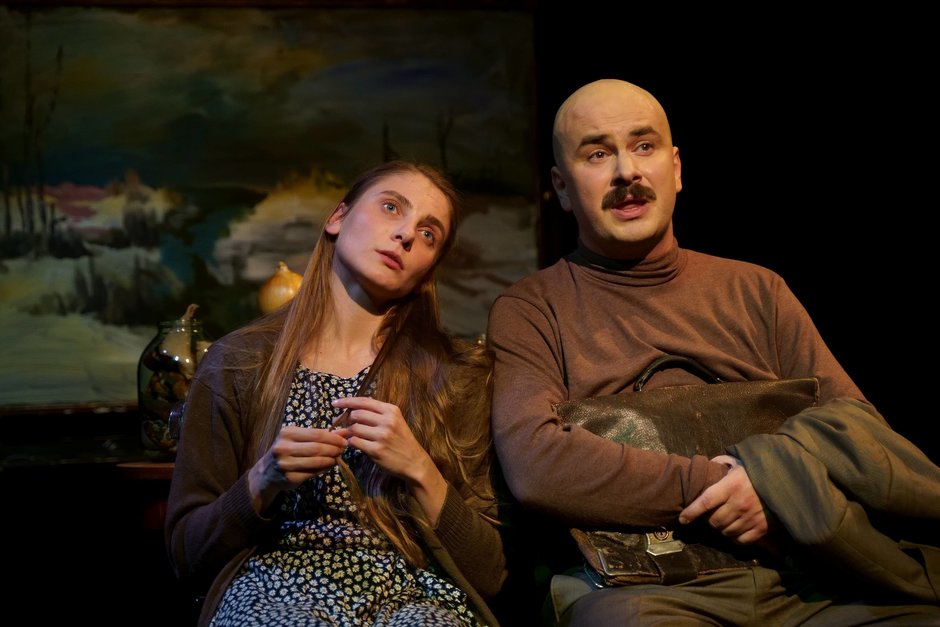
— This is an interesting theatre company that worked at “Ploshchadka 51.” “Ploshchadka 51” closed in January 2024, and at the same time, several other independent theatre venues closed because they lived on city subsidies for independent theatres and at some point did not win them. We bought their lighting equipment and took several resident performances for ourselves — from the theatre “Tru” and the theatre “Organizmy.” Now, the theatre “Organizmy," which consists of Vladimir Antipov and Sasha Byankin, is a resident of “Uzel.” The collective considers it important to preserve its identity, so we indicate that it is the theatre “Organizmy” performing. Vladimir Antipov wrote the play “My Rubtsov” and performed the lead role (a very difficult one!). It all started with a reading; Ekaterina Shikhova's sketch turned out to be successful, and we offered to turn it into a full performance.
This is a very popular performance. When those who have never been to “Uzel” ask me what to see, I recommend “My Rubtsov.” It has what characterizes the “Uzel” style, what we like and reflects our taste: the complexity of the characters and their relationships, grotesque, metaphysics. On the other hand, in our repertoire, this is probably, in a good sense, the performance with the lowest entry threshold. We see a very diverse audience: both those who know Vladimir Antipov and the trash style of post-ironic theatre “Organizmy," and those who simply saw the name of the beloved poet Rubtsov on the poster.
— It is clear that this is a fairly low-budget performance. Do you have any economic calculations on how a performance pays for itself?
— We try to calculate the trajectory of a performance's audience success, so to speak. In our first year, we had sixteen premieres. We understand that for the premiere, we will always gather an audience — some buy tickets, some use promo codes; critics, students, and friends of the artists come for free. Let's say, we are guaranteed to fill the hall twice. But it is important that the performance continues to sell afterwards. Therefore, we try to understand at the stage of agreement with directors what the fate of this performance will be. For example, there is director Roman Muromtsev, whose performances sell out a month or two in advance. When announcing a new premiere, Andrey simply marked it on the poster as “P.M.: a new performance by Roman Muromtsev," indicating that tickets for “early birds” are sold at a lower price, and closer to the premiere date, tickets will become more expensive. And the audience immediately bought everything. Shock!
Sometimes we really want to work with a director who is not yet known even in narrow circles but is already interesting. I try to watch student work and attend directing laboratories. Sometimes a director has not yet earned a media name, but you see that this is a very interesting person to us. We invite them to release a premiere but try to support them, for example, with actors who already have some recognition. Or to create a situation where the performance can still gather audiences after the premiere. And then word of mouth, PR, and so on. And, of course, the producer of the performance: if there is one, the project becomes more sustainable.
An unknown name is certainly a risk, but how can there be no risk? One of our most popular performances, “Hypnotheatre by Branko Dušić," was created by a then-unknown director, student Nikita Vasilyev, but now St. Petersburg audiences and critics have learned that name. And not only St. Petersburg ones — recently, we took this performance to the prestigious Diaghilev Festival.
— Out of sixteen performances, did all survive?
— There is one performance that is temporarily on hold: the director wants to rework it. There are a couple of performances that we have difficulty gathering audiences for, but we are not giving up on them because they are objectively worthy of attention. We have a new SMM specialist, and we hope to somehow boost them. Some things sell easily and quickly, while others do not. And this is not directly related to the quality of the performances.
— How was the performance “Water Tower” by the creative association mader nort created?
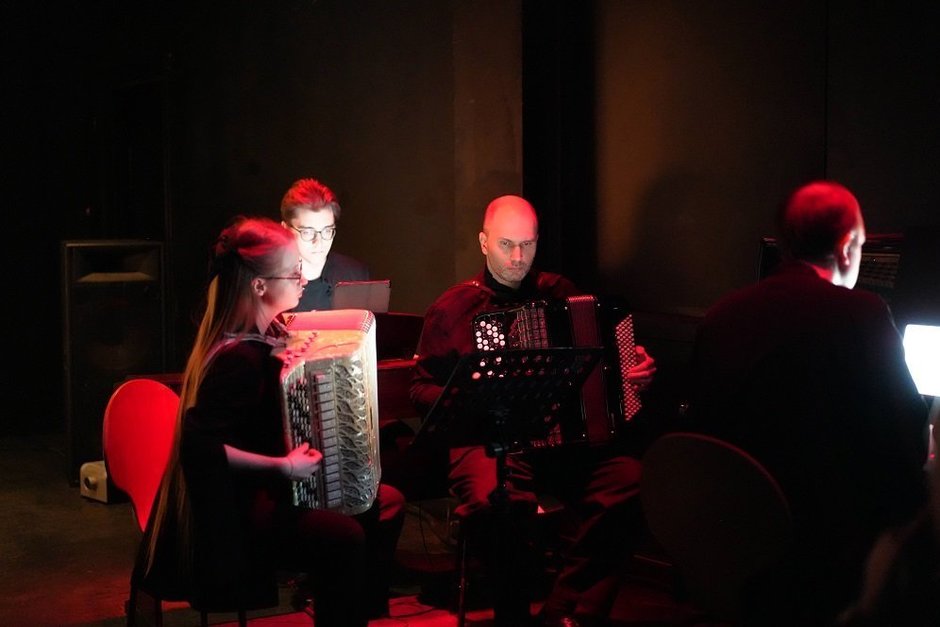
— They are also our favorite residents. They learned about our new venue and wrote to me in January 2025, when we were still in the middle of renovations, saying they wanted to collaborate. At “Ploshchadka 51," mader nort worked with Muromtsev and the theatre “Organizmy.” This is a collective of academic musicians, led by conservatory teachers, pianists, and composers Yaroslav Kovalenko and Vlad Fedorov. They are students of a very important composer for St. Petersburg, Anastasia Khrushcheva. From her, they inherited an interest in theatre, non-trivial musical taste, and adventurousness. Yaroslav and Vladislav made “Water Tower” with Volodya Antipov; the premiere took place at the “MIRA-center” in Suzdal. Mader nort works with directors Roman Muromtsev, Sonya Dymshits, Ekaterina Shikhova, Nikita Vasilyev, and Anna Belich. At the same time, they constantly organize their own concerts at various venues: for example, in September, they will have another “Insignificant Concert #3” at “Uzel.” Mader nort concerts are always the most incredible set of tracks: Bolovlenkov, Schumann, Kuryokhin, Tsoi, Venya D'rkin, Bach, Khrushcheva, Russian folk. And all this with an eccentric host and the craziest video fragments. On stage, there may be one pianist or a large orchestra with vocalists. Mader nort is an endless number of combinations and variations with an absolute level of quality.
In “Water Tower," Vladimir Antipov delivers a long, long text, which in itself is a musical composition, but there are also fragments performed by musicians on their instruments. By the way, Ekaterina Vinogradova from mader nort plays the accordion in the performance “My Rubtsov.”
— To complete the repertoire, tell us about Angelina Zasentseva's stand-up.
— Angelina is a natural talent and today an independent major figure in St. Petersburg theatre. I tell students in their final acting courses about her as an example of how an actor can make themselves without fitting into repertory institutions. Gelya is from the Khakass village of Bely Yar, studied in Yekaterinburg, worked in a theatre in Rostov, came to St. Petersburg for a laboratory, and met Boris Pavlovich, who initiated the “Forest” project, where various people — mainly actors, but not only — created and realized independent projects. This is how the stand-up “Forest. Angelina” was born. Angelina performed it in St. Petersburg bars, then began touring with it, and eventually, it was nominated for the Golden Mask award. Exactly a year ago, in the summer, Angelina called me and said she had accumulated material for a second stand-up; if we set a deadline — a premiere date — she would release it at “Uzel.” Thus, a new auto-fiction was born: “Nothing Sacred.”
This is not a sequel to “Forest”; they are two self-sufficient and different works. “Nothing Sacred” seems to me more frank and more unhinged. I really appreciate Angelina's self-irony and sense of humor, but also her sense of proportion. On one hand, she immerses us in a very personal story — it seems she takes off her skin, telling the story of her addiction. On the other hand, there is a lot of humor in it. I would compare this to what Ildar Alekbaev does in Kazan in “15 172”; it is a symmetrical story where everything works through humor and a bright theatrical form. At the same time, it is an honest, frank, and important conversation.
— In what you bring from MOÑ, there seems to be more emphasis on physicality. At “Uzel," there is more word and music...
— That's how it happened. It's great that you saw a concept in this. Of course, there were many different pitfalls, including economic and logistical ones. We are still a small venue in terms of resources; neither we nor MOÑ yet have the economic ability to bring large-scale performances to each other. Nevertheless, we exchange works emblematic for us, and I hope this is only the beginning. A few years ago, Andrey Yurchenko and I both ended up at the auto-fiction theatre festival at MOÑ, where the premiere of “15 172” took place. From that moment, we immediately wanted this work to come to us. And when we got our venue, we immediately started thinking about arranging exchange tours with MOÑ. Because MOÑ has always been a role model for us. When I am asked somewhere about independent theatres in Russia, I always mention MOÑ.
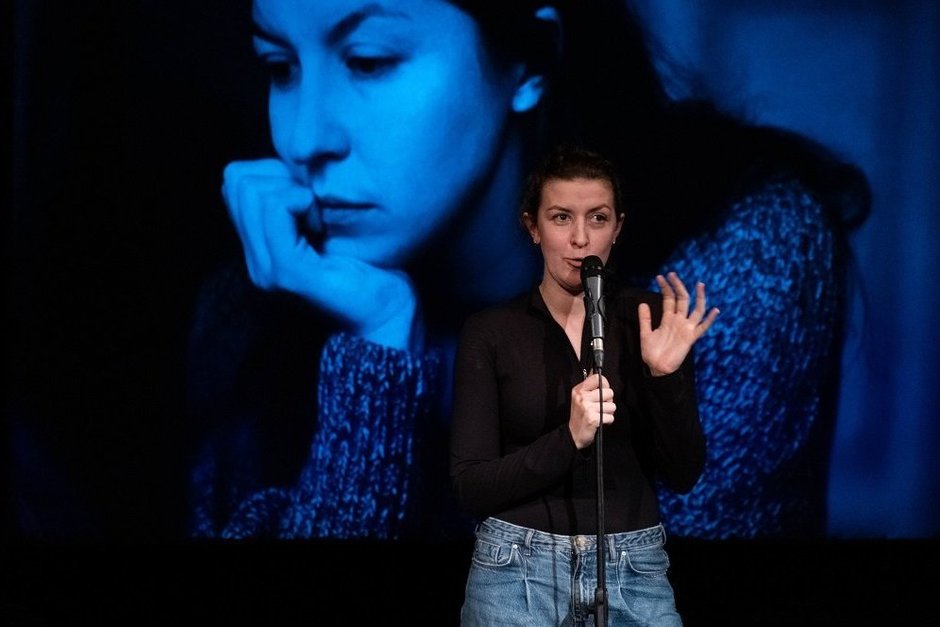
“Much more remains outside the repertoire”
— You also had a format called “Open Mondays.” Does it work?
— Yes, we constantly receive applications because there are many theatre universities in St. Petersburg and many small independent projects. As a rule, we receive applications with videos of finished performances, but sometimes there is nothing in the application but a concept. We review all incoming applications, and if something seems promising or simply interesting to us — why not show it once? — we invite the project to an “Open Monday.” Some works have thus entered our repertoire. For example, Aneli Filippova's student work “Voices of the Family” was shown at “Open Monday” and is now performed regularly. Sonya Dymshits's work “Undine” we also kept in the repertoire. But much more remains outside the repertoire. However, we ideologically find it important from time to time to show other works that may not quite fit our direction or our taste. But they are curious, sometimes wild — why not show them? Soon, for example, we will have a performance called “On the Road” by the association “Beautiful Dilettantes”: inspired by Jack Kerouac's text, it will be based on documentary material about hitchhiking. It will be great — we'll keep it.
— Have you ever refused someone you had worked with before?
— Yes, it happens. Up to the New Year, we have everything scheduled, with at least five premieres to come. And now I am gathering my strength to write to one director, a well-known acquaintance, that no, unfortunately, it won't work out. Of course, we are far from ready to cooperate with everyone.
— At the same time, there are many different venues in St. Petersburg, and this person can turn to them.
— I see that we receive applications, we refuse, and then the person performs this performance elsewhere. I think that people who release small works outside a specific venue send applications everywhere at once. St. Petersburg has an amazing situation in this regard. First, there are quite a few brilliant actors, directors, and artists who have consciously chosen to work in the independent segment. In the case of actors, this is a special new generation that makes me very happy. Second, everything, or almost everything, finds its audience. Even what seems completely unwatchable.
There is currently an obvious theatre boom; several audience clubs are actively operating in St. Petersburg, there are theatre bloggers who give advice and direct audience attention, and sometimes even organize group theatre outings. It seems to me that the more small theatres or people involved in theatre, the more viewers there are overall, oddly enough. And where there are no independent theatres, it is harder to survive. Where there are already five, ten, twenty projects, thirty will survive too. It is soil that nourishes itself.
— Like mycelium.
— Exactly!