WB instead of corner shops: wine delivery to pickup points kill local liquor stores?
Russia’s Ministry of Digital Development has announced a pilot project for selling Russian wine via marketplaces, but the latter say they are “ready, though it is unclear for what exactly”
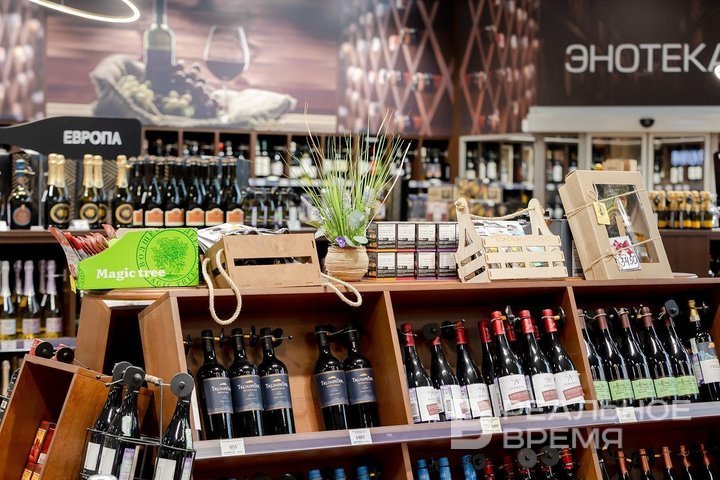
The Ministry of Digital Development of the Russian Federation has announced its intention to conduct an experiment on the remote sale of Russian wine through Russian marketplaces in the second and third quarters of 2026. And while the agency speaks of selling bottles via biometrics, in Tatarstan some alcohol stores have already been selling spirits online for more than six months. Read the details in Realnoe Vremya’s report.
Age of customers will be verified through the Unified Biometric System
Russia’s Ministry of Digital Development has announced an experiment on the remote sale of Russian wine via domestic online marketplaces in the second and third quarters of 2026. This was stated by Deputy Head of the Ministry Oleg Kachanov at the Digital Solutions conference.
Future sales will take place in test mode, with mandatory age verification of customers through the Unified Biometric System (UBS). Identity verification will be conducted in two ways: by directly comparing biometric data and a passport photograph confirmed in the UBS. The process looks as follows: the customer selects a product online, and a courier at the delivery point verifies the identity documents.
Representatives of the Ozon marketplace confirmed to Realnoe Vremya their readiness to join the pilot project. While outlining their position, they noted the need for technical improvements to adapt the platform’s functionality.
“We support the launch of a unified pilot for the sale of age-restricted goods using biometrics and are ready to participate in it. For example, we plan to verify the age of energy drink buyers through the identification system of the MAX messenger. This mechanism already operates in offline retail and has proven effective for verifying age and protecting minors. Undoubtedly, scaling it online will require technical fine-tuning to ensure that the service remains convenient for users in the digital environment. We are ready to move in this direction together with the regulator and the messenger team," Ozon noted.
You can buy it, but only with pick-up and a passport
Wildberries’ press service confirmed that an experiment on remote alcohol sales is possible only if strict legal requirements are met, including mandatory presentation of documents upon purchase at the pick-up point. The platform itself acts as an intermediary, providing a virtual storefront for sellers.
“We are currently analysing this business model, after which we will decide on the feasibility and possibility of joining the experiment. At present, alcohol products on the marketplace can be ordered exclusively via the seller’s in-store pick-up service (Click&Collect). Only a post-payment scheme is permitted for this category — at partner store tills after booking the product," Wildberries told Realnoe Vremya.
Tatarstan has been selling alcohol on WB for more than six months
Meanwhile, one well-known alcohol retail chain has already launched alcohol sales via Wildberries under the Click&Collect model. Customers reserve goods online and then collect them from specialised partner stores. This scheme requires mandatory in-person age verification upon order handover.
According to the retailer, its store has been operating on Wildberries for seven months. At the same time, the store page shows only three recorded sales, without specifying which products were purchased.
Every fifth order on marketplaces in Tatarstan accounts for e-grocery (delivery of food products — 20% of all online sales). According to the Association of Internet Trade Companies (AITC), the volume of online trade in Russia for the first half of 2025 reached 5.3 trillion roubles, showing a 36% increase compared with the previous year. In turn, Tatarstan became one of the leaders in the share of online sales, ranking seventh along with the Samara and Nizhny Novgorod regions. Each of these regions posted approximately 106 billion roubles in online orders, which accounts for 2% of the national total.