A trillion in sight: Tatarstan’s builders set for a record year-end output
The Republican Ministry of Construction has summed up the preliminary results of 2025
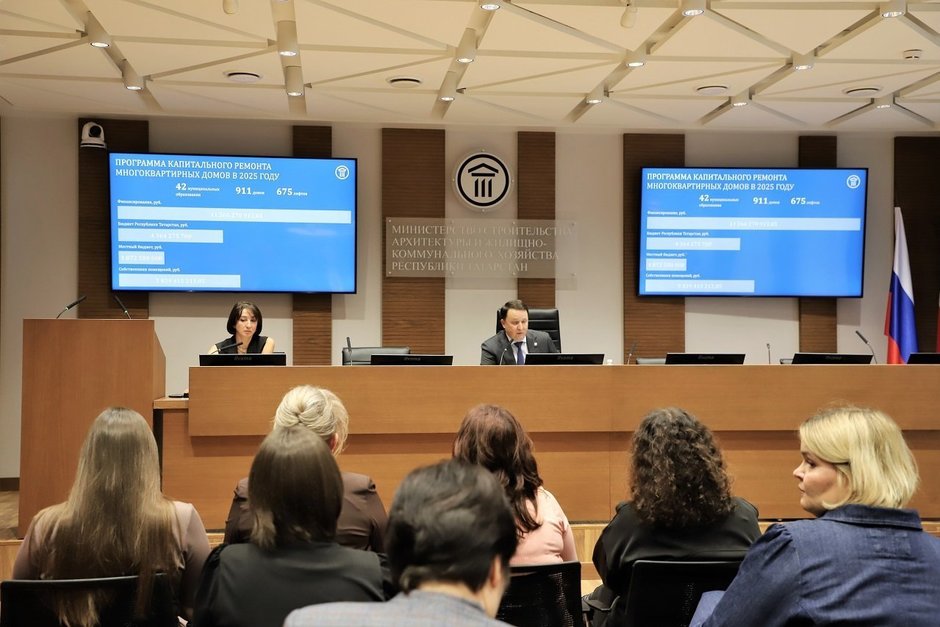
The construction sector of Tatarstan has set its sights on reaching a trillion in gross regional product by the end of 2025. This was announced today at a meeting with journalists by the Minister of Construction, Architecture and Housing and Utilities, Marat Ayzatullin. He congratulated the winners of the traditional media competition for the best coverage of construction-related topics, among whom this year was Vasilya Shirshova, deputy editor-in-chief of Realnoe Vremya. Read the details from the press conference and the award ceremony in the report by Realnoe Vremya.
Forecasts for growth
The share of the republic’s construction sector in gross regional product in 2025 is currently estimated at 7.3%, with the projected annual volume of work approaching almost 959 billion rubles, Marat Ayzatullin said today at a meeting with journalists. And he added:
“I believe this figure will grow further. Most likely, we will cross the one-trillion threshold… Compared with last year, we have increased by roughly 50 billion. The average number of employees has also risen, though slightly — by 600 people. And wages in construction have also increased.”
If in 2024 the construction sector of Tatarstan employed 86,000 people, then 2025 is expected to end with 86,600 — an increase of 0.7%. Meanwhile, the average monthly wage over the year rose by 25.2%, increasing from 68,300 rubles in 2024 to 78,200 in 2025.
Speaking about housing commissioning in the republic, the minister noted that as of 11 November, 3.334 million square metres had been delivered, with the year expected to surpass the 3.5-million mark. Based on housing-commissioning data for January to October 2025, Tatarstan ranked fifth in Russia, behind only the Moscow Region, Krasnodar Territory, Moscow and the Leningrad Region.
“Our urban development potential is almost 6 million square metres, not including individual housing construction and issued permits,” the minister said, indicating that Tatarstan still has space for further construction.
Fewer employees in utilities, but higher earnings
Marat Ayzatullin reported that by year-end utilities organisations are expected to complete work worth 69.3 billion rubles, which is higher than in 2024, although the number of employees in the utilities sector slightly decreased — from 27.36 thousand to 27.2 thousand. However, the remaining employees saw their average monthly salary increase by 35% compared with last year — from 53,000 to 66,500 rubles.

Throughout the year, engineering infrastructure modernisation programmes worth 12.67 billion rubles were implemented — 4.15 billion in federal funding and 8.53 billion in republican funding. A total of 409 km of engineering networks were repaired, 25 water towers constructed, two wastewater treatment facilities built, 15 pumping stations installed, and seven boiler houses commissioned.
“If we take significant facilities — this includes the completion of the water-supply network in the village of Kuyuki. It had been a huge problem; around two kilometres of pipeline were laid,” noted Marat Ayzatullin. “Our next task is wastewater treatment — there is a plan to connect it to Kazan’s treatment facilities. We have also completed the construction of four boiler houses in the settlement of Dzhalil and completed reconstruction of the water-supply network in Nurlat.”
By the end of 2025, the Ministry of Construction plans to deliver 3,864 facilities worth 147.92 billion rubles. The main volume of work has been completed, with only a few facilities and documentation formalities left for year-end. If in 2025 the ministry implemented 48 republican programmes, then in 2026 two more will be added.
“We have completed the construction of five schools, three academic buildings for 5,251 students, and seven kindergartens,” the minister said. “A large volume of work has been carried out on major repairs. The most significant involves education facilities — we have 265 of them.”
Speaking about major repairs of the republic’s housing stock, Marat Ayzatullin noted that this year the programme was funded with 11.27 billion rubles: 4.36 billion from the republican budget, 1.07 billion from local budgets, and another 5.83 billion contributed by homeowners.
A total of 911 buildings in 42 municipalities took part in the major-repair programme. As a key achievement, the minister highlighted the replacement of lifts — 675 lifts in apartment buildings were modernised in 2025, whereas previously around 300 were replaced each year. This was made possible thanks to an additional 2-billion-ruble allocation from the republican government.
Ambitious plans and achievements
The minister also named significant social facilities delivered in 2025 — including a care home for the elderly and disabled for 120 residents in the Zelenodolsk District, funded by the federal budget, as well as the Fencing Centre on Korolenko Street in Kazan, opened on 1 September and designed for 100 athletes.
“Next year we will be commissioning such facilities as the Alina Zagitova Figure Skating School in Kazan’s Privolzhsky District, near Portovaya Street (on the site of the Vodnik football stadium), and an archery centre at the Tasma Olympic Reserve School on Gagarin Street in the Moskovsky District.”
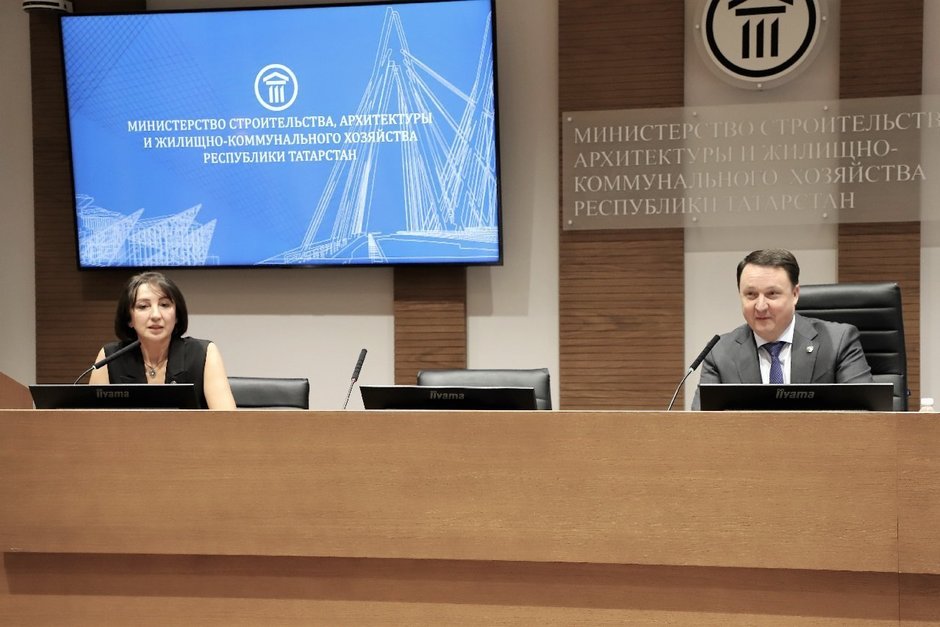
The meeting concluded with the awarding of winners and runners-up of the annual journalism competition for the best coverage of topics related to the construction sector. In one of the categories, first place went to Vasilya Shirshova, deputy editor-in-chief of Realnoe Vremya.