‘Eastern Bazaar in Kazan’ — an instrument of people’s diplomacy
The festival now has four official languages — Arabic has been added
The International Festival of National Cultures “Russia — East”, also known as the “Eastern Bazaar in Kazan”, is taking place in the Tatarstan capital. It is not merely a pop music competition for performers, but an important diplomatic instrument in the conditions of the new world. For the second year, its programme includes not only concerts but also a scientific conference. Read more details in the Realnoe Vremya report.
20 regions, 40 countries
The festival’s website states that it began in 2022, “when the first sounds of the ‘bazaar’ filled the air and the gala concert brought together representatives of 20 countries and regions”. The Russian Foreign Ministry’s office in Kazan recalls that the opening of the first International Festival of Pop Music of Turkic Peoples, the “Eastern Bazaar in Kazan”, took place on 10 December 2021. Back then it was a large-scale but strictly pop music competition — a continuation of the Vagapov Festival and the “Yana tatar jyry”/“New Tatar Song” contest.
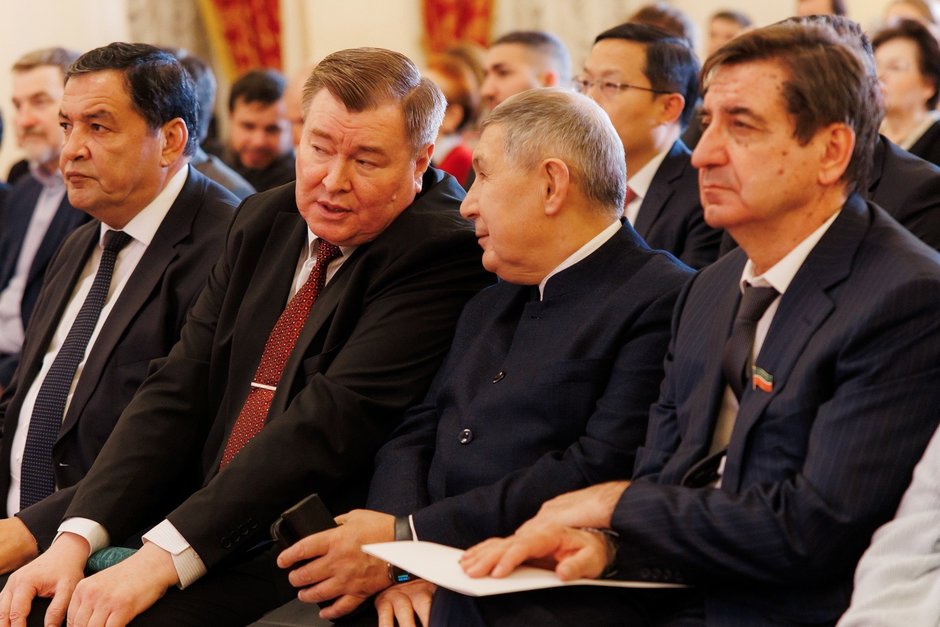
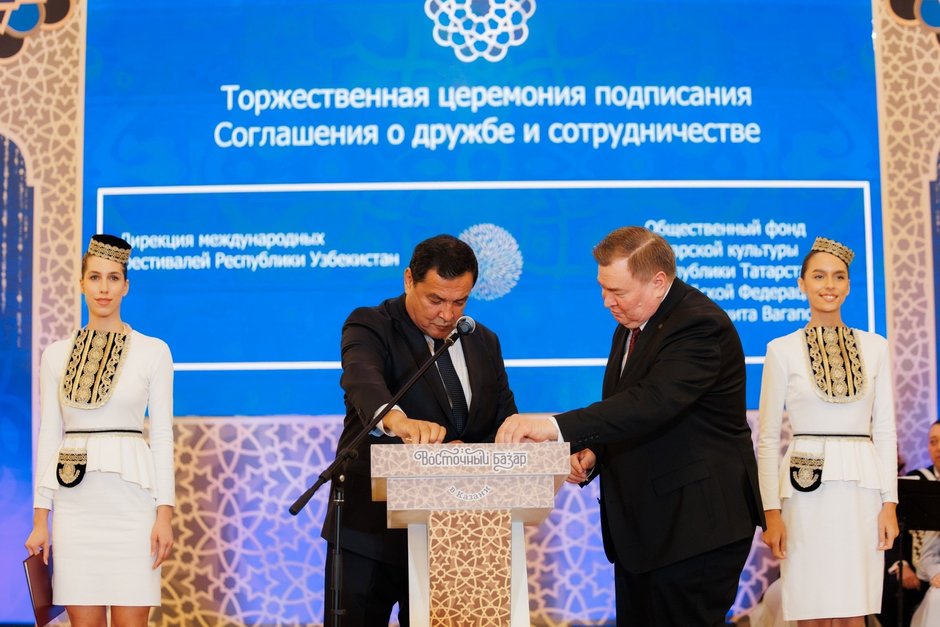
But times have changed significantly. Now, in 2025, when it is held for the fourth time, the festival has a second name — “Russia — East” — and the geography of its participants has expanded to 20 regions and 40 countries, including 30 Islamic ones. It is a kind of warm-up before 2026, when Kazan will become the cultural capital of the Islamic world. The opening ceremony, traditionally held in Kazan City Hall, is now less about culture or music than about diplomacy: the hall was filled mainly with consuls from various countries.
“A bazaar is above all a developed social institution, an institution of diplomacy and culture,” said the festival’s general producer, Rifat Fattakhov, director of the Tatar Culture Public Foundation of Tatarstan named after Rashit Vagapov.
“The ‘Eastern Bazaar’ festival makes a significant contribution to the development of Russia’s multicultural space and to the comprehensive expansion of cultural and humanitarian cooperation with foreign partners,” noted the deputy chairman of the State Council of Tatarstan, Yury Kamaltynov. “Having become one of the important instruments of ‘people’s diplomacy’, the festival helps build bridges between us and the Eastern world.”
Kamaltynov also read out a message from the rais of the republic, Rustam Minnikhanov: “The territory of Tatarstan has historically served as a bridge of cooperation between East and West, an example of constructive interaction among different peoples.”
“Mother” and munajats
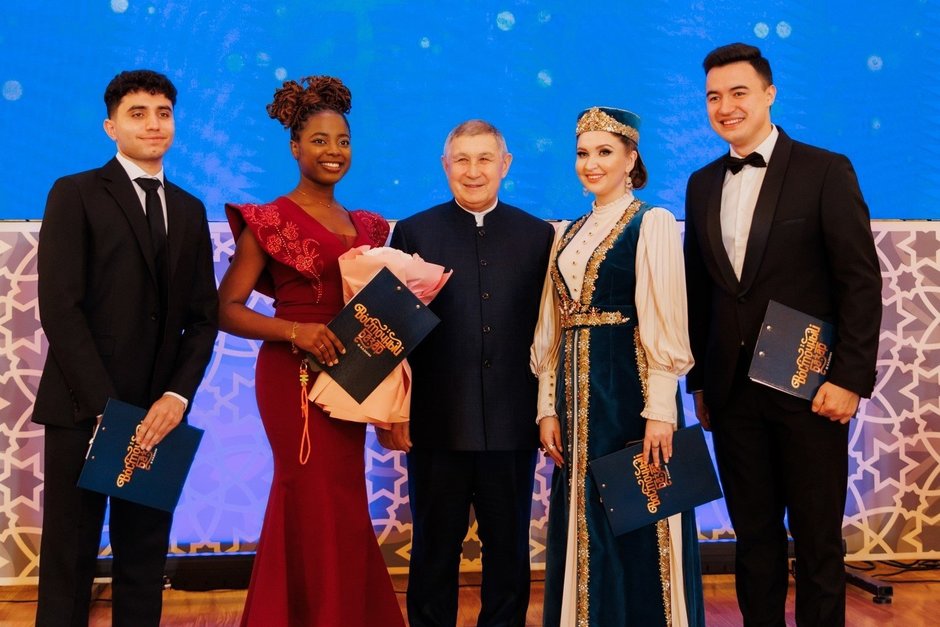
Interestingly, this year the festival has four official languages — Arabic has been added. Therefore, the opening ceremony was hosted by four presenters. English was handled by Victoria Etta, winner of the student festival “Pearl of the World — 2025” from Nigeria, who is studying at a medical university.
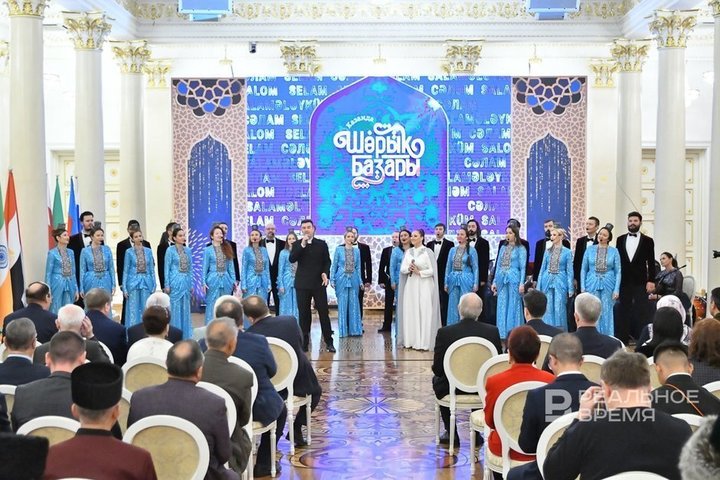
As for the music, the organisers’ choices for the opening were obvious. Accompanied by the Kazan Nury orchestra, Alina Sharipzhanova and Aidar Suleimanov performed the anthem of the “Eastern Bazaar”. The Tatar Soviet song was represented by Vagapov Festival laureate Adilya Zinnatullina. Maria Karpova sang “Mother”, and People’s Artists of the Chechen Republic performed “Katyusha”.
Also appearing on stage was the performer of munajats and hafiz of the Holy Quran, Saidkamol Suyunov. Incidentally, one of this year’s festival events is the Day of Arabic Culture.
Not only singers but scholars
As last year, the festival opened with a scientific and practical conference involving more than 200 scholars. Part of it is held at KazGIK, while the archaeology section is being hosted in Yelabuga.
The conference began in the grand hall of the Academy of Sciences of Tatarstan and, to be frank, made the impression of a big concert. At the very start, one could learn about the work of the ethnographic photographer Samuil Dudin in the early 20th century. On the other hand, many speakers used their allotted time for uninspired presentations about their home institutions.
At times the conference turned into a platform for expressing opinions. The acting rector of the Ufa State Institute of Arts named after Zagir Ismagilov, Ilmar Almukhametov, for instance, rejoiced that he would be able to see in Kazan the premiere of the Gafuri Theatre’s “On the Night of a Lunar Eclipse”, which he had missed at home. Then he criticised a foreign production in which a granddaughter destroyed both herself and her grandfather. And at the end he recalled seeing a book by Guzel Yakhina once at Sheremetyevo Airport and questioning the shop assistant: whether she had a grandfather, whether he had fought in the war, and whether she knew that the writer had allowed herself harsh statements about the country. His speech ended with applause.
A significant part of the 2025 festival consists of solo concerts by renowned ensembles: the almost obligatory appearance of the “Yalla” ensemble from Tashkent, the “Dances of the Peoples of the Caucasus and the East” show, and a performance by the Vainakh dance ensemble. Unusual features include an “Eastern Party” at a restaurant, which is planned to evolve into a “Student Bazaar” in 2026. Among the obligatory elements is a memorial concert for Ilham Shakirov. This year, tributes to him have already been organised by the Directorate of Parks and Squares and by the creative association “Kaleb”. This is the third version — it is announced that Shakirov’s songs will also be performed in other languages.
At the same time, the “Eastern Bazaar” remains a competition for young performers. Participants aged 18 to 33 who sing in their native languages are eligible to take part. Travel to Kazan is not covered, but the organisers take responsibility for accommodation in the Tatarstan capital. Contestants can be heard at the gala concert.