Bullets over Wall Street: bitcoin crash becomes the first warning sign ahead of stock market correction
The situation in the markets serves as a reminder of a simple truth: after periods of growth, a time for greater caution inevitably follows

Amid record highs of the S&P 500 index and unrestrained optimism surrounding artificial intelligence, a sobering and ominous warning was voiced. JPMorgan Chase CEO Jamie Dimon stated that the market is underestimating risks and that the likelihood of a serious correction within the next year and a half to two years stands at 30%. His words proved prophetic: just a day after his statement, the cryptocurrency market — often seen as a barometer of global risk appetite — collapsed, sending a worrying signal across the financial world. An analysis of the situation — in an exclusive opinion column by digital economist Ravil Akhtyamov for Realnoe Vremya.
Why is Dimon expecting a storm?
Jamie Dimon, one of Wall Street’s most respected bankers, quantified his concerns: he estimates the probability of a market downturn at 30%, while in his view, current prices reflect only a 10% risk. Yet more important than the numbers were his remarks on the causes of the impending storm. The head of JPMorgan linked the risks to an unprecedented mix of geopolitical tension, massive U.S. government spending, and the remilitarisation of the global economy.
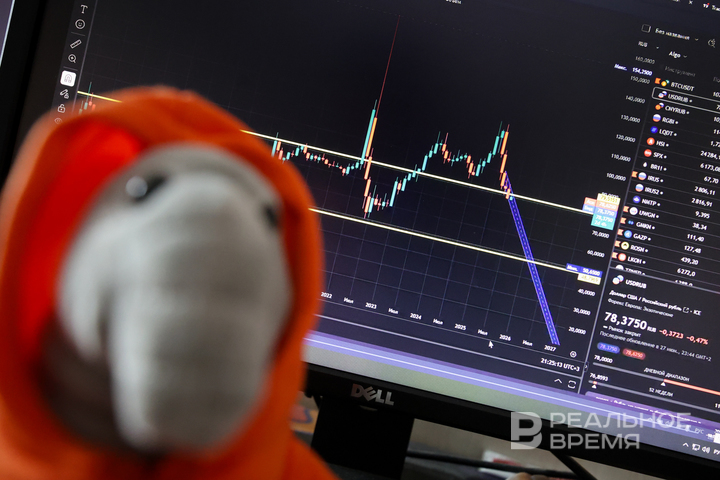
His warnings were so stark that he publicly stated: “People talk about stockpiling assets such as cryptocurrency. I always say we should be stockpiling bullets, guns, and bombs.” This metaphor has become a vivid symbol of the growing unease within global financial circles.
The situation in Russia: cryptocurrencies as a mass investment asset
The growing popularity of the crypto market and its influence on the financial system became a major topic of discussion at the FINOPOLIS 2025 Forum of Innovative Financial Technologies. During the session “Cryptocurrencies as an Investment Asset: First Results and Future Prospects in the Russian Market,” experts noted that digital assets have ceased to be a niche instrument.
As Vladimir Verkhoshinsky of Alfa-Bank pointed out, more than 7 million Russian citizens are already actively investing in cryptocurrencies. The volume of their transactions, according to various estimates, reaches 180 billion dollars — an amount comparable to half of Russia’s annual export revenue. Such a scale of retail investor participation in a high-risk asset makes the development of regulated digital instruments, including a potential BRICS stablecoin, particularly relevant.
The AI bubble and regulators’ warnings
A significant part of the market’s recent growth has been driven by the excitement surrounding artificial intelligence. Dimon acknowledges that AI is a real and transformative technology, but he cautions investors against excessive enthusiasm, drawing a historical parallel.
“AI is real. Overall, AI will pay off — just as cars and televisions ultimately did — but most of the people involved in creating them did not succeed,” he said, adding that part of the investment in AI will likely be lost.
Regulators share his view. The Bank of England has warned that the share prices of technology companies linked to AI “appear overvalued,” increasing the risk of a “sudden correction.” A similar opinion was voiced by IMF Managing Director Kristalina Georgieva, who urged investors to “fasten their seat belts,” as “uncertainty is the new normal.” Analysts at Goldman Sachs note that the current situation — including rising valuations and circular financing schemes — “rhymes with previous bubbles.”
Systemic risks: what lies behind the facade of market optimism
Dimon’s concerns are not exaggerated. They reflect specific systemic threats that analysts are already observing in current market data. Key risks to financial stability are outlined below:
Risk category | Manifestation and consequences |
Market overvaluation | S&P 500 P/E ratio stands at 22.6x, 25% above the median level. Market concentration has reached extreme levels: 10 stocks account for nearly 40% of S&P 500 capitalization. |
Consumer sector | American households are under pressure from record-high credit rates (21.76%) and historical credit card debt ($1.337 trillion). |
Foreign policy | Trade wars and prohibitive tariffs from the Trump administration increase business costs, accelerate inflation, and provoke retaliatory measures from partners. |
Bitcoin as a panic indicator: the first alarm bell has rung
Dimon’s warnings that “the level of uncertainty should be higher” materialized almost immediately. On the night of October 11, the cryptocurrency market experienced its largest collapse since April 2025. Below is the market reaction to U.S. President Donald Trump’s tariff announcement on October 10–11:
Market / Asset | Dynamics | Commentary |
Bitcoin (BTC) | Crash of -17%, falling below $105,000 | The largest liquidation in history, market capitalization decreased by ~$300 billion |
S&P 500 | -2,7% | Worst performance since April, hit broad market |
Nasdaq | -3,6% | Major decline concentrated in technology stocks |
The immediate trigger for the collapse was President Trump’s statement on the readiness to impose additional 100% tariffs on imports from China. Investors interpreted this as a signal for a full-scale trade war, prompting a flight from risk assets. The cryptocurrency market’s decline, occurring before the main trading sessions opened, became a precise and early warning to the world of a broad market correction.
What this means for investors
The situation in the markets serves as a reminder of a simple truth: after periods of growth, a time for greater caution inevitably follows. This is especially relevant for millions of Russian investors who, as discussions at FINOPOLIS 2025 showed, are actively participating in the crypto market.
When the largest U.S. bank and the International Monetary Fund simultaneously warn of risks, it is worth paying attention. This does not mean rushing to sell all assets, but taking reasonable precautions:
- Keep the majority of investments in the currency in which you earn and plan to spend: for most Russian investors, this is the ruble.
- For significant investments in cryptocurrencies, consider their exceptional volatility.
- Monitor developments in digital asset regulation both in Russia and internationally.
- Diversify savings across different asset classes.
The recent drop in Bitcoin demonstrated how quickly markets react to political decisions. It serves as a timely reminder that investing requires constant attention and a measured approach. Instead of emotional decisions — careful assessment and deliberate action.