‘They say money is expensive!’: Ministry of Economy of Tatarstan forecasts an increase in investments
Deputy Speaker of the State Council of Tatarstan has expressed a critical view of the socio-economic development forecast for 2026 prepared by the Ministry of Economy

“The budget is a reflection of the economy. But the main question is — on what basis should it be created? The investment potential of Tatarstan for next year stands at 1.7 trillion rubles — I have remembered this figure of yours. And they say money is expensive, or that there is none at all!” — exclaimed the Deputy Speaker of the Republic’s State Council, Marat Akhmetov, following the presentation of the socio-economic development forecast for 2026–2027. As usual, the Ministry of Economy of Tatarstan based its forecast on a conservative scenario for economic growth, yet it incorporated an ambitious increase in private investment by 15–20%. The Ministry of Finance of the Republic took a more pragmatic approach in its assessment: the budget will have to be “fed” through personal income tax revenues. Read more details in Realnoe Vremya’s report.
No recession in sight
The Parliament of Tatarstan has begun reviewing the draft of the republican budget for 2026–2028. Its essence lies in the complete rejection of the possibility of an economic recession — at least in the coming year. The Ministry of Economy of the Republic of Tatarstan presented its socio-economic development forecast, which sets the economic growth rate for next year at 102.1%, though it did not specify the dynamics for the following two years. This omission raised some questions, as such forecasts usually include three consecutive figures for a three-year period to outline the overall perspective.
Nevertheless, the initial 102.1% is quite an optimistic figure — one that allows room to “fall” without much concern. For instance, during the pandemic, the ministry’s experts were not afraid to project growth within one percent. These figures did not alarm anyone, as they tended not to materialise. “Caution: forecast ahead!” — as the wags say.
Rygat Khusainov, Chairman of the State Council Committee on Economy, Investments and Entrepreneurship, made it clear from the outset that the republic’s stable economic growth would continue. “The forecast is being formed amid economic risks associated with sanctions pressure on our country. Despite this, sustainable economic growth in Tatarstan is expected to persist,” he said. According to him, the key sectors will continue to expand, and employment levels do not cause concern.

Chemistry and defence industry lead growth
The main contours of the socio-economic development forecast were outlined by First Deputy Minister of Economy of Tatarstan, Oleg Pelevin. Once again, he deviated from the long-standing practice: instead of providing a detailed economic forecast for 2026, he chose to describe the current situation.
Since the beginning of the year, the republic’s GRP has increased by 2.9%, reaching 3.7 trillion rubles, Pelevin reported. The growth, he said, was driven by manufacturing, petrochemicals, and mechanical engineering — particularly the defence industry, which grew by almost 40%. The slides showed that industrial production rose by 11%. Agriculture and the expansion of consumer lending also made a noticeable contribution to economic growth, he added. The overall industrial growth index stands at around 7%, Vice Speaker Marat Akhmetov later noted.
The gap between growth rates in key industries is indeed significant. According to the Ministry of Economy, the largest increase is expected in the chemical industry — up 9% to 5.66 trillion rubles — while oil production is projected to decline by 1.6%. As a result, GRP growth for the year is estimated at 102.4%.

Based on this, the Ministry of Economy forecast GRP growth of 102.1% for 2026 — reaching 5.7 trillion rubles, Pelevin said. However, industrial output could drop to 101.7%, or 5.9 trillion rubles. Oil production is unlikely to show growth, yet the automotive sector could see a 9% rebound (following a downturn in 2025). “Construction — 101.8%, agriculture — 101.5%, moderate growth in consumer activity is expected, with retail trade turnover reaching 102.8–103%,” Pelevin added.
Preferences as a way to cut costs
Another source of economic growth, according to the Ministry of Economy, lies in preferential regimes. “The Alabuga and Innopolis special economic zones have attracted more than 460 billion rubles in investments — another 40 billion this year,” reported Deputy Minister Oleg Pelevin. “A further 147 residents operate in priority development areas, having invested over 86 billion rubles.”
The ministry intends to continue its efforts in this direction. “It is now important to maintain a high level of investment activity. Preferential regimes help comprehensively and systematically reduce business costs,” he stated.
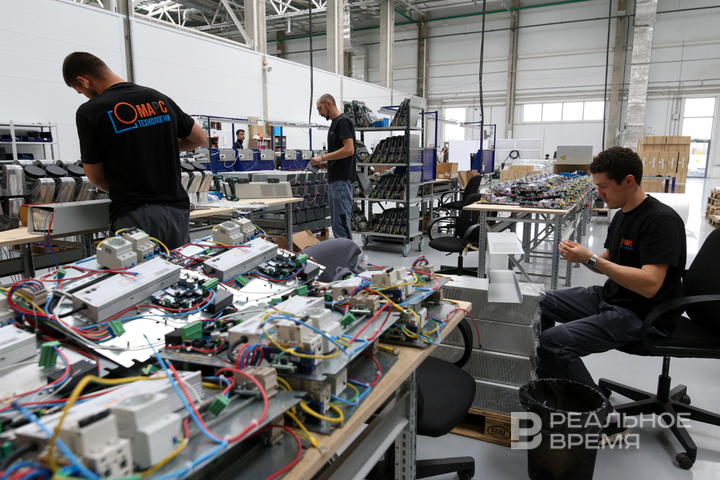
Pelevin reminded that the new Green Valley SEZ in the Zainsk district is currently being populated with residents. The initiative was launched by Tatneft, and it focuses on biotechnology. Investments are estimated at 15.4 billion rubles. The slides revealed the first six residents, including Polikhim Zainsk, Biovolokno, and Inlipor-Pharm.
High hopes are also pinned on industrial parks, with good news for private park management companies. According to Pelevin, federal authorities have resumed the SME support programme for industrial parks. “Demand for SME products is being stimulated through the republican marketing centre. Over the first nine months, more than 9,000 enterprises generated revenues totalling 162 billion rubles,” he reported.
Marat Akhmetov: can growth be ensured next year?
The Ministry of Finance of Tatarstan presented the basic parameters of the republican budget for 2026. Revenues are expected to total 498.2 billion rubles, expenditures — 512 billion, with a deficit of 13.8 billion, reported Deputy Minister of Finance Alla Anfimova. The main source of budget revenue will be personal income tax, amounting to 235.9 billion rubles. The second-largest source will be profit tax, with projected collections of 130 billion rubles. Excise duties (51.1 billion) and property tax (44.6 billion), along with non-tax revenues of 37.5 billion rubles, are expected to contribute around 100 billion rubles in total.
Vice Speaker of the State Council Marat Akhmetov reacted cautiously to the forecast. “The budget, of course, reflects the economy. As the economy is, so is the budget. But the main issue is the foundation on which it is built. The investment potential of Tatarstan for next year is 1.7 trillion rubles. And they say money is expensive — or that there is none at all!” he exclaimed.

He also voiced doubts about the possibility of industrial growth. “I don’t know how difficult things are for the industry, since it has shown almost 7% growth this year. How can growth be ensured next year with such a base? They probably don’t know themselves,” Marat Akhmetov remarked skeptically.