«The Perfect Observer» and «Alien on Earth»
What kind of writer was Yevgeny Chizhov?
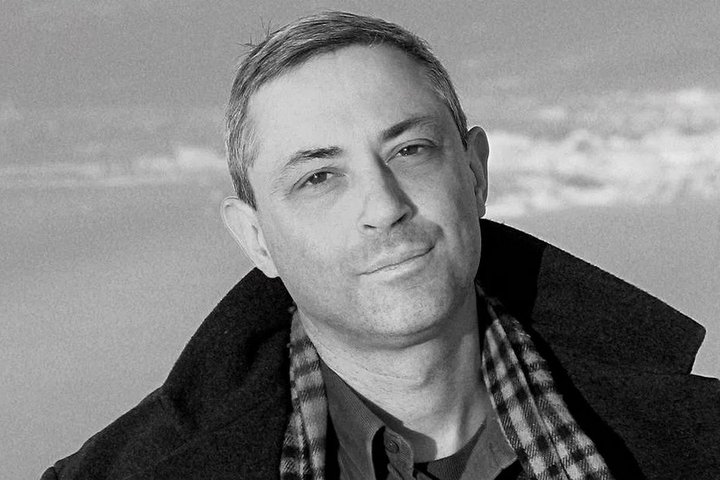
On the morning of August 11, a storm warning was issued in the Kaliningrad region, and red and black flags were hoisted in designated swimming areas, indicating that swimming was prohibited. At that time, Russian writer Yevgeny Chizhov was отдыхал отдыхал отдыхал отдыхал отдыхал with his wife in the settlement of Mechnikova, near the city of Baltiysk. In addition to the storm warning, there was a danger of a rip current, which can carry a person not to the bottom of the sea but deeper into it. Chizhov was swimming on an unequipped beach and was probably unaware of the danger. He was unable to get out of the water. Yevgeny Chizhov wrote four novels, two stories, one collection of short stories, and was discussing his next book with the publisher on the eve of the tragedy. Literary critic of «Real Time» Ekaterina Petrova tells us what kind of writer Yevgeny Chizhov was.
A decent family, the turbulent 1990s, and short-term emigration
Yevgeny Chizhov was born on October 29, 1966, in Moscow, into a family of a German translator and a lawyer. As the writer himself said, into a family of «decent Soviet people». At first, the family lived in the center, but when Yevgeny was five years old, they moved to Kuzminki. «So I am a person from the Moscow outskirts», the writer noted. They settled in a nine-story building near the Ryazansky Prospekt metro station. The apartment block was surrounded by two-story wooden houses and apple and pear orchards.
«Almost every day, a horse harnessed to a cart passed along the 1st Kuzminkskaya Street, which ran between our house and the metro station. Often I woke up in the morning to the sound of hooves on the asphalt and ran to the window to look at it», Chizhov said in one of the interviews.
In his teenage years, Yevgeny had a difficult relationship with his parents: «it was hard for me to live in the family», «they [parents] annoyed me». He found an outlet for his «rage» in writing. At first, he wrote down all the parental реплики, especially since he heard them many times, and then this grew into a passion for literature, facilitated by interest in reality. «I have always been a storyteller since childhood for my friends», Chizhov said. He came up with various stories based on characters from Gaidai's comedies. These were «science-fiction and adventure series» that Yevgeny could tell for years. And then he drew cartoons with his friends and collected filmstrips based on the plots.
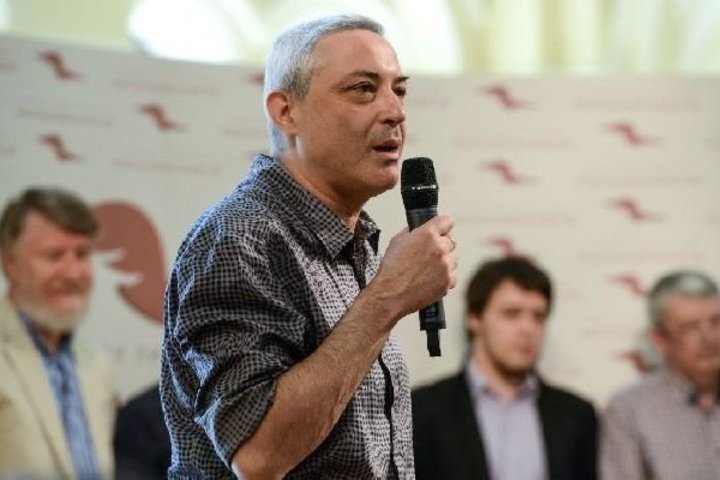
After school, Yevgeny Chizhov entered the Faculty of Law at Moscow State University. As a student, he had already read almost all of Dostoevsky, much from the works of Thomas Mann, Hermann Broch, and Robert Musil. «I felt a special attraction to German-Austrian literature, which integrated philosophy in much the same way as Russian classics absorbed religious problems», Chizhov said. Then he became confident that «something truly interesting can only arise from the collision of fantasy with reality». And this happened when Chizhov graduated from university in 1987 and began working as a defense lawyer in the Moscow Bar Association, mainly on criminal cases.
At the same time, Yevgeny moved from Kuzminki to the center. In the early 90s, he rented a room for three years in a huge ten-room apartment in Ananievsky Lane, which was about 400 square meters. It was a house that before the revolution belonged to the merchants Shah-Paronyats. The whole house was resettled, but one of the rooms still belonged to the wife of Chizhov's friend. Yevgeny rented this room. But he didn't live in the apartment alone. «Instead of them [resettled residents], various people who came to Moscow in search of happiness and luck moved in there by squatting. It was an interesting company of the early 1990s, characteristic of its time», the writer noted. From time to time, the police came there for searches. The illegal residents scattered, Chizhov was left alone for some time, and then they appeared again.
«Moscow in the 1990s was a heavily criminalized city, it's not a legend, but I was just in my twenties, everything was interesting to me and I didn't care», said Yevgeny Chizhov.
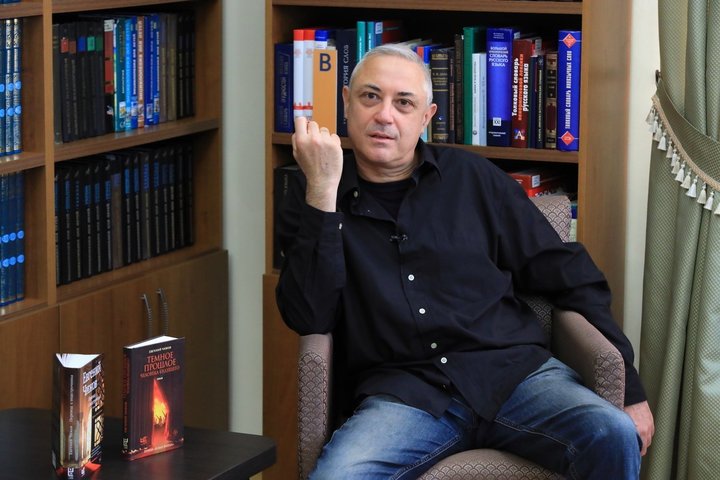
One of his neighbors was killed, not in the apartment, but in general. It became uncomfortable to live there. And three years later, Yevgeny moved away. Far away. To Germany. Chizhov ended up in Germany in 1994 «by coincidence». He had a reason and an invitation. «I didn't have any fixed idea to leave», Yevgeny said. Then he was 28 years old, «many things were done quite easily». In Germany, his son was born, and he had to earn a living somehow. There was no decent job, so he took on any work. He worked on a construction site, a factory, pasted posters, helped a gardener, conducted tours, and worked as an interpreter. «I lasted from two weeks to a month at each of these jobs. They gave me, of course, some idea of the German way of life and my inappropriateness in it», Chizhov noted in one of the interviews.
In Germany, Chizhov began to write «with a claim to professionalism». He wanted to create a finished work. He had a little free time, as well as the physical opportunity to distance himself from «the dense, scary, hopeless Moscow life». He was able to assess it from the outside and understand how «it was entertaining and good». Thus, the first story «The Infinite Holiday» appeared. Chizhov didn't think about publishing it. He just sent it to a friend, who showed it to Alexander Mikhailov, the publisher of the magazine «Solo». So the story was published in one of the issues in 1997.
Return and literary success
Chizhov returned to his homeland in 1997. Publication in the magazine didn't make him famous. Yevgeny worked as a journalist, columnist for the newspaper «Latest News» and did some translations. He is often listed as a translator, although he didn't consider himself one.
«I'm not a translator. I translated from English, translated from German, but only for money, very occasionally. I think I translated one book from English... In some very ancient times, when I decided to leave the profession of a lawyer and was looking for something to do, I translated some nonsense about aliens from English. Then I had to translate from German», Chizhov said.

In 2000, Yevgeny Chizhov's first novel «The Dark Past of the Man of the Future» was published in the magazine «October». Later he would say that «each of his novels is a rather long story». But he wrote «The Dark Man» in just one night. He had an «attack of inspiration», he only had time to write. It happened back in Germany. Chizhov tried to publish the novel, but unsuccessfully. Then the manuscript was read by the poet and translator Anatoly Naiman. His summary — «a clever and unimportant thing, deep and unpretentious» — gave the green light for publication. This novel is often called the best book about the 1990s.
«The Dark Past of the Man of the Future» by Yevgeny Chizhov is the story of a stage machinist at the opera house, whose mysterious life intertwines with the criminal and political events of October 1993, turning the chronicle of a troubled time into an atmospheric novel on the verge of reality and dream. Chizhov didn't intend to show the era of the 1990s. He wanted to write «a portrait of a paradoxical character who brings недостоверности to everything he comes into contact with, overturns moral values, at the same time unusual and recognizable». That's why many readers recognize the traits of people they know in the antagonist.
And in the same novel, Chizhov raises the theme of memory, which runs through all his works. «Because a person is memory. A person as an individual, as an individuality; what distinguishes a person from nature and surroundings is memory, the ability to connect separate episodes of existence. And on the other hand, strange things happen with memory around us. I often had to observe — here it is enough what happens around — when within one generation the memory of events and the attitude towards them changes before our eyes. I mean, say, the assessment of events during the cult of personality, for example, the 1930s—1950s», the writer said.
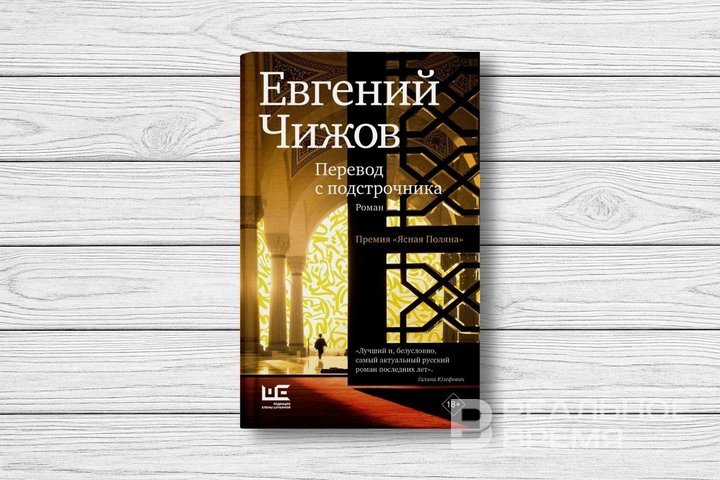
In 2008, Chizhov published his second novel, «Character Without a Role», in which the writer housed the tenants from Ananievsky Lane. But even then, great fame did not come to the writer, although the book was appreciated by critics. Fame came when Chizhov moved to «Elena Shubina's Editorial» and published his third novel, «Translation from the Interlinear». The book made it to the shortlists of the «Yasnaya Polyana» and «Big Book» awards. It is the story of Moscow poet Oleg Pechigin, who went to Central Asia. He was invited there by a student friend who had become an influential person in the Koshtyrbastan government. Pechigin needs to translate the poems of President Gulimov into Russian. This is quite talented poetry, which formed the basis of the national ideology, and Gulimov became a kind of prophet.
«I wanted to write a travel novel as an immersion into a fundamentally different world. The experience of traveling to Central Asia played a certain role here. And there was an idea to confront a European person with a world of fundamentally different values. The novel is based on poetry as magic, which transforms reality», Yevgeny Chizhov said in an interview with Boris Minaev.
President Gulimov from «Translation from the Interlinear» evokes clear associations with the former President of Turkmenistan Saparmurat Niyazov. But in one of the interviews, Chizhov denied such a version. The prototype of Gulimov is Arthur Rimbaud. They have a lot of biographical intersections. For example, Chizhov mentioned those episodes of Gulimov's youth that the old Koshtyr poet tells the main character. «You will find similar episodes in any decent biography of Rimbaud. But the main thing that attracted me to Rimbaud, of course, is not these youthful escapades, but his famous theory of the poet as a clairvoyant, whose poems directly affect reality, a poet who has achieved the superhuman status of a prophet», the writer said.
For Chizhov himself, this book is about a journey to the East, «into a world where poetry and politics are varieties of magic, where reality is fraught with miracle and at the same time completely inhumane. This world seems extremely far from us, but it's not quite so. Koshtyrbastan is similar to Russia as much as Russia itself is the East, as much as its impulses towards Europe are drowned in its Asian expanses. Let me note that I love the East, and of course, Oleg Pechigin's journey is based on my own wanderings in those parts».
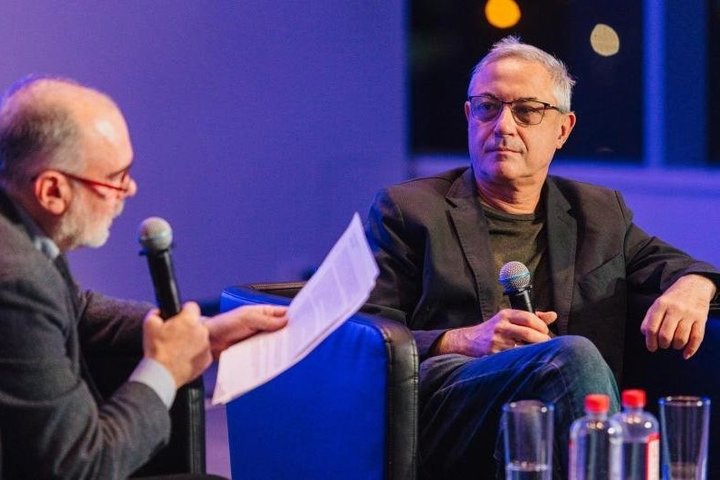
The writer visited Central Asia more than once. He first ended up there as a student, then traveled there in the nineties. In 2009, Chizhov traveled with his wife along the mountain range of Tajikistan — the Pamirs. A terrible tragedy occurred there. They both fell off a cliff. «I broke my spine and was confined to bed for several years», the writer said. Compared to other novels, «Translation from the Interlinear» was written faster, «lying with a broken spine, so that nothing distracted me and tempted me to interrupt the work». At the same time, Chizhov had problems with sleep. Often he couldn't sleep because of back pain, and «there was nothing left for him but to come up with new moves and plots».
«Once I wrote that a person's courage is measured by how much he is able to be alone. Now I'm ready to measure it by how many nights he can stay awake without panicking», (from Yevgeny Chizhov's diary).
Nostalgia, award, and Alzheimer's disease
Since living in Ananievsky Lane, Chizhov has developed a habit of going to flea markets. He didn't consider himself obsessed with collecting, he was more attracted to the gathering of marginalized and outsiders who gather at flea markets. These are the heroes of the novel «The Gatherer of Paradise», which was published in 2019. «People who don't fit into their time are attractive because they give the opportunity to guess the alternative, unclaimed by the era, answers to eternal questions embodied in them. And the search for such answers is, in my opinion, one of the most interesting tasks of literature», the writer said. In 2020, this novel became the winner of the «Yasnaya Polyana» award.
«I didn't expect this at all, not in the slightest... I wasn't surprised when my book made it to the finals, because I knew it was a good book. But it seemed to me that my characters were so hopeless outsiders, and I always write about such people, that they wouldn't be allowed further than formal recognition — into polite society, into the winners. I am infinitely grateful to the «Yasnaya Polyana» award, which for me is an award, a group of people preserving the extraneous quality of literature», Chizhov said at the award ceremony.

The main character of «The Gatherer of Paradise», Kirill Korol, goes to flea markets and collects artifacts of the Soviet past, nostalgic for it. This is a book about nostalgia, but it's not nostalgic. «I'm interested in nostalgia as a diagnosis, as a disease — but a disease that almost everyone is susceptible to», the writer noted at one discussion. He believed that from a certain moment, nostalgia becomes the defining emotion in a person's life. «Time is just a harsh thread that strings life and passes through the heart. For me, this theme is key from the first novel, one can say that it's an obsession. The first half of life is driven by love, the second half by nostalgia», Chizhov added.
But in addition to nostalgia, Yevgeny Chizhov raises another important theme closely related to memory. This is Alzheimer's disease. The mother of the main character Kirill suffers from this terrible diagnosis. She gets lost in the vastness of Moscow from time to time. This irritates, infuriates and unsettles Kirill. «I had the opportunity to observe this [Alzheimer's disease] quite closely», the writer said in a conversation with Rusina Shikhatova. The fact is that his parents moved to New York, where the writer's mother was diagnosed with this disease.
«The embodiment of the irreparability of life. Alzheimer's disease is the release of the world from language. Her notebook: «Noodles are what I eat for breakfast». Helpless attempts to stop the decay of language...» (from Yevgeny Chizhov's diary).
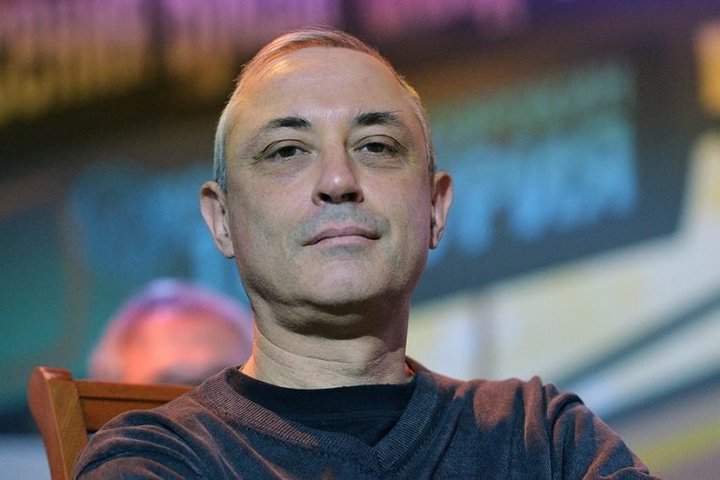
Perhaps that's why Chizhov called «The Gatherer of Paradise» his «most serious» and «most dramatic book» of all he wrote. For him, it's «an attempt to touch such things as death, madness — irreversible things», in which «time is the most irreversible of all known things».
Very lonely and a bit of a recluse
Writer Yegor Appolonov compared Yevgeny Chizhov to Salinger. The latter, after the release of the novel «The Catcher in the Rye», went into seclusion, fenced himself off from everyone, stopped giving interviews, and banned the publication of his texts, only twenty years after his death. Chizhov is not that much of a recluse. But he moved from Moscow to Zelenograd, where his wife is from. And in general, he wasn't very involved in the literary scene. Chizhov himself explained this rather by geographical remoteness than by conscious choice. Although he admitted that he always stood a little aloof.
«I was a stranger everywhere I was: at school and at the institute, in the bar and in emigration, in the newspaper and in the magazine, in the 90s and in the 2000s, in literature and in my own (especially the first) family. Before it was a constant aching pain, longing for my own, now I'm beginning to see the advantages in this: freedom from group conformism, from the boredom of a familiar environment, from the basic obviousness shared by «their own», from being tied to their own time, which, passing, washes you away with it. The perfect observer, completely free from all predefined conventions — an alien on Earth», (from Yevgeny Chizhov's diary).
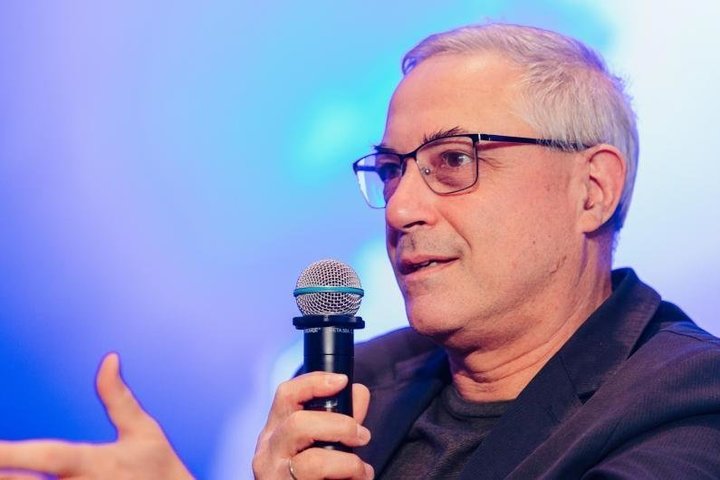
In 2020, he said that he had only recently bought a smartphone. Before that, he used a «tiny Sony without internet access». But what he never got used to was writing on a computer. Yevgeny Chizhov wrote all his novels by hand. At the same time, he did translation work and wrote journalistic articles on the computer. He tried several times to write prose on it, but since he didn't type very well, there were a lot of typos. Correcting them caused irritation. «Mistakes are one part of the problem. The main thing is that you have a text alienated from you. When it's typed, it seems not yours right away. And as long as this text is written by hand, you look at it as a draft. You're not afraid of it», Chizhov said. He called his novels literally «handmade» in contrast to market fast food. «Well, I can't do anything about the fact that the general public prefers fast food», he added.
Despite the fact that Yevgeny Chizhov was often plagued by insomnia, he preferred to write during the day. Although he said that things were better thought out at night. «The best things are thought out at night, and they are realized, written down during the day and corrected again during the day with a clear head. Because when you write at night, you don't really understand what you're writing», the writer said. By modern standards, when some authors produce a novel a year, Chizhov was a slow writer. He wrote daily, but not like Tolstoy 20 pages or Dostoevsky 50. «Everyone has their own capabilities. For me, two or three pages is a successful day. It's enough for me. When these three pages appear out of nowhere, you feel deep satisfaction», Yevgeny Chizhov said.
At the beginning of his career, the writer said that for him, writing is a way to resist total reality. And at the same time, he considered it important to distance himself from his era, from the agenda. «With the distance from your time and the opportunity to choose topics, you can already relate to the era as you see fit», Chizhov noted. And although he constantly reflected on time, as a writer, he was not at all interested in the situation «here and now». He believed that individual writers could be politicized, but literature could not.
«Politicization is the least interesting path for a writer, since power is limited to today, while the artist claims the day after tomorrow, power over the future», Chizhov said. But he also noted that politics cannot be completely ignored and pretended not to exist. Therefore, in his words, it is important that «not the artist serves politics, but politics serves the artist». «As a sphere in which a person can reveal himself in an unexpected way, it is of the same interest as all other areas of life. Since it's impossible to get rid of it, we must use it», the writer added.
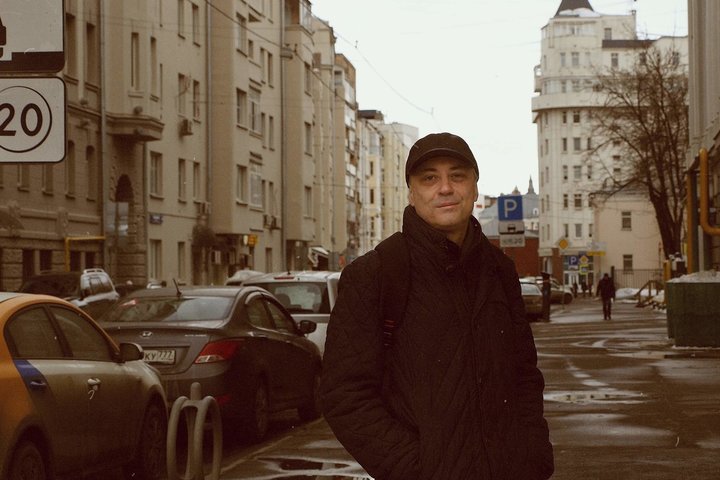
Yevgeny Chizhov believed that he had no friends because he had no enemies. He «slipped between». «He who slips between is always alone», he wrote in his diary. Although he still had one enemy. It's the common, collective, the same. «Everyone hides in themselves the possibility of escaping from the common into the unique and only «their own», but when they hide behind the common, they seem to slam the door in front of my nose. Hence the disgust for people when the common obscures the personal in them. <...> This is how the vicious circle of loneliness arises: the farther from people, the greater the hostility they inspire. To love them, you need to get closer», Yevgeny Chizhov noted in his personal notes.
Chizhov assumed that he had no formal grounds to be a writer: «mediocre education, ordinary life experience, average and below average knowledge in all fields, lack of outstanding achievements in any field except literature». And all his literary achievements and ambitions eventually built on what he called minuses: «my mother's madness, my father's oddities, sleep problems, environment, sex, Jewish foreignness in Russia and my alienness among my fellow tribesmen». He saw life as sailing in the ocean of the unknown. And either you learn to swim, or...
«We stand on a narrow strip of shore, which is hit by the ocean of the unknown. It seems that only on the shore do such things as our individuality, its tastes and needs retain their meaning. Once you break away from the shore and set sail on the open sea, the first wave overturns the boat of our personality, throwing out of it — and out of all our assessments, opinions, knowledge of causes and effects... Obviously, sailing in this ocean of the unknown is available only to those who can exist beyond their «I», for others it is fatal. «Learn to swim...» E.G.» (from Yevgeny Chizhov's diary).
Ekaterina Petrova — literary critic for Realnoe Vremya online newspaper and host of the Telegram channel Buns with Poppy Seeds.